
Riepe Four-Stage Application Sequence: LPZ/II, NFLY, LP289/99 and LP163/93
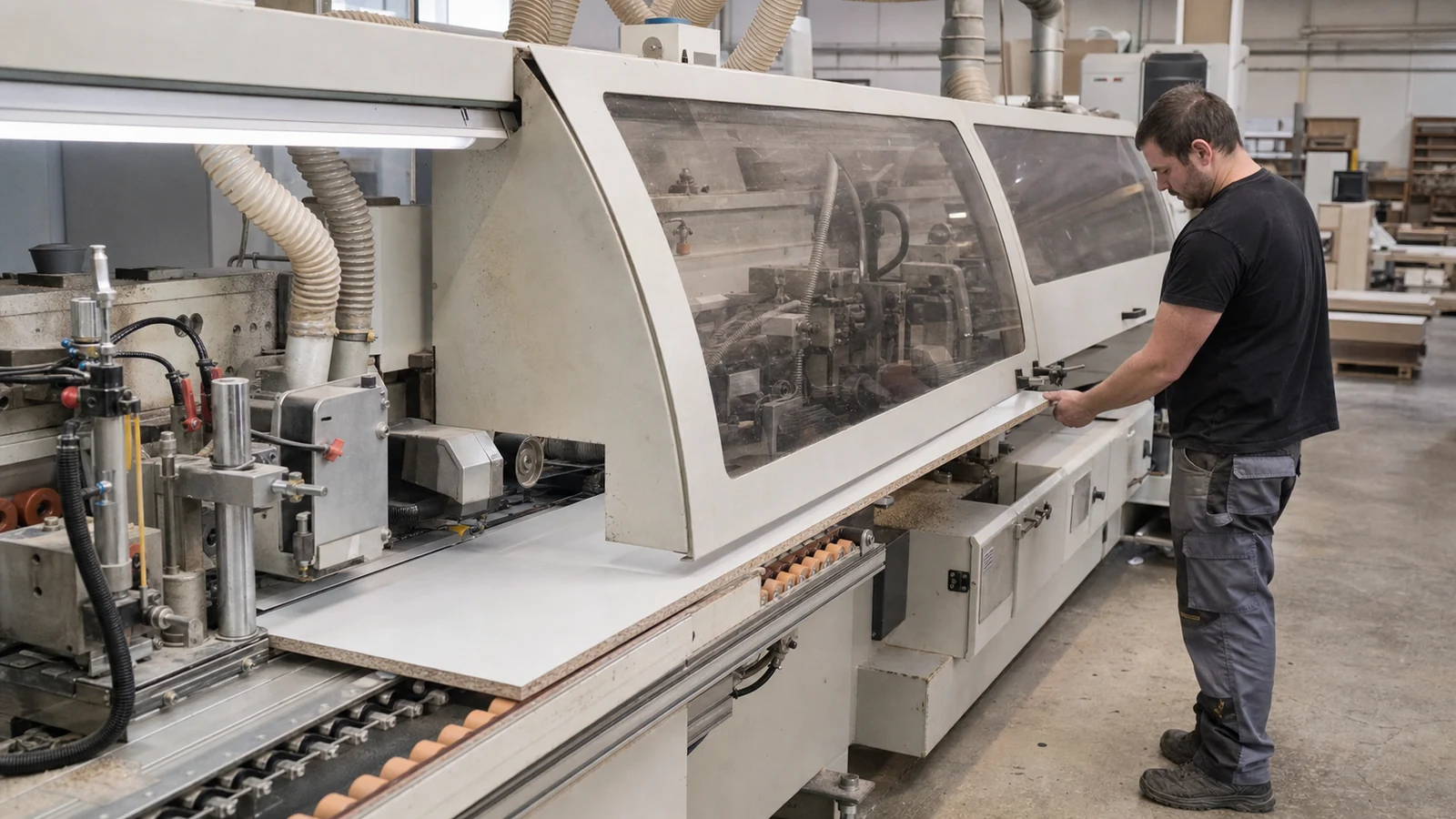
In typical Riepe edge machining flow, LPZ/II reduces the adhesion of adhesive residue at the inlet; NFLY manages friction and adhesion at the pressure roller, edge band and associated contact points; LP289/99 provides antistatic cooling after bonding; LP163/93 helps remove loose residues with process fluids in the finishing and polishing section. The exact nozzle position and dosage should be verified with the machine configuration according to the manufacturer's instructions.
In the edge banding process, finishing quality is achieved not with a single chemical, but with the correct sequence of application points that complement each other. According to Riepe's official product descriptions, LPZ/II, NFLY, LP289/99 and LP163/93 serve different roles. This guide makes the ranking understandable; Exact placement, spray adjustment and consumption should be based on machine configuration, product SDS and Riepe technical instructions.
Four-stage process flow
- Introduction – LPZ/II separator: is a protective initial stage that helps reduce residue adhesion to the workpiece surface before adhesive application.
- Print and edge management – NFLY lubricant: manages the effect of adhesion and friction on the main print roller, edge band and appropriate contact points.
- After gluing – LP289/99 antistatic coolant: helps to cool the adhesive line evenly, reducing static load and chip adhesion.
- Finishing – LP163/93 cleaner:supports the removal of previously applied process fluids and loose adhesive residues in combination with polishing units.
Product tasks and checkpoints
| Product | Main task | Signal for the operator to follow |
|---|---|---|
| LPZ/II | Helps reduce adhesive residue adhesion to the surface. | Residue behavior on the inlet surface, nozzle spray pattern and subsequent areas |
| NFLY | Supports slip/adhesion balance at printing roller and edge contacts. | Roll cleaning, trace and protective film behavior on the edge surface |
| LP289/99 | Helps reduce chip retention with antistatic effect and controlled cooling. | Glue line, static chip accumulation and cleaning of subsequent tools |
| LP163/93 | Supports the removal of process liquids and loose residues in finishing. | Surface, traces and need for rework after polishing |
Line setup and shift start
- Verify from label/line plan that each product matches the correct tank, feed line and nozzle.
- Check the nozzle direction and spray pattern on the reference sample.
- Retrace the result on the first pieces when machine speed or panel/edge type changes.
- Consumption is not only determined by volume; Save with meter, product group, shift and finishing result.
- Confirm with the technical team the alternative product and system recommended by Riepe in special cases such as PMMA/acrylic, hot-air or laser process.
What signals does the wrong sequence or setting produce?
Inlet separation, spray pattern or adhesive process setting should be checked together.
Lubricant application, roller cleaning and adhesive overflow should be evaluated simultaneously.
Antistatic cooling, nozzle direction and the condition of the suction system should be compared.
Excessive application in previous areas should be examined as well as the cleaner/polishing phase.
Diagnostic approach: Do not try to solve a quality defect by increasing a single product. Check the row, nozzle, line speed, adhesive overflow, suction and polishing conditions together.
Safe use and recording discipline
Transfer, storage and application of chemicals should only be carried out in accordance with current SDS, label instructions, local legislation and trained personnel procedure. Appropriate personal protective equipment should be used; Products should not be kept outside their defined containers and different chemicals should not be mixed without technical approval.
For product images and technical guidance, visit All Riepe Chemical Products page; For dosage control approach, you can review Riepe coolant dosage protocol.
Riepe Four-Stage Application Sequence: LPZ/II, NFLY, LP289/99 and LP163/93 hakkında merak edilenler
Do LPZ/II and LP163/93 do the same job?
No. LPZ/II is a separator that helps reduce adhesive residue adhesion to the workpiece at the inlet. LP163/93 is a cleaner that supports the removal of process liquids and loose residues in the finishing/polishing section.
Why is LP289/99 used after bonding?
According to the official Riepe description, the product is applied to the adhesive line and edge banding, helping to reduce static charge, controlled cooling and reduce chip adhesion.
Are the four products connected to the same point on each machine?
No. Although the sequence of functions is similar, the number of nozzles, location, alternative products and settings may vary depending on the machine configuration and process. Riepe and machine manufacturer instructions should be taken as basis.
Does increasing the dosage necessarily solve the finishing problem?
No. Overapplication may lead to new surface marks, unnecessary consumption or process instability. First, the nozzle, row, adhesive overflow, line speed and suction/polishing conditions should be checked together.
Technical resources and verification
The content has been prepared in Turkish with the technical experience of Koçak Endüstri, based on the following manufacturer resources.
Let's choose the right adhesive for your application together
You can get technical guidance and offers for Jowat products by sharing your machine, material and consumption information.
Get a technical quote

