

Thermal Conductive Gap Fillers & Structural Cell Bonding in EV Battery Packs: Thermal Management, Dielectric Safety & UL 94 V-0
In electric vehicle (EV) lithium-ion battery packs, maintaining cells within their optimal operating window (20°C–35°C) is essential for cycle life, ultra-fast charging capabilities, and passenger safety. Two-component (2K) thermally conductive liquid gap fillers applied between prismatic, pouch, or cylindrical cells and the aluminum bottom cooling plate eliminate microscopic air gaps, conducting heat away to liquid channels (2.0 to 4.0 W/mK conductivity). These low-density polyurethane or silicone elastomeric compounds effectively dissipate peak temperatures generated during rapid acceleration and high-power DC fast charging, eliminating the risk of catastrophic Thermal Runaway. In modern Cell-to-Pack (CTP) architectures, they also act as structural adhesives—locking cells securely to the tray to absorb high-G road shock and vibration, providing >10 kV/mm dielectric insulation, and meeting UL 94 V-0 flame resistance standards.
In modern e-mobility engineering, battery thermal management dictates range, vehicle longevity, and charging speeds. During high-power DC fast charging or aggressive acceleration, lithium-ion cells generate intense heat. Exceeding 55°C accelerates battery degradation, while localized hotspots above 80°C risk triggering Thermal Runaway—a self-propagating chain reaction leading to fire. Thermally Conductive Liquid Gap Fillers bridge the critical interface between battery cells and the aluminum liquid cooling plate, eliminating thermal resistance while providing indispensable structural bonding.
1. Thermal Runaway Mitigation and Optimal EV Battery Thermal Architecture
Lithium-ion cells operate with peak electrochemical efficiency between 20°C and 35°C. Temperature deltas exceeding 5°C across cells cause uneven internal impedance and rapid pack degradation. Because air is a poor conductor (0.026 W/mK), microscopic surface roughness and manufacturing tolerances between the cell casing and the cooling plate create thermal insulation pockets. High-performance gap fillers (2.0–4.0 W/mK) wet every micro-crevice, establishing an efficient conductive highway into the chilled glycol loop.
2. Liquid Gap Fillers vs. Solid Thermal Pads: The Case for Automated Dispensing
While early EV battery packs used prefabricated solid silicone pads, high-volume automated manufacturing has transitioned decisively to liquid 2K gap fillers:
- Zero Compression Strain on Cells: Compressing solid pads requires heavy clamping forces that can crush delicate prismatic cell walls. Liquid gap fillers flow effortlessly under minimal insertion pressure.
- Superior Tolerance Accommodation: Readily bridges variable gap widths ranging from 0.5 mm to 3.0 mm across large module trays.
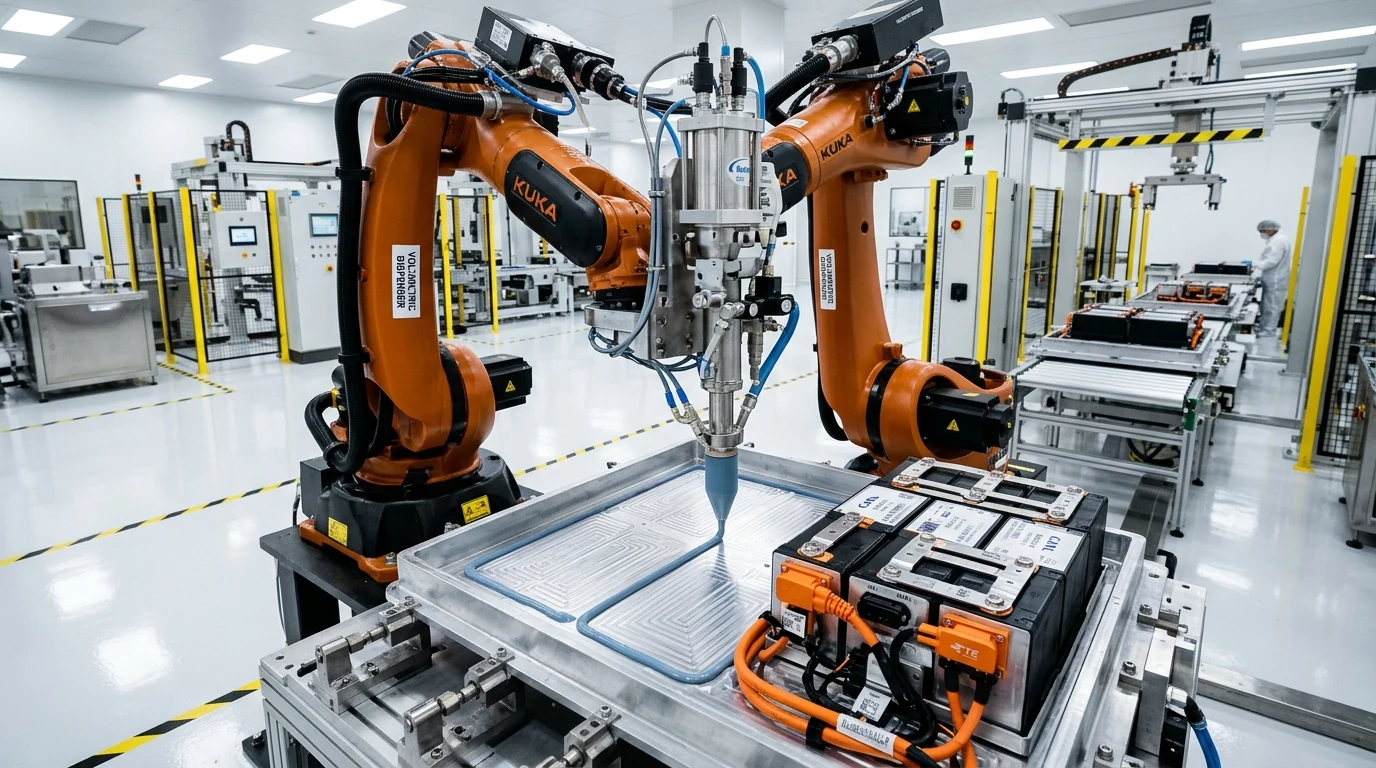
- High-Speed Robotic Dispensing: Meter-mix systems dispense precise volumetric beads in seconds without manual handling.
3. Polymer Matrix Selection: 2K Polyurethane vs. Silicone Gap Fillers
Two primary chemical platforms dominate the thermal interface market: 2K Polyurethanes and 2K Silicones. Polyurethanes are the preferred standard in commercial automotive lines due to their structural bonding strength (>5.0 MPa lap shear) and zero siloxane outgassing, ensuring electrical relay contacts remain uncontaminated.
4. Cell-to-Pack (CTP) Structural Adhesion and Vibration Dampening
Modern Cell-to-Pack (CTP) and Cell-to-Chassis (CTC) designs eliminate intermediate module housings to maximize volumetric energy density. Here, the gap filler performs dual-function duty: transferring heat while structurally gluing cells directly to the chassis to withstand dynamic automotive vibration and severe collision impact loads.
5. Dielectric Breakdown Insulation (>10 kV/mm) and UL 94 V-0 Flame Retardancy
With 800V fast-charging architectures becoming industry standard, electrical isolation is paramount. Filled with specialized ceramic particles (aluminum hydroxide/oxide), gap fillers deliver dielectric breakdown protection exceeding 10–15 kV/mm and meet UL 94 V-0 flame retardancy, self-extinguishing immediately to delay cell-to-cell thermal propagation.
6. Automated 2K Meter-Mix Dispensing: Squeeze Force and Void-Free Fill
High-viscosity 2K formulations require precision gear-pump or piston dispensing with static-dynamic mixing nozzles. During cell placement, squeeze force must be calibrated to ensure bubble-free wetting without adhesive displacement.
7. Koçak Endüstri EV Battery Adhesives & On-Site Engineering Support
Koçak Endüstri provides automotive OEMs and battery module integrators with state-of-the-art Mayer® and Jowat® thermal gap fillers. Our engineering team conducts rheological modeling, thermal conductivity certification (Hot Disk method), and automated dispensing trials on production lines.
Thermal Conductive Gap Fillers & Structural Cell Bonding in EV Battery Packs: Thermal Management, Dielectric Safety & UL 94 V-0 hakkında merak edilenler
Why did liquid gap fillers replace solid thermal pads in EV manufacturing?
Liquid gap fillers eliminate mechanical assembly stress on battery cells, accommodate broad tolerance variations, offer lower thermal contact resistance, and are fully compatible with high-speed automated robotic dispensing.
What is the practical impact of higher thermal conductivity (e.g., 3.0 W/mK vs. 1.5 W/mK)?
Higher conductivity allows faster heat dissipation during 350 kW ultra-fast charging, keeping cell temperatures under 40°C and preventing charging power throttling, cutting charging times by up to 25%.
Does polyurethane gap filler emit harmful outgassing inside closed battery packs?
No. Automotive-grade Koçak Endüstri 2K polyurethanes are 100% solids, solvent-free, and compliant with strict low-VOC standards, eliminating volatile gas buildup and contact corrosion.
Can battery modules be disassembled for recycling or repair (reworkability)?
Yes. Specially engineered reworkable gap filler formulations allow modules to be peeled from cooling plates during battery pack servicing without damaging cell casings.
Technical resources and verification
The content has been prepared in Turkish with the technical experience of Koçak Endüstri, based on the following manufacturer resources.
Let's choose the right adhesive for your application together
You can get technical guidance and offers for Jowat products by sharing your machine, material and consumption information.
Get a technical quote

