



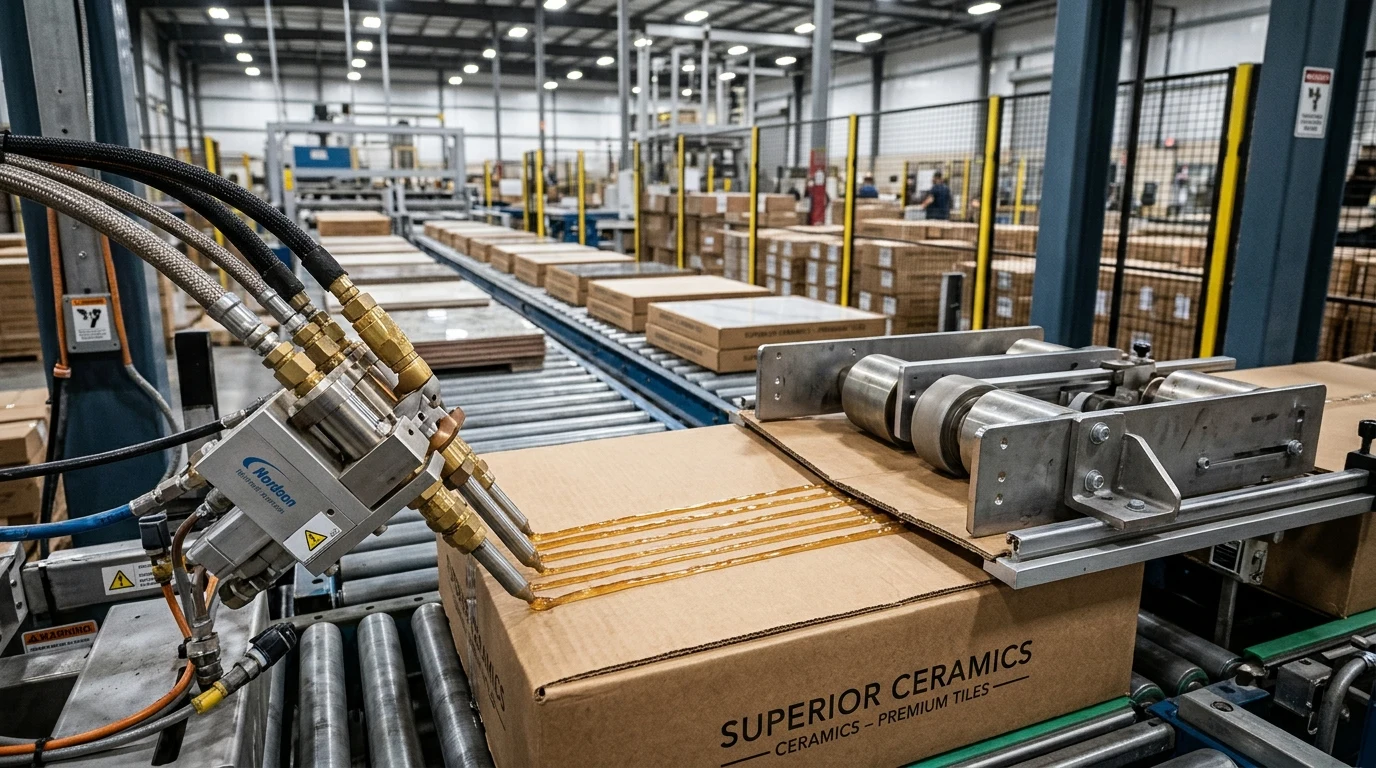
Hot Melt Selection for Ceramic, Tile, and Granite Packaging: Preventing Box Pop-Open under Heavy Loads
Corrugated boxes packaging ceramic tiles, porcelain slabs, and heavy granite tiles endure extreme static and dynamic loads ranging between 25 kg and 45 kg per carton. The primary operational risk in these high-speed lines is box flap pop-open failure during palletizing, warehousing, or ocean container transit. To prevent catastrophic box failures, manufacturers must transition from conventional EVA hot melts to high-cohesion metallocene polyolefin (mPO) hot melts. Featuring superior shear resistance (SAFT > 85°C), rapid setting times of 1.5 to 3.0 seconds, and 100% deep substrate fiber tear, mPO formulations overcome the high mechanical spring-back forces of heavy double-wall (BC-flute) corrugated boards. Applied via multi-bead or dotting nozzle patterns at 160°C–175°C, mPO hot melts cut adhesive consumption by up to 30% while guaranteeing zero flap pop-opens under export container heat.
In the ceramic, porcelain, and natural stone industries, manufacturing mega-slabs (e.g., 60x120 cm, 120x240 cm) introduces severe packaging challenges. A single carton of porcelain tiles frequently weighs between 25 kg and 45 kg. If the hot melt adhesive sealing the bottom and top flaps fails, cartons burst open during automated palletizing or export shipping. This results in shattered porcelain, collapsed pallet stacks, and severe commercial claims. This technical article examines the adhesive engineering required to permanently eliminate carton pop-open failures using metallocene polyolefin (mPO) chemistry, high SAFT thermal stability, and optimized nozzle dispensing patterns.
1. Heavy-Duty Tile Packaging Dynamics and Pop-Open Failure Risks
Unlike light consumer cartons where glue only resists paper spring-back, heavy tile packaging joints face three concurrent destructive forces:
- Static Gravitational Load: 30–45 kg of stone exerts continuous downward shear stress on bottom flaps, causing substandard glues to suffer viscoelastic creep.
- Corrugated Board Flap Memory Effect: Heavy 350–500 g/m² kraftliner and double-wall (BC-flute) corrugated boards exert powerful elastic recovery forces attempting to snap open.
- Dynamic Forklift & Transit Shocks: Factory conveyor transfer points, rough forklift maneuvering, and road vibrations induce shock loads that shatter brittle adhesives.
2. Polymer Chemistry: Conventional EVA vs. High-Cohesion Metallocene Polyolefin (mPO)
Traditional Ethylene Vinyl Acetate (EVA) hot melts struggle with high mechanical and thermal demands. Modern packaging operations are converting to Metallocene Polyolefin (mPO) hot melts:
| Technical Parameter | Conventional EVA Hot Melt | Metallocene Polyolefin (mPO) Hot Melt | Reactive PUR Hot Melt |
|---|---|---|---|
| Polymer Architecture | Broad molecular weight distribution | Narrow, uniform polymer chains | Moisture-curing polyurethane |
| Cohesive Strength | Moderate (Creep under heavy loads) | Superior (High tensile & shear strength) | Extremely High (Chemical cross-linking) |
| Heat Resistance (SAFT) | 60°C – 70°C | 85°C – 105°C (Ocean container safe) | 130°C – 150°C |
| Tank Charring | High (Frequent nozzle clogs) | Virtually Zero (Clean tank, water-clear) | Low (Closed moisture-free system) |
| Application Mileage | Baseline (100% consumption) | 25% – 35% Lower Consumption | 40% Lower Consumption |
| Setting Time | 3.0 – 5.0 Seconds | 1.0 – 2.5 Seconds (Rapid green strength) | Reaction-driven (Minutes) |
3. Thermal & Mechanical Integrity: SAFT (>85°C), Shear Strength, and Flap Memory Effect
The standard benchmark for hot melt thermal stability is the SAFT (Shear Adhesion Failure Temperature) test (ASTM D4498). During summer ocean freight across the Mediterranean, Red Sea, or Atlantic, temperatures inside shipping containers routinely reach 60°C–65°C. EVA adhesives soften and shear apart, whereas advanced mPO hot melts with SAFT values above 90°C maintain rigid joint integrity.
Furthermore, true bonding quality is confirmed by 100% Substrate Fiber Tear: forcing open a bonded flap must tear deep corrugated paper fibers, never separating cleanly at the adhesive interface.
4. Automated Line Optimization: Open Time, Compression Timing, and Bead Geometry
Automated case erecting and closing machines operate at speeds up to 45 cartons per minute. Process parameters must be precisely dialed in:
- Open Time: Time elapsed between adhesive extrusion and flap compression must not exceed 1.0–2.0 seconds to prevent premature surface chilling (skinning).
- Compression Dwell Time: Pneumatic compression belts must maintain active pressure for at least 1.5 seconds to force molten adhesive into paper pores.
- Multi-Dot vs. Continuous Bead: High-speed electric dispensing guns applying high-frequency dotting patterns provide equivalent bond area while reducing adhesive usage by 30% and cooling faster.
5. Logistics & Warehousing: High Humidity, Container Heat (65°C), and Pallet Stacking
Loaded tile pallets often weigh 1.5 tons and are stacked 2 to 3 tiers high in warehouses. Metallocene hot melts resist moisture plasticization in humid coastal warehouses and prevent carton failure under crushing Box Compression Test (BCT) loads.
6. Koçak Endüstri & Jowat Heavy-Duty Packaging Adhesive Solutions
Koçak Endüstri partners with major tile manufacturers, providing Jowat's premier Jowat-Toptherm® Metallocene Polyolefin systems alongside on-site technical audits, SAFT evaluations, and nozzle angle calibrations.
7. Frequently Asked Questions (FAQ)
Why do ceramic carton pop-opens spike during summer shipments?
Standard EVA hot melts have SAFT ratings around 65°C. Ocean container temperatures exceed 60°C in direct sunlight, causing EVA glue lines to soften and fail under the spring-back force of heavy flaps. Metallocene hot melts with SAFT ratings of 95°C–105°C eliminate this risk.
How does metallocene hot melt reduce cost per box?
Metallocene hot melts have a 15% lower density than EVA and higher tensile strength, enabling thinner beads. Combined with multi-dotting, operations routinely achieve 25%–35% adhesive mass savings while eliminating downtime for nozzle cleaning.
Hot Melt Selection for Ceramic, Tile, and Granite Packaging: Preventing Box Pop-Open under Heavy Loads hakkında merak edilenler
Why do ceramic carton pop-opens spike during summer shipments?
Standard EVA hot melts have SAFT ratings around 65°C. Ocean container temperatures exceed 60°C in direct sunlight, causing EVA glue lines to soften and fail under flap memory spring-back forces. Metallocene hot melts with SAFT ratings of 95°C–105°C eliminate this risk.
How does metallocene hot melt reduce cost per box?
Metallocene hot melts have a 15% lower density than EVA and higher tensile strength, enabling thinner beads. Combined with multi-dotting, operations routinely achieve 25%–35% adhesive mass savings while eliminating downtime for nozzle cleaning.
How to fix adhesion issues on heavy double-wall (BC flute) corrugated boards?
Heavy liners act as heat sinks. Increase nozzle temperature by 5°C, increase compression pressure, and ensure open time remains below 1.5 seconds.
Technical resources and verification
The content has been prepared in Turkish with the technical experience of Koçak Endüstri, based on the following manufacturer resources.
Let's choose the right adhesive for your application together
You can get technical guidance and offers for Jowat products by sharing your machine, material and consumption information.
Get a technical quote

