



Hotmelt Selection in Robotic and Automatic Dispenser Lines: Viscosity, Pressure and Nozzle Calibration
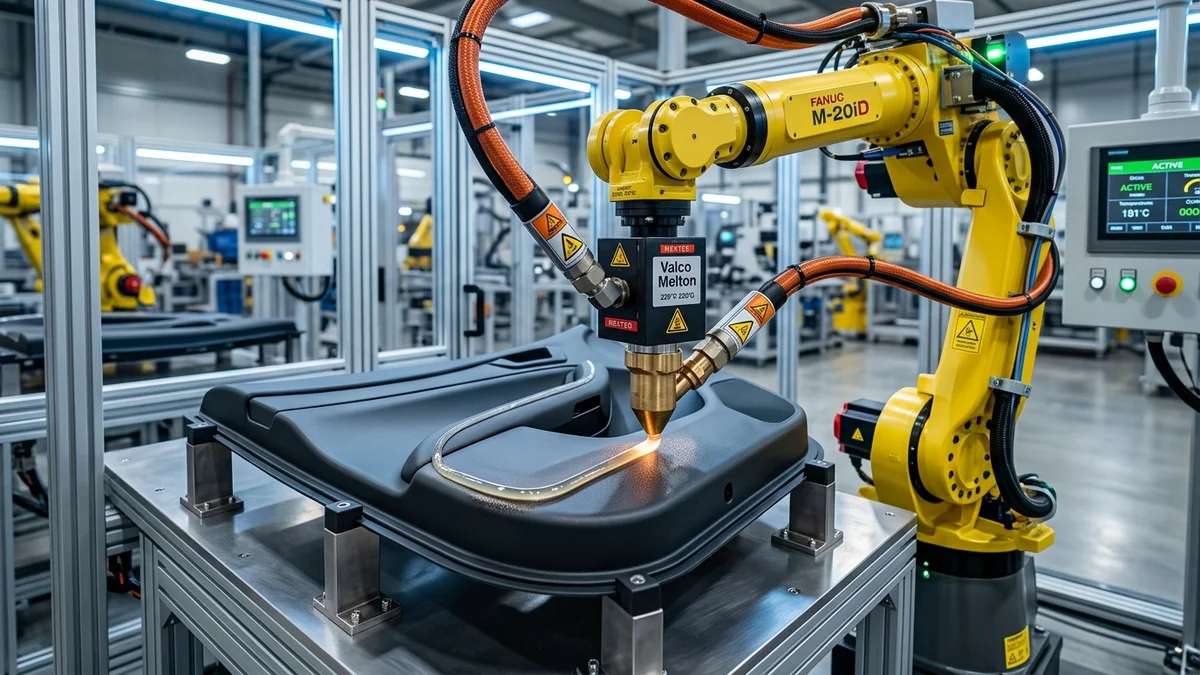
Selection of hotmelt adhesive in robotic and automatic dispenser lines; It requires constant viscosity stability, clean cut-off capability and homogeneous flow under high pressure, fully adapting to the variable feed rate (TCP speed) of the robotic arm. With the correct nozzle diameter, hose temperature profile and proportional flow control, a glue line with millimetric precision is obtained.
In Industry 4.0 and smart production facilities, gluing processes are rapidly being transferred from manual guns to 6-axis articulated robots, Cartesian robots and high-speed automatic dispenser applicators. However, a small viscosity fluctuation or slight stringing that can be tolerated on a manual line can lead to part rejection, optical sensor contamination and costly line stoppages on a robotic line. Choosing the right hotmelt adhesive in robotic and automatic distribution lines requires perfect chemical stability as well as mechanical precision.
As Koçak Endüstri, we offer engineering calibration support with Jowat technical adhesives , PUR and PO hot glues developed for high-precision automation lines.
What are robotic hotmelt dispensing systems?
Robotic distribution; It is the transfer of the adhesive, which is carried from a melting unit (tank or barrel melter) to the applicator module at the end of the robotic arm via high-pressure heated hoses, to the surface at the programmed speed and flow rate along 3D contours.
The robot arm slows down when turning corners and accelerates on straight lines. For this reason, the shear thinning behavior and viscosity stability of the hot glue used must be able to instantly respond to the variable line speed of the robot.
5 critical adhesive criteria for automation
| Criteria | Why Is It Important? | Risk Encountered in Wrong Selection |
|---|---|---|
| Wide Open Time Range | Maintaining bond strength as the robot completes its trajectory | Setting of the glue (cold tack) before part assembly |
| Low Abrasiveness | Fillers do not corrode the nozzle needle | Premature nozzle leakage and loss of flow control |
Nozzle calibration, pressure and flow control
- Nozzle Diameter Selection: A needle or nozzle tip suitable for the width of the glue line to be drawn (e.g. 1.5 mm - 3 mm) should be selected. Nozzles that are too narrow create unnecessarily high pump pressure.
- Proportional Valve and Pressure Control: Proportional pneumatic/gear pump control should be applied, which increases the glue flow rate when the robot's progress speed increases and reduces the flow rate when it slows down.
- Hose Length and Temperature Compensation: Armored hoses suitable for the flexibility of the robot arm should be selected; ±2°C temperature homogeneity must be ensured throughout the hose.
- Snuff-Back Calibration: When dispensing is completed, the applicator needle should be retracted at the micro level to vacuum the dripping at the nozzle tip.
Automotive, white goods and filter applications
- Automotive Interior Trim and Door Panels: Bonding of sound insulation felts, cable ducts and leather/fabric coverings with robotic PUR or PO hotmelt.
- White Goods Insulation and Anti-Vibration: Mastic/hotmelt sealing and bonding lines on refrigerator, washing machine and oven panels.
- Industrial Filter Manufacturing: Micron precision bead glue lines for layer separation and frame fixing in HEPA and activated carbon filter panels.
- Electronic Case and PCB Fixing: Vibration-resistant part fixing with low-corrosion polyamide (PA) or PSA hot glues.
Error prevention and line maintenance checklist
- At the beginning of the shift, the nozzle tip should be cleaned with silicone cleaner or a brass brush to remove any residue.
- Glue tank and applicator filters should be checked regularly according to the manufacturer's period.
- Calibration deviation should be verified by weighing the glue flow rate (grams per second) with a scale in a weekly period.
- In lines where PUR reactive glue is used, a special cleaner must be charged during weekends or long downtimes.
Technical support and product supply
Koçak Endüstri provides adhesive solutions with the highest process stability for your robotic gluing cells and automatic distribution lines. To determine the most suitable product type and process parameters for your automation line, you can get support from our experts via Quotation Form ; For other technical details, you can visit our Technical Information Center page.
Hotmelt Selection in Robotic and Automatic Dispenser Lines: Viscosity, Pressure and Nozzle Calibration hakkında merak edilenler
What is the most common problem in robotic hotmelt application?
Problems such as overflow at corner turns, threading and dripping at the nozzle tip occur as a result of the glue flow rate remaining inconsistent while the robot speed changes.
How to prevent threading in the applicator on the robot head?
Special hotmelt formulations to prevent threading should be selected, nozzle temperature should be optimized and a snuff-back system should be used in the applicator.
Which glue chemistry is preferred in robotic lines?
Reactive PUR is preferred for high heat resistance, Polyolefin (PO) for standard assembly, and Polyamide (PA) for electronics/filters requiring high temperature resistance.
How does glue viscosity affect robot speed?
If the viscosity is too high, the pump will be stressed at high speeds and streaks will occur; If it is too low, it will flow on the surface and line stability will be impaired.
Technical resources and verification
The content has been prepared in Turkish with the technical experience of Koçak Endüstri, based on the following manufacturer resources.
Let's choose the right adhesive for your application together
You can get technical guidance and offers for Jowat products by sharing your machine, material and consumption information.
Get a technical quote

