

Scratch, Adhesion, and Joint Line Issues on High-Gloss & Acrylic Edgebanding: Release Agents and PUR Adhesives
In High-Gloss and acrylic edgebanding, manufacturers face three recurring defects: surface scratching under pressure rollers, adhesive squeeze-out sticking to mirror finishes, and dirty dark joint lines (fugue). Solutions require spraying Riepe® release agent at infeed to prevent glue adhesion, applying antistatic cooling fluid before pressure rollers, utilizing moisture-curing Jowat PUR hot melt for invisible zero-joint aesthetics, and polishing with Riepe® cleaners to eliminate static dust attraction.
Mirror-finish High-Gloss and acrylic panels define premium kitchen and luxury cabinetry. However, processing high-gloss parts through edgebanders poses extreme scrap risks; a single micro-scratch or baked glue smudge ruins the finished workpiece.
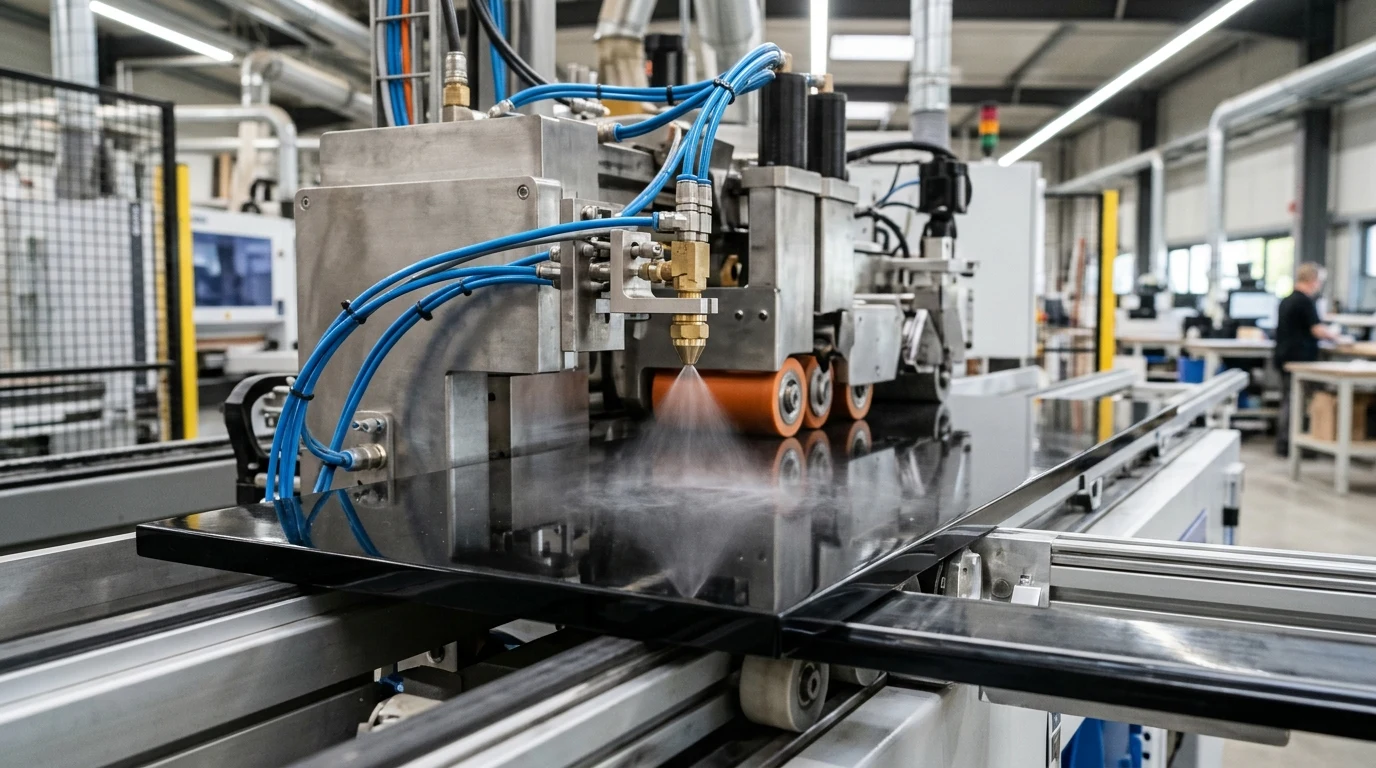
3. The Riepe® 4-Point Chemical Spray System
State-of-the-art edgebanders rely on Riepe electronic spray technology:
- Infeed Release Agent (LP163/93): Forms a microscopic barrier preventing hot glue from adhering to top/bottom panel faces.
- Antistatic Coolant (LP288/99): Chills the glue line instantly and neutralizes electrostatic charges to repel milling dust.
- Buffing Cleaner (LPZ/II): Dissolves lingering glue haze ahead of buffing wheels without dulling acrylic.
4. Achieving Zero-Joint (Invisible Seams) with Reactive PUR
Using Jowatherm-Reaktant® PUR yields ultra-thin, moisture-curing bondlines that eliminate unsightly dirt-trapping seams and resist kitchen steam permanently.
6. Frequently Asked Questions (FAQ)
For chemical spray calibration and PUR setup audits, reach out to Koçak Endüstri.
Scratch, Adhesion, and Joint Line Issues on High-Gloss & Acrylic Edgebanding: Release Agents and PUR Adhesives hakkında merak edilenler
Can paint thinners be used to remove glue smears from acrylic panels?
Never. Solvents like thinners or acetone attack acrylic surfaces, causing permanent haze and loss of gloss. Only dedicated cleaners like Riepe LPZ/II should be used.
What is the function of the infeed release agent?
It coats the panel surface with a micro-thin parting film, ensuring that squeezed-out hot melt cannot stick to the decorative face.
Why is PUR preferred over EVA on high-gloss panels?
PUR hot melt applies with minimal film thickness, creating an invisible zero-joint line that never discolors or attracts dirt.
How does static electricity scratch acrylic finishes?
Milling generates electrostatic charges that pull abrasive plastic chips onto the mirror surface, causing buffing wheels to scratch the face.
Technical resources and verification
The content has been prepared in Turkish with the technical experience of Koçak Endüstri, based on the following manufacturer resources.
Let's choose the right adhesive for your application together
You can get technical guidance and offers for Jowat products by sharing your machine, material and consumption information.
Get a technical quote

