

Primary and Secondary Sealant Engineering in Insulated Glass Units (IGU): Butyl vs. Polyurethane and Polysulfide Comparison
Ensuring insulated glass units (IGU) maintain condensation-free durability and low Ug thermal conductivity for over 25 years requires seamless chemical synergy between primary and secondary sealant barriers. Primary Polyisobutylene (PIB/Butyl) acts as an impermeable moisture vapor (MVTR < 0.1 g/m²·d) and argon barrier. Outer two-component reactive polysulfide or polyurethane secondary sealants provide structural cohesion against wind load and thermal stress. Complying with EN 1279-2 moisture ingress (I < 0.20) and EN 1279-3 gas loss (< 1.0%/year) standards demands precise meter-mix automated dispensing with zero void inclusions.
In modern architectural facades and energy-efficient building envelopes, double and triple insulated glass units (IGU) dictate acoustic and thermal insulation performance. Preventing internal fogging and retaining argon gas over a 30-year design life depends entirely on the chemical integrity and mechanical durability of the perimeter sealant system. This technical white paper examines the chemistry of primary polyisobutylene (butyl) and secondary polysulfide/polyurethane sealants, EN 1279 test protocols, and robotic dispensing precision.
1. Dual-Seal Architecture in Insulated Glass Units
No single sealant compound can simultaneously provide both an absolute moisture vapor barrier and high mechanical structural elasticity. Therefore, global building standards enforce a dual-seal perimeter configuration:
- Primary Seal (Inner): Thermoplastic Polyisobutylene (PIB/Butyl) extruded hot onto both lateral sides of the spacer bar. Its sole mission is to block moisture vapor penetration and stop noble gas leakage.
- Secondary Seal (Outer): A chemically curing 2-component polymer (polysulfide, polyurethane, or structural silicone) filled into the perimeter cavity behind the spacer. It absorbs structural wind loads, seismic movements, and thermal shear.
2. Primary Sealant: Polyisobutylene (PIB / Butyl) Gas Retention
PIB features dense hydrocarbon chain packing that yields exceptionally low permeability coefficients. Dispensed at 115°C to 130°C onto aluminum or warm-edge spacer profiles, butyl forms an uninterrupted seal under mechanical nip-roller compression. Maintaining continuous corner sealing on bent spacer frames prevents micro-void channels where gas loss typically initiates.
3. Secondary Sealants: 2K Polysulfide vs 2K Polyurethane vs Silicone
Selecting the secondary sealant depends on factory handling speeds and facade engineering criteria:
| Engineering Criteria | 2K Polysulfide (PS) | 2K Polyurethane (PU) | Structural Silicone (IGS) |
|---|---|---|---|
| Polymer Matrix | Thiol-terminated liquid polysulfide | Polyol + isocyanate adduct | Alkoxy / oxime neutral cure silicone |
| Mechanical Modulus | High elasticity, low stress | High tensile modulus & rigidity | Superior elastic recovery |
| Moisture Vapor Barrier (MVTR) | Exceptional barrier | Very low permeability | Higher permeability (relies on butyl) |
| Argon Gas Barrier | Outstanding (< 0.5% / year) | Excellent (< 0.7% / year) | Low gas retention capacity |
| Direct UV Exposure | Moderate to high (framed sash) | High (shaded edge seal) | Infinite UV resistance (mandatory for SSG) |
| Tack-Free Curing Time | 90 – 150 minutes | 45 – 90 minutes (rapid shipment) | 180 – 300 minutes |
| Odor & Environment | Sulfur odor, plasticizers | Low odor, mercury-free catalysts | Solvent-free, neutral odor |
4. EN 1279-2 and EN 1279-3 Certification Standards
Compliance with EN 1279 is mandatory for CE marking in Europe and internationally:
- EN 1279-2 (Moisture Penetration Index - I): Units endure rigorous thermal cycling (+55°C, 95% RH). Moisture penetration must stay below I < 0.20 to guarantee 25+ years without condensation.
- EN 1279-3 (Gas Leakage Rate - L): Annual gas leakage must remain below L < 1.0% per year, ensuring gas retention exceeds 80% after 25 years in service.
- EN 1279-4: Validates tensile, shear, and aging adhesion to glass, warm-edge composite spacers, and aluminum.
5. CNC Robotic Extrusion, Meter-Mix Calibration & Butterfly Test
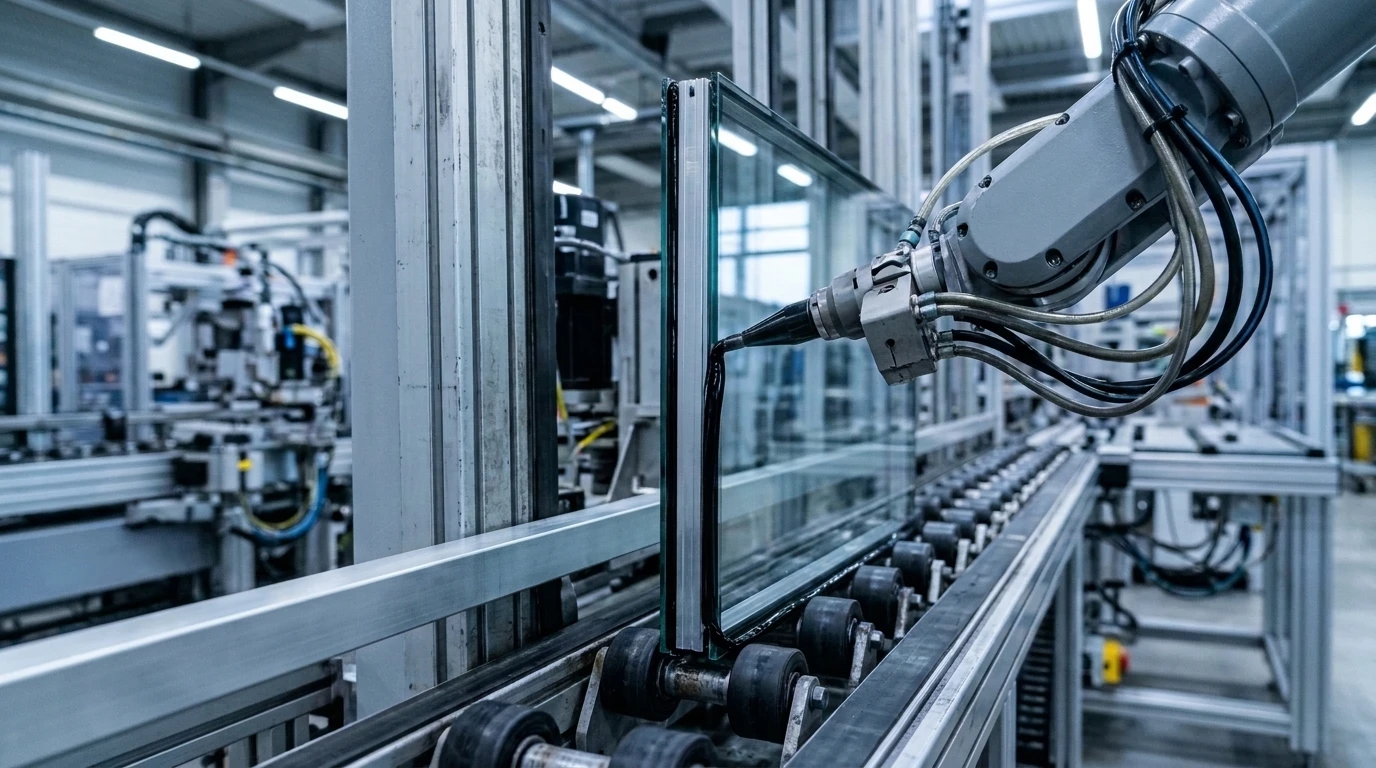
Modern vertical sealing lines employ automated CNC applicator heads. To ensure consistent 10:1 ratio mixing of base paste and catalyst, quality protocols mandate the Butterfly Test at every shift transition. A folded paper smear must display completely uniform dark anthracite color without striations or marbling, verifying full polymerization across all corner joints.
6. Koçak Endüstri Insulated Glass & Facade Sealant Portfolio
Koçak Endüstri supplies certified primary butyl hot melts, 2K polyurethane/polysulfide secondary sealants, and purging maintenance materials to leading glass processing plants across Turkey.
7. Frequently Asked Questions (FAQ)
Primary and Secondary Sealant Engineering in Insulated Glass Units (IGU): Butyl vs. Polyurethane and Polysulfide Comparison hakkında merak edilenler
Can insulated glass be manufactured using only secondary sealant without butyl?
No. Secondary sealants provide mechanical cohesion but possess moisture vapor transmission rates hundreds of times higher than butyl. Units made without a primary butyl seal develop internal condensation within 12 to 24 months.
What is the maximum allowable gas leakage rate under EN 1279?
The maximum permissible rate under EN 1279-3 is 1.0% per annum. A properly formulated butyl and polysulfide/PU seal achieves loss rates below 0.4% per year.
Why is structural silicone required for Structural Glazing (SSG) facades instead of polysulfide?
Polysulfides undergo polymer degradation under permanent unshaded UV exposure. Structural silicone is chemically engineered with UV-immune siloxane bonds required for exposed silicone glazed curtain walls.
What is the purpose of the shift-start Butterfly Test?
It provides visual confirmation that the 2-component meter-mix system is dispersing catalyst homogenously. Any streaks indicate unreacted soft patches that cause seal failure.
Technical resources and verification
The content has been prepared in Turkish with the technical experience of Koçak Endüstri, based on the following manufacturer resources.
Let's choose the right adhesive for your application together
You can get technical guidance and offers for Jowat products by sharing your machine, material and consumption information.
Get a technical quote

