



Bonding Performance Tests and TDS Reading Guide: How to Evaluate Peel, Shear and Heat Resistance?
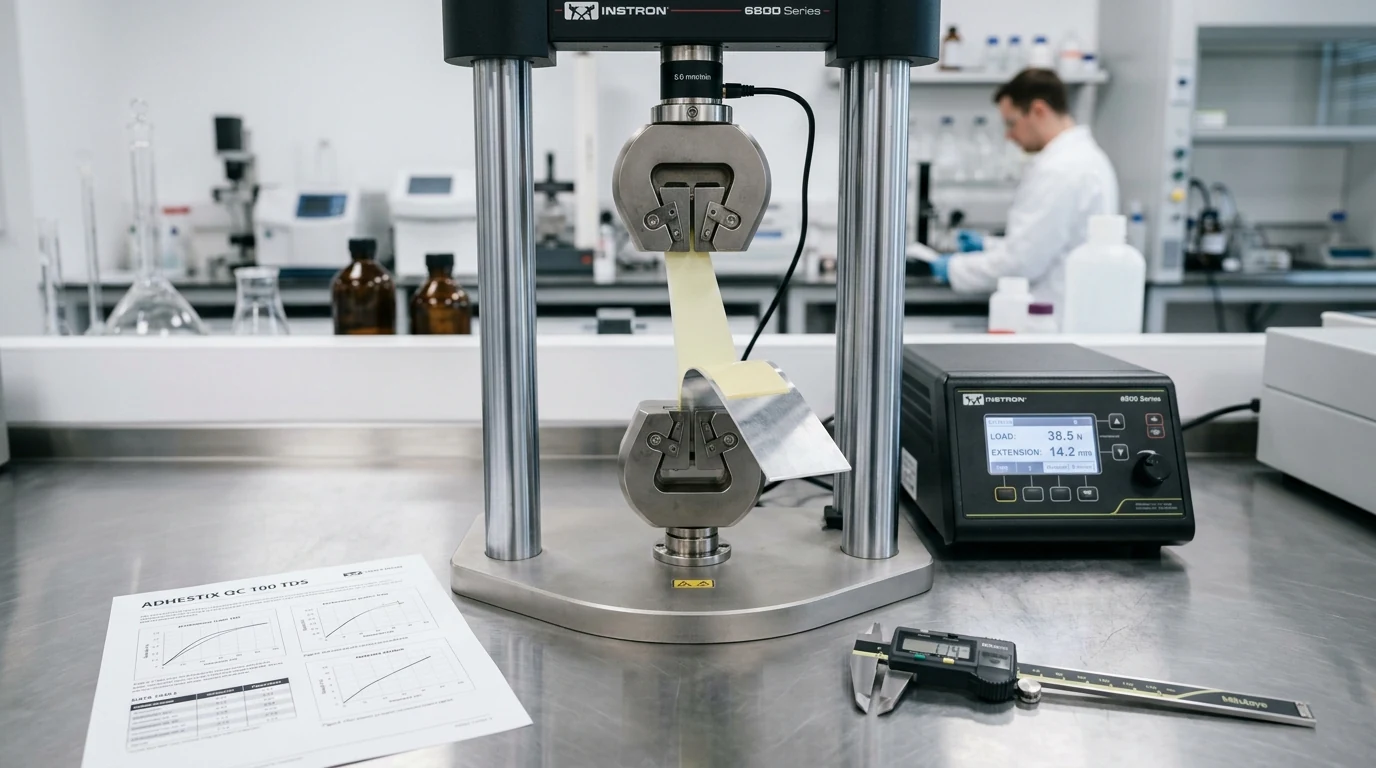
Technical Data Sheet (TDS) of an adhesive; It includes basic physical parameters such as viscosity, softening point, density, open time and application temperature. The basic mechanical tests that determine the adhesion performance are: 180° or 90° peel test, shear test that measures the resistance to shear forces parallel to the surface, and Heat Resistance (SAFT / WATT 91) tests that determine the resistance to opening under high temperatures. The values given in TDS are references obtained under standard laboratory conditions (usually 20°C and 50% RH); Actual line performance must be verified on site according to surface roughness, humidity, weight and pressing pressure.
The most frequently used document by purchasing and quality control teams in industrial adhesive supply and raw material acceptance processes is Technical Data Sheet (TDS) . However, seeing a TDS document as just the product code and price invites costly malfunctions in production. When the viscosity, open time, peel strength and heat resistance of an adhesive are not analyzed correctly, it becomes impossible to choose the right product.
As Koçak Endüstri, in line with our transparent technical engineering principle, we provide full data access to our users with all Jowat TDS documents and Mayer Tutkal verified TDS documents on our site.
What is a Technical Data Sheet (TDS) and why should you read it?
TDS is a technical identification document that summarizes the chemical and physical properties obtained by the manufacturer through controlled test methods (DIN, EN, ISO, ASTM standards) in a laboratory environment. While the safety data sheet (MSDS/SDS) covers occupational health and environmental safety, TDS directly defines the processing parameters and mechanical capabilities of the product.
Basic mechanical tests: Peel, Shear and Tensile Strength
| Label, tape, protective film, foil lamination | ________Pallet fixing, furniture solid panel joining | ________ Printing house, book and catalog binding lines
Thermal and chemical resistance: SAFT, Ring & Ball and WATT 91
- Softening Point (Ring & Ball / ASTM E28): Shows the degree to which the hotmelt adhesive transitions from solid form to fluid form as the temperature increases. It is the basic guide to understanding the melting threshold of the adhesive.
- SAFT (Shear Adhesion Failure Temperature): It is the critical temperature at which the adhesive under load loses its shear resistance when the temperature is increased.
- WATT 91 (DIN EN 14257): It is the most prestigious European heat resistance standard that measures the tensile strength of wood adhesives (D3/D4) under 80°C baking.
Glossary of TDS parameters: Viscosity, Open Time and Cure
Practical meanings of technical abbreviations encountered in TDS pages:
- Viscosity (mPa·s / Brookfield): It is the internal resistance of the melt glue to flow. Measured at specified temperature (e.g. @180°C). Low viscosity indicates fluidity and high viscosity indicates filling power.
- Open Time: It is the maximum time (seconds or minutes) that the glue maintains its adhesion ability from the moment it is applied until it is combined with the opposite surface.
- Setting Time: It is the time during which the part can hold on without falling apart after applying the press.
- Density (g/cm³): While pure glues without fillers are around 0.95–1.05 g/cm³, mineral-filled EVA glues are around 1.30–1.50 g/cm³. Low density means sticking more meters with the same kilogram.
Differences between laboratory conditions and factory field
The values in TDS are produced on perfectly calibrated test plates under 20°C and 50% relative humidity. In the field, dusty environment, wood moisture differences, cold air flow and operator settings directly affect performance. For this reason, TDS values should not be considered as an absolute guarantee, but as a technical compass for choosing the right product and should be confirmed by trial runs.
Access to Jowat and Mayer verified TDS documents
You can visit our Jowat TDS Locator and Mayer Product Center pages to review the official technical data sheets of the products you use or are considering switching to in your facility; You can contact our technical experts for sample and test protocol.
Bonding Performance Tests and TDS Reading Guide: How to Evaluate Peel, Shear and Heat Resistance? hakkında merak edilenler
What is the difference between TDS and MSDS (SDS)?
TDS describes the technical performance of the product such as viscosity, strength, temperature; MSDS/SDS includes occupational health, safety, storage and chemical risks.
What does the Peel and Shear test show?
The Peel test shows the separation resistance when pulled perpendicular to the surface, and the Shear test shows the internal resistance against shear forces parallel to the adhesion surface.
Is the open time value in TDS the same in every environment?
No. Open time may be shortened or extended depending on the ambient temperature, material temperature, amount of glue applied and air flow.
Why is low density glue more advantageous?
Unfilled adhesives are lighter (approximately 1.0 g/cm³); In this way, 30-40% more boxes or edge bands can be glued with 1 kg of glue compared to mineral-filled heavy glues.
Technical resources and verification
The content has been prepared in Turkish with the technical experience of Koçak Endüstri, based on the following manufacturer resources.
Let's choose the right adhesive for your application together
You can get technical guidance and offers for Jowat products by sharing your machine, material and consumption information.
Get a technical quote

