

High-Strength Bottoming and Seaming Adhesives for Multi-Wall Valve Kraft Paper Sacks and Cement Bags
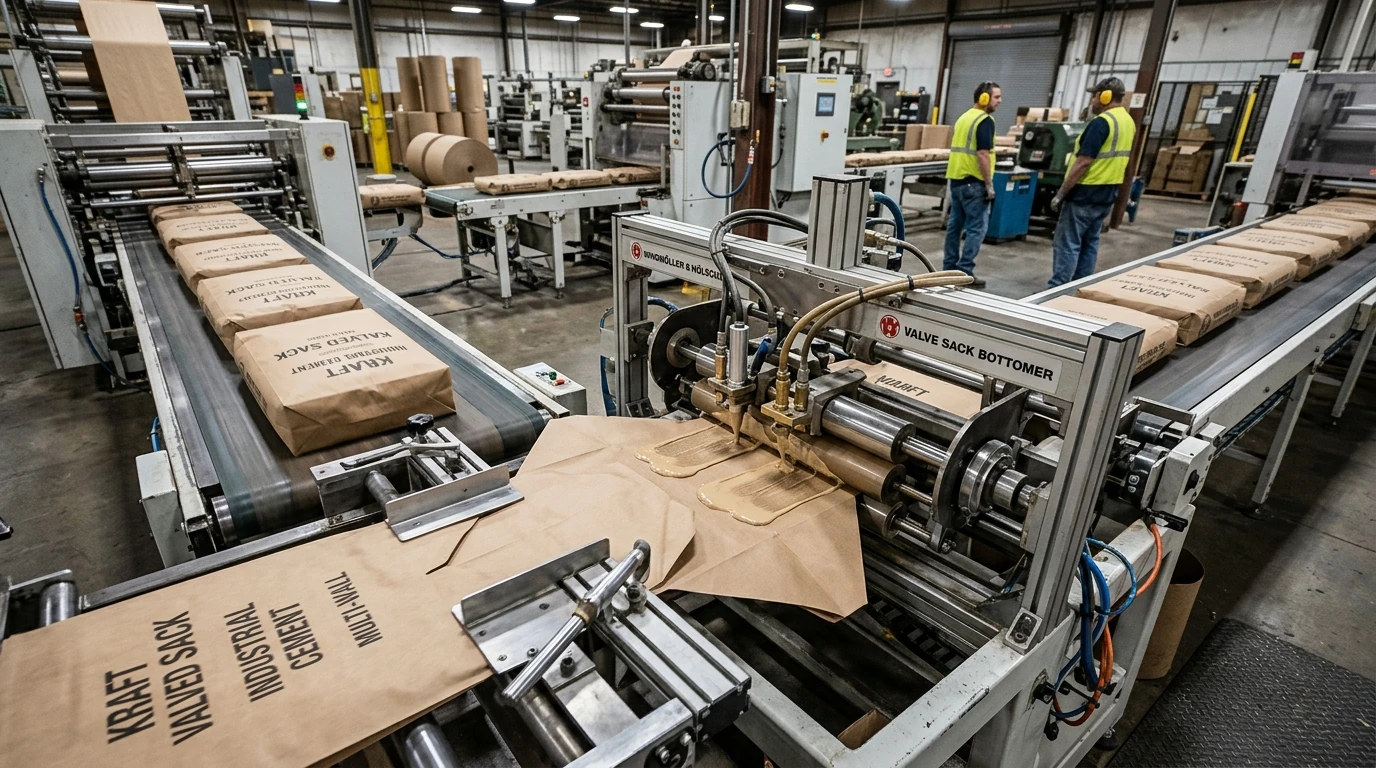
Multi-wall (2 to 4 ply) valve kraft paper sacks engineered for bulk cement, construction chemicals, flour, seeds, and chemical pellets require extreme adhesive joint resilience to prevent catastrophic bursting during 50 kg high-pressure pneumatic filling and rough logistical transport. Formulated for high-speed automated bag-making lines (operating at 300 to 400 sacks/min), water-based synthetic polymer and modified starch hybrid dispersions (Jowacoll® series) penetrate deep into porous kraft paper fibers, delivering instantaneous green tack. Fully compliant with ISO 7965 drop test standards, Koçak Endüstri sack adhesives eliminate roller misting and nozzle spitting, withstand pneumatic shock loads, provide superior moisture barrier properties, and comply with FDA/BfR food contact regulations to ensure zero downtime and minimal scrap.
In heavy-duty industrial packaging, the safe bulk transport of cement, dry mortar, flour, sugar, and polymer pellets hinges entirely on multi-wall valve kraft sacks. On modern converting machinery running at speeds exceeding 350 bags per minute, the synchronization of open time, initial green tack, and ultimate tensile bond strength is paramount. Inadequate bonding at the bottom fold or valve sleeve inevitably results in bag ruptures during pneumatic packing, damaging brand equity and causing massive material loss. Koçak Endüstri supplies next-generation water-based dispersion adhesives that optimize every stage of industrial sack conversion.
1. Multi-Wall Valve Sack Architecture: Structural Bonding Stations
Modern multi-ply paper sacks are engineered from high-tensile semi-extensible (semi-clupak) kraft paper combined with internal high-density polyethylene (HDPE) barrier liners. The manufacturing process involves three critical adhesive operations:
- Longitudinal Seaming (Tubing): High-speed lap gluing that forms continuous multi-wall paper tubes at line speeds up to 400 m/min.
- Cross-Pasting: Precision spot or stripe adhesive application that interlocks individual plies together, preventing paper slipping and ensuring composite mechanical strength.
- Bottoming & Valve Insertion (Bottoming Paste): Folding and securing the bottom and top covers under intense pressure, creating hermetic seals capable of withstanding severe drop impacts.
2. Bottoming Paste Dynamics and Multi-Ply Cross-Pasting Engineering
Bottoming paste applied via rotary roller cylinders requires tailored thixotropic flow. At high shear rates, the adhesive must spread evenly without splashing (anti-misting), while upon contact with the paper substrate, capillary suction must rapidly lock the polymer chains into the porous cellulose matrix.
| Application Stage | Adhesive Chemistry | Viscosity (mPa·s / 20°C) | Core Engineering Requirement |
|---|---|---|---|
| Bottoming Paste | Synthetic Dispersion + Modified Starch Hybrid | 3,000 – 6,000 | Instant green tack, 50 kg pneumatic shock resistance |
| Longitudinal Seaming | Fast-Setting PVAc Dispersion | 1,500 – 2,500 | Zero creep at 400 m/min tube forming speed |
| Cross-Pasting | Low-Viscosity Dextrin / Synthetic Hybrid | 800 – 1,800 | Ply interlocking, zero paper distortion, breathable |
| PE Liner / Kraft Lamination | Modified Acrylic / EVA Copolymer | 2,500 – 4,500 | High adhesion to corona-treated PE barrier films |
3. Synthetic Polymer Dispersions vs. Starch Pastes: Tack and Speed Optimization
While traditional starch adhesives are cost-effective, their slow drying times and sensitivity to ambient moisture make them unsuitable for high-speed converting. Koçak Endüstri hybrid polymer dispersions combine modified starches with advanced PVAc/EVA resins, providing 100% fiber-tearing bond strength within seconds, ensuring immediate palletization without bottom opening.
4. ISO 7965 Drop Testing and 50 kg Pneumatic Packing Impact Resilience
During automated rotary valve filling, 50 kg of powder is injected under high pneumatic air pressure in less than 4 seconds. Under ISO 7965-1 and ISO 7965-2 testing, filled sacks undergo free-fall drops from 1.2 meters. Koçak Endüstri adhesives form a flexible, rubbery elastomer film that dissipates peak impact shocks, preserving seam integrity and preventing seam blowouts.
5. High-Speed Machine Runnability (W&H, New Long): Rheology and Anti-Misting
Machine downtime due to dried glue encrustations on roller pans and application nozzles drains converter profitability. Our Jowacoll® sack adhesives are engineered with prolonged wet-edge open times on rollers while maintaining rapid setting speeds once pressed onto paper, virtually eliminating misting and roller cleaning stops.
6. Food Contact Compliance (FDA 175.105, BfR XIV) and UN Hazardous Goods Sacks
For paper sacks holding food staples (flour, starch, sugar, milk powder), our formulations strictly comply with FDA 21 CFR 175.105 and European BfR XIV standards, ensuring zero odor migration and low VOC content. Furthermore, for chemical exporters, our adhesives satisfy UN regulations for hazardous bulk transport.
7. Koçak Endüstri Industrial Sack Adhesives and Field Technical Support
Koçak Endüstri provides complete packaging line support across Turkey and neighboring regions. Our chemical engineers conduct on-site roller gap adjustments, paper porosity audits, and ISO 7965 laboratory validation to minimize adhesive consumption and optimize plant throughput.
High-Strength Bottoming and Seaming Adhesives for Multi-Wall Valve Kraft Paper Sacks and Cement Bags hakkında merak edilenler
Why can't standard PVAc wood glue be used on paper sack bottoming lines?
Standard wood PVAc glues lack the immediate green tack needed on 350 bags/min machines, causing bottom flaps to unseal on the conveyor. High-speed sack converting requires specialized starch-synthetic hybrid dispersions.
How is roller misting and splashing prevented at high converting speeds?
Misting is controlled through customized polymer rheology that exhibits pseudoplastic shear-thinning inside the roller pan but rapid elastic recovery upon roller transfer, preventing droplet dispersion into the ambient air.
Can these adhesives bond polyethylene (PE) moisture barrier plies?
Yes. Our specialty EVA-copolymer modified formulations provide strong chemical adhesion to corona-treated polyethylene and polypropylene barrier films without requiring aggressive solvents.
How do Koçak Endüstri adhesives guarantee ISO 7965 drop test compliance?
By retaining controlled elasticity after full cure, the adhesive absorbs pneumatic and kinetic impact stresses during free-fall drops, preventing brittle seam rupture.
Technical resources and verification
The content has been prepared in Turkish with the technical experience of Koçak Endüstri, based on the following manufacturer resources.
Let's choose the right adhesive for your application together
You can get technical guidance and offers for Jowat products by sharing your machine, material and consumption information.
Get a technical quote

