


Marine Woodworking Adhesive Standards in Boat and Yacht Building: Epoxy vs. Reactive PUR on Teak Decks and Keels
Bonding wood in marine environments represents one of the harshest engineering challenges due to salt crystallization, UV exposure, dynamic wave torsion, and cyclic swelling and shrinking. While epoxy resins provide unmatched rigid shear strength (> 25 MPa) for structural keels, frames, and cold-molded hull laminations, reactive polyurethane (1K/2K PUR) and hybrid polymers are essential for teak decking and seam caulking. PUR adhesives deliver over 300% elongation at break, absorbing wood dimensional movements without delamination while complying with EN 204 D4 boiling water resistance and IMO MED wheelmark flame retardancy standards.
From custom racing yachts to classic wooden shipwright restorations, maritime wood construction represents an unforgiving proving ground for adhesive engineering. Saltwater crystals penetrate bond interfaces, intense deck sunlight elevates temperatures to 70°C, and heavy seas apply perpetual torsional shear. Specifying the wrong chemical adhesive leads to catastrophic deck delamination or timber joint failure. This technical guide explores the distinct mechanical roles of marine epoxies and reactive moisture-curing polyurethanes (PUR) across teak decking, keel framing, and international maritime safety standards.
1. Marine Environmental Stresses: Saltwater, UV and Dynamic Flex
Timber is an active hygroscopic material that changes volume with moisture fluctuations. In offshore conditions, marine wood adhesives must resist:
- Osmotic Salt Crystallization: Saltwater penetrates cell structures; upon evaporation, growing NaCl crystals exert microscopic mechanical pressure that destroys brittle adhesive bonds.
- Hygroscopic Stress (Swelling and Shrinking): Teak expands across its grain when wet and contracts under baking sun. Rigid glues fail to absorb this strain and shear along the wood interface.
- Hull Torsion: Hulls twist dynamically as vessels cross swells. Rigid, brittle adhesives crack under prolonged harmonic vibration.
2. Epoxy Resins vs Reactive PUR: Rigid Structural Bond vs Elastic Joint
In naval architecture, epoxies and polyurethanes serve distinct, complementary roles:
| Engineering Metric | Marine Epoxy System | 1K / 2K Reactive Marine PUR | Standard D3/D4 PVAc Dispersion |
|---|---|---|---|
| Mechanical Behavior | Rigid, high tensile & shear (> 25 MPa) | Elastomeric – Semi-Rigid (Damping) | Thermoplastic, creeps under load |
| Elongation at Break | 3% – 6% (Low elasticity) | 300% – 500% (High elasticity) | 10% – 15% |
| Teak Deck Bedding | Unsuitable (Lacks expansion flex) | Superior (Absorbs thermal movement) | Unsuitable (Dissolves in moisture) |
| Keel & Stringer Lamination | Exceptional (Zero creep, rigid) | Excellent (EN 15425 structural PUR) | Prohibited by maritime classification |
| Boiling Water Resistance | Complete hydrolytic stability | Passes EN 204 D4 boil testing | Hydrolyzes and softens over time |
| Moisture Tolerance | Demands dry wood (< 12% moisture) | Requires moisture to cure | Requires dry substrates |
3. Teak Deck Bedding and Seam Caulking Engineering
Teak contains natural silica and protective oils that confer natural decay resistance but challenge adhesive wetting:
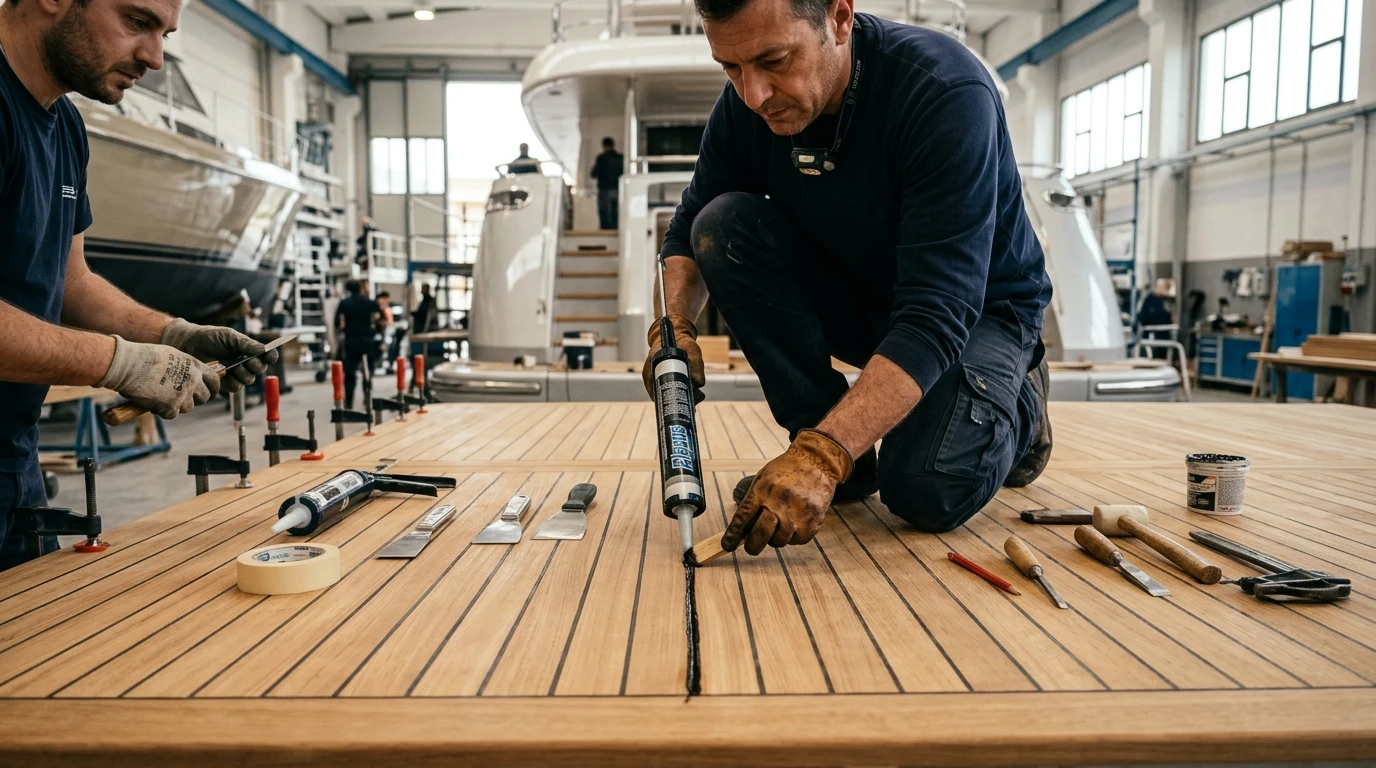
- Screwless Bedding: Modern yacht decks bond teak planks to GRP or aluminum decks using elastomeric polyurethane or hybrid bedding polymers without penetrating screws, eliminating leak points.
- Seam Caulking: 4–6 mm perimeter joints are filled with UV-stable marine polyurethane caulking.
- Bond Breaker Tape: A release tape must be positioned at the bottom of the seam groove. This prevents 3-sided adhesion, allowing the sealant to stretch freely across 2 opposite faces without tearing down the center.
4. Keel and Structural Timber Standards: EN 204 D4 & EN 15425
Laminated structural keels and hull frames require rigorous certification:
- EN 204 D4: Endures 6 hours of boiling water immersion followed by immediate wet shear strength testing exceeding 4 N/mm².
- EN 15425: Certifies that 1K polyurethane adhesives exhibit zero structural creep under long-term dead loads.
- Classification Approvals: Lloyd's Register, DNV, and RINA require wheelmark (IMO MED) flame-retardant compliance for commercial vessels.
5. Substrate Preparation: Natural Teak Oleoresins and Priming
Prior to adhesive application, teak surfaces must be scrubbed with pure acetone using lint-free cloths to extract surface oleoresins, followed by 60–80 grit mechanical abrading and dedicated polyurethane primer application on composite subdecks.
6. Koçak Endüstri & Jowat Marine Wood Adhesive Systems
Koçak Endüstri provides shipyards with certified Jowapur® 1K moisture-curing polyurethane glues, D4 structural adhesives, and marine grade seam sealants.
7. Frequently Asked Questions (FAQ)
Marine Woodworking Adhesive Standards in Boat and Yacht Building: Epoxy vs. Reactive PUR on Teak Decks and Keels hakkında merak edilenler
Why is polyurethane preferred over epoxy for teak deck bedding?
Epoxy cures into a rigid plastic that cannot accommodate teak's natural hygroscopic expansion in sun and water, causing bond fracture. Polyurethane offers over 300% elongation, acting as a flexible shock absorber.
Why is bond breaker tape required in deck caulking seams?
Without release tape at the bottom, the sealant adheres on three sides. When the deck planks move, three-point adhesion concentrates stress and tears the seam. Two-point adhesion allows free elongation and 10+ year longevity.
Is an EN 204 D4 glue suitable for continuous underwater immersion?
D4 certification indicates boiling water and weather proofing. However, for structural submerged hulls and keel laminations, EN 15425 structural polyurethanes or marine epoxies certified by classification societies are required.
Technical resources and verification
The content has been prepared in Turkish with the technical experience of Koçak Endüstri, based on the following manufacturer resources.
Let's choose the right adhesive for your application together
You can get technical guidance and offers for Jowat products by sharing your machine, material and consumption information.
Get a technical quote

