


What is Water Based Glue? Where is it used? PVAc and Dispersion Guide
Water-based glue is an adhesive system in which the polymer is dispersed or dissolved in water and the bond develops with the removal of water. PVAc and different dispersions can be used in wood, paper, cardboard, packaging, textile, lamination and membrane pressing applications. Drying, absorbency, surface moisture, press time and environmental conditions directly affect product selection.
Water-based glue is an adhesive that uses water as a carrier phase and forms the polymer film by evaporation of water or absorption by the surface. While PVAc dispersions are common in wood and paper applications, different copolymer or PU dispersions can be formulated for more specific surface and strength targets.
What is water-based glue?
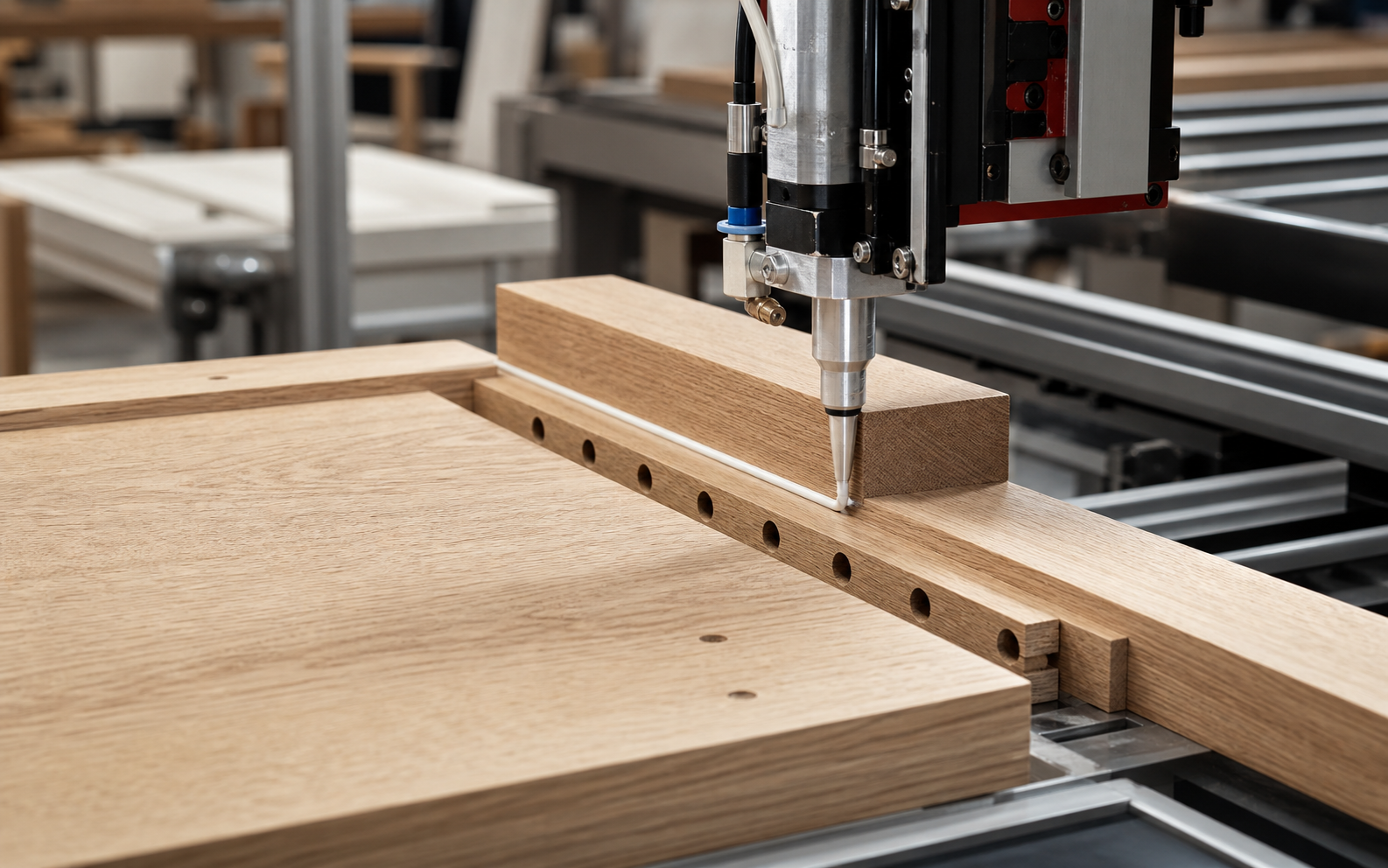
In the water-based system, the adhesive is applied as a controlled film between two surfaces. As the water moves away from the surface, the polymer particles come closer together and a bond film develops. Therefore, surface absorbency, ambient temperature, relative humidity, application amount and pressing time are the main determinants of performance. Drying may be slower if the surface is too closed; If it is very absorbent, the open time of the glue and the effective film thickness may vary.
Water-based products should not be treated in the same way as solvent-based or hot melt systems. Application speed, open waiting time, press pressure and moisture balance are different. For current technical values, the dispersion adhesives page and the relevant TDS should be examined.
How does it form a bond?
- The surfaces are cleaned, measured and sanded if necessary.
- Water-based glue is applied homogeneously to the surface.
- The second surface is combined within the open time of the product.
- Contact with press or pressure is provided.
- As water moves away, film strength improves; Final strength may require waiting depending on product and application.
On absorbent wooden surfaces, some of the water may pass to the substrate. On film, foil or closed surfaces, evaporation occurs mostly from the edges and the junction line. For this reason, the same product may require different pressing times and weights in different materials.
Where is water-based glue used?
| Application | Important target | Checkpoint |
|---|---|---|
| Wood and furniture | Panel, solid piece and assembly connection | Wood moisture, surface smoothness and pressing |
| Paper and cardboard | Folding, lamination and box applications | Absorbency, line speed and wrinkling |
| Textile | Coating, lamination and nonwoven bonding | flexibility, film formation and surface feel |
| Membrane pressing | PVC film and shaped panel coating | Drying, activation, vacuum and press time |
Drying and pressing criteria
"Fast drying" in water-based glue is not just about increasing the ambient temperature. Air movement, relative humidity, absorbency of the surface, film thickness and open waiting time of the parts are evaluated together. Over-application may prolong drying time; Too little application may prevent the formation of a continuous and sufficient bond film.
- Keep surfaces free of dust, oil and loose fibers.
- Keep the product within the application amount specified in the TDS.
- Monitor open time and tack window before assembly.
- By sample testing press pressure and time Determine.
- Protect the dried product from freezing, extreme temperatures and direct sun.
Questions to ask when choosing a product
Are the surfaces absorbent or closed? Will the connection work indoors or outdoors? Is transparency, flexibility or water resistance required? What is the line speed and press capacity? Is the product single component, is additional hardener required? It is not right to just search for "the strongest water-based glue" without answering these questions.
Koçak Endüstri You can compare the product family according to the application purpose through the product catalog and technical information center and convey your sample conditions to the technical team.
What is Water Based Glue? Where is it used? PVAc and Dispersion Guide hakkında merak edilenler
How long does it take for water-based glue to dry?
Duration; It depends on product formulation, application amount, surface absorbency, temperature, relative humidity, air movement and press conditions. Instead of giving a single time period, product TDS and actual part testing should be used.
Can water-based glue be used on wood?
Yes, PVAc and suitable dispersions are widely used in wood and furniture applications. Wood moisture, surface preparation, press pressure and waiting time determine the performance of the product.
Is water-based glue water resistant?
Not every water-based product is in the same strength class. Water resistance varies depending on the chemical structure of the product, the crosslinker, if any, and the relevant standard; The current TDS and classification should be checked.
Technical resources and verification
The content has been prepared in Turkish with the technical experience of Koçak Endüstri, based on the following manufacturer resources.
Let's choose the right adhesive for your application together
You can get technical guidance and offers for Jowat products by sharing your machine, material and consumption information.
Get a technical quote

