

Application Methods in Water Based Dispersion: Applying, Spraying, Rollers and Choosing the Right Method
Application method in water-based dispersion adhesives (PVAc, EVA dispersions, acrylic emulsions); It is selected according to the geometry of the part, production line speed, targeted grammage thickness (g/m²) and rheological viscosity character of the glue. 'Roller Coater' method, which leaves a homogeneous film on wide and flat sheets (wood panel, lamination); Non-contact high-speed 'Nozzle / Extrusion' method in packaging and case folding (folder-gluer) lines; On uneven or 3D surfaces, the 'Spray' method is preferred. Not every water-based glue can be applied by every method; Viscosity and shear thinning must be fully compatible with the mechanical equipment.
water-based dispersion adhesives (PVAc glues and synthetic emulsions) widely used in furniture, paper packaging, corrugated cardboard, printing and textile industries; It stands out with its environmentally friendly structure, solvent-free content and high final bond strength. However, most of the complaints about inadequate adhesion, glue overflow, long drying time or line pollution in businesses are caused not by the chemical quality of the adhesive, but by incorrect application method and mechanical equipment incompatibility .
Not every dispersion can be applied by every method. A low viscosity spray glue splashes and foams on the roller; A high viscosity solid wood glue does not flow from the nozzle and locks the pump. As Koçak Endüstri, we offer process-specific mechanical application consultancy for your facilities with Mayer Glue water-based series and Jowat dispersion adhesives .
The importance of the correct application method in dispersion glues
Adhesion in water-based adhesives depends on the absorption of water by the porous material fibers and evaporation and coalescence of the polymer particles. If the thickness of the applied glue film cannot be controlled at the micron level; Too much glue applied slows down the line by delaying drying, while too little glue leaves an insufficient film, causing dry adhesion.
Three basic methods: Roller, Nozzle and Spray
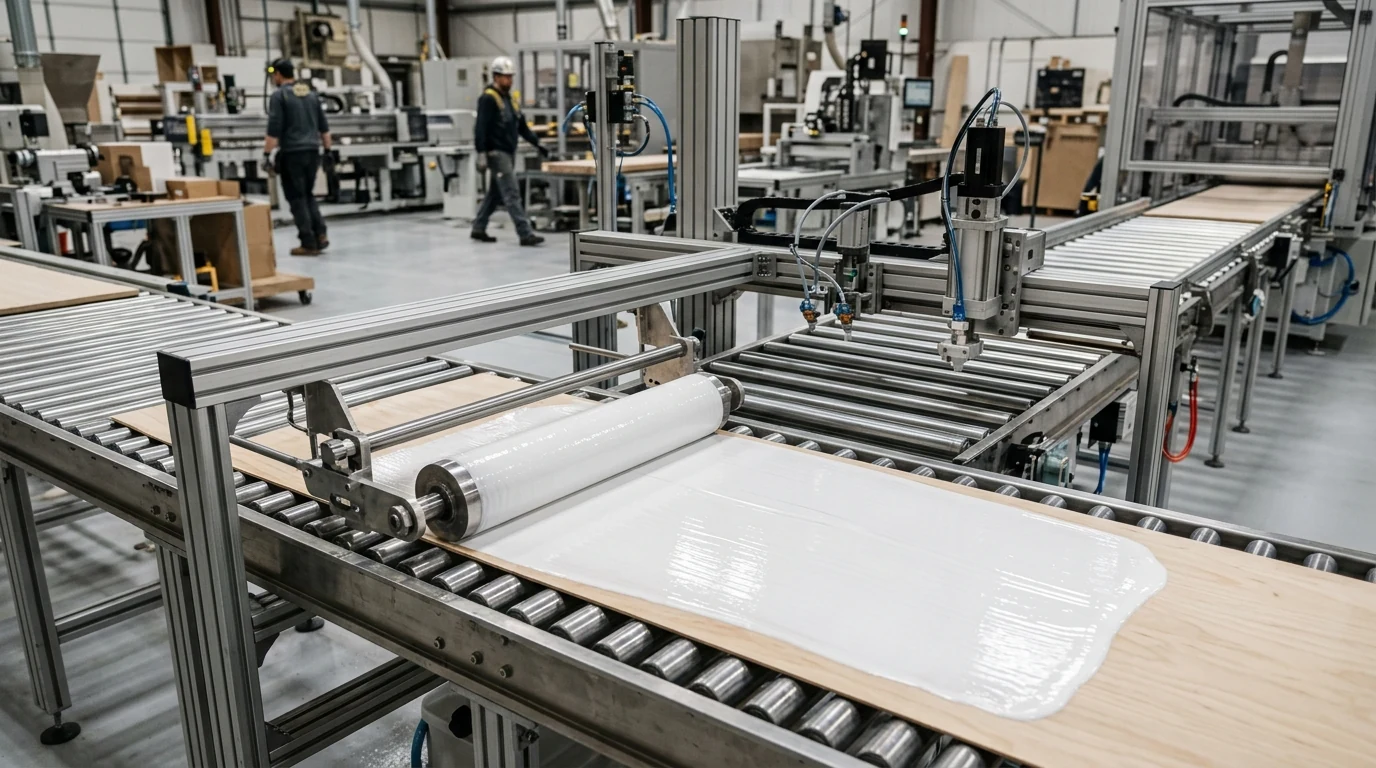
- 1. Roller Coater: It is the transfer of a continuous liquid glue film to the panel surface by rotating rubber or steel rollers. Flat sheet lamination is the most efficient way to distribute equal weight over large surfaces in parquet production and plywood pressing.
- 2. Nozzle Extrusion: It is the discharge of the glue pressurized by a piston or diaphragm pump as a line, dashed line or point from contact or non-contact nozzle heads. It is used in box folding (folder-gluer), paper bag bottom gluing and parcel flaps.
- 3. Spray Application: Sprinkling the glue on the surface as a micronized mist cloud with compressed air (air-assisted atomization) or high hydraulic pressure (airless). It provides a homogeneous thin film on surfaces with profile details or sponge/bed bonding.
Application methods technical comparison matrix
| High precision (with doctor roller) | Solid wood panel pressing, door surface bonding | ________Millimetric line and dot control | Folder-gluer cardboard box, envelope, paper bag | ________ (Fogging risk)Flooring sponge, technical textile, panel insulation | ________ Point milliliter dosageCNC in-hole dowel pin fixing (e.g. Mayer MT-WB 440) |
Balance of viscosity, solids and shear stress
Dispersion adhesives are thixotropic or shear-thinning fluids. As they pass through the pump or through the narrow nozzle hole, their viscosity drops momentarily due to friction; When they reach the surface, they thicken again and stop flowing. If incorrect viscosity is selected:
- The glue foams or clumps under high shear in the roller chamber.
- Contaminates the packaging box by dripping or splashing at the nozzle tip.
- It does not spread homogeneously by forming cobwebbing when sprayed.
Scaling and nozzle cleaning in water-based lines
The biggest process risk of water-based adhesives is that water evaporates at the points in contact with air and forms an elastic polymer skin (skinning) on the surface. Between shifts, the nozzle tips should be covered with a damp cloth or protective cover; Pipes and pump lines should be washed periodically with warm water. Hardened PVAc residues should be softened with suitable cleaners rather than mechanical scraping.
Mayer and Jowat water-based dispersion products
Koçak Endüstri product range includes Mayer MT-WB 400 D3 Monocomponent (solid panel joining), MT-WB 430 Packaging (folder-gluer packaging lines) and MT-WB 440 Dowel Products with special viscosities such as (high speed CNC dowel injection) are optimized for the respective mechanical application method.
Stock and technical support
You can contact our Koçak Endüstri technical team to determine the most suitable water-based adhesive viscosity for your roller, nozzle or spray system in your production line and to perform sample tests.
Application Methods in Water Based Dispersion: Applying, Spraying, Rollers and Choosing the Right Method hakkında merak edilenler
Can any water-based glue be sprayed?
No. High viscosity glues will clog the gun or become fibrous like a spider web; Spraying requires special modified dispersions below 1,500 mPa·s.
What causes foaming in roller gluing?
It is caused by mechanical shear stress trapping air in the glue as a result of excessively fast rotation of the roller; Dispersions with antifoam should be selected.
Why does the glue line cut when applied with a nozzle?
Interruptions occur due to high glue viscosity, insufficient pump pressure, or dried glue crust accumulation at the nozzle tip.
Why does Mayer MT-WB 440 Dowel have such a low viscosity?
In CNC dowel machines, a fluid of around 300 mPa·s is produced so that the glue is sprayed from the gun through high-pressure micronized holes within milliseconds and penetrates into the hole.
Technical resources and verification
The content has been prepared in Turkish with the technical experience of Koçak Endüstri, based on the following manufacturer resources.
Let's choose the right adhesive for your application together
You can get technical guidance and offers for Jowat products by sharing your machine, material and consumption information.
Get a technical quote

