


EVA and POE Encapsulation in Photovoltaic Modules: Mitigating PID and Delamination Risks
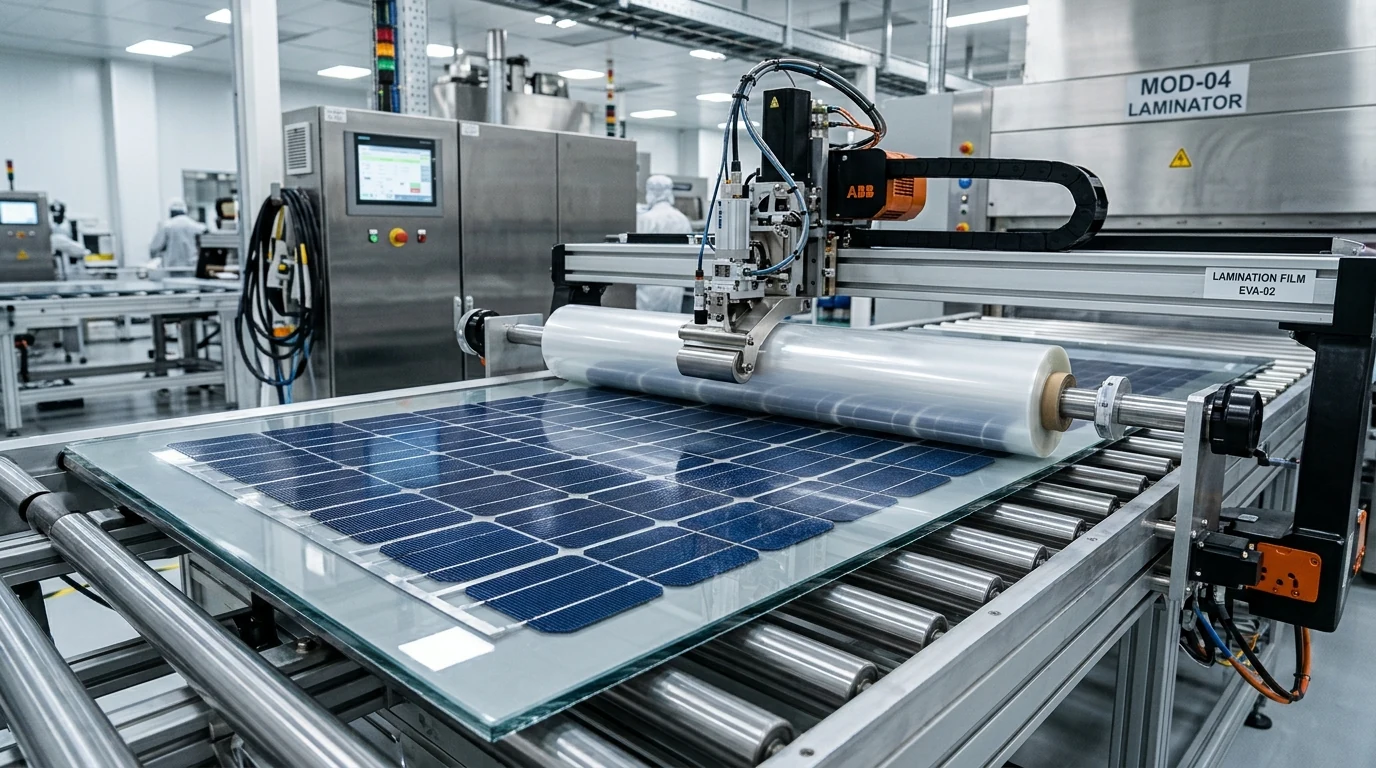
In photovoltaic (PV) module manufacturing, solar cells are hermetically encapsulated between front glass and backsheet using cross-linkable polymeric films. While traditional Ethylene Vinyl Acetate (EVA) has been the industry standard for p-type PERC modules due to optical transparency (>91%) and lower cost, next-generation n-type TOPCon and Heterojunction (HJT) bifacial glass-glass panels strictly mandate Polyolefin Elastomer (POE) or co-extruded EPE (EVA/POE/EVA) films. POE features a water vapor transmission rate (WVTR < 0.5 g/m²·day) that is 30 times lower than EVA, releases zero acetic acid upon hydrolysis, and exhibits ultra-high volume resistivity (10¹⁶ Ω·cm) to completely prevent Potential-Induced Degradation (PID) and corrosion of silver busbars. Achieving an optimal cross-linking gel content (80–88%) during the 140°C–150°C vacuum lamination cycle alongside high-grade silicone edge sealing ensures 25-to-30-year lifetime reliability under IEC 61215 and IEC 61730 standards.
As the global solar industry transitions rapidly to high-efficiency n-type TOPCon and HJT cell architectures, long-term 25-to-30-year warranty performance hinges directly on encapsulation engineering. Protecting fragile silicon cells from moisture, thermal cycling, and wind load requires rigorous polymer formulation. Inadequate cross-linking or inferior materials lead to yellowing, acetic acid corrosion, edge delamination, and fatal Potential-Induced Degradation (PID). This technical guide explores EVA and POE encapsulation films, lamination kinematics, and IEC 61215 compliance.
1. Critical Role of Solar Encapsulation in 25-Year Reliability
Operating under extremes ranging from desert UV heat (+85°C panel temperatures) to sub-zero blizzards (-40°C), solar modules require encapsulants to deliver optical clarity (>91% transmission), dielectric insulation (up to 1500V DC), mechanical cushioning against cell micro-cracks, and an impermeable moisture barrier.
2. Comparative Chemical Analysis: EVA vs. POE vs. EPE
While EVA remains viable for single-glass p-PERC, POE and EPE dominate n-type bifacial panels due to zero acetic acid byproduct and dramatically lower moisture vapor permeability (WVTR < 0.5 vs. 30 g/m²·day).
3. Potential-Induced Degradation (PID): Sodium Drift and Acetic Acid Corrosion
In 1500V system arrays, electrostatic voltage drives Na⁺ ions from the glass into the silicon p-n junction, causing catastrophic shunt resistance drops. POE's non-polar molecular structure and 10¹⁶ Ω·cm volume resistivity physically halt sodium migration, ensuring under 1% degradation in 192-hour damp-heat PID stress tests.
4. Vacuum Lamination Parameters: Temperature, Cycle, and Gel Content
Optimal vacuum lamination at 142°C–148°C activates peroxide thermal initiators, establishing a 3D polymer cross-linked network. Soxhlet toluene extraction must confirm gel content between 80% and 88%; under-curing causes hot-spot creep, while over-curing induces brittle stress cracking.
5. Edge Delamination Prevention: Butyl and Silicone Sealant Integration
Glass-glass edges require primary polyisobutylene (PIB) butyl moisture barriers combined with neutral-cure RTV silicone or 1K reactive polyurethane frame sealants (Mayer/Jowat) to absorb mechanical wind load and eliminate water pooling.
6. Koçak Endüstri Solar PV Chemical Solutions
Koçak Endüstri supplies certified frame sealants, junction box potting resins, and vacuum lamination process engineering support to photovoltaic manufacturers across Eurasia.
EVA and POE Encapsulation in Photovoltaic Modules: Mitigating PID and Delamination Risks hakkında merak edilenler
Why does EVA encapsulant turn brown over time?
Thermal degradation of vinyl acetate under intense UV combined with moisture breakdown releases acetic acid, which autocatalyzes chromophore formation and browning, degrading power yield.
Why is POE mandatory for n-type TOPCon panels?
TOPCon front-side passivation layers are exceptionally sensitive to moisture and acidic corrosion. POE's near-zero WVTR and absence of acid byproduct protect cell efficiency.
What is the acceptable gel content for solar module lamination?
Between 80% and 88% gel content measured via ASTM D2765 Soxhlet extraction ensures long-term thermo-mechanical stability.
How can module manufacturers eliminate air voids during lamination?
Maintaining vacuum levels below 1.0 mbar for at least 3-4 minutes before diaphragm pressurization guarantees complete volatile degassing.
Technical resources and verification
The content has been prepared in Turkish with the technical experience of Koçak Endüstri, based on the following manufacturer resources.
Let's choose the right adhesive for your application together
You can get technical guidance and offers for Jowat products by sharing your machine, material and consumption information.
Get a technical quote

