

What is PUR Glue? Where is it used? Reactive Polyurethane Guide
PUR glue is a polyurethane-based high-performance adhesive system that can cure by reacting with moisture. When reactive PUR is used as hot melt, initial adhesion begins with cooling, and then cross-linking develops with ambient humidity. It is used in edge banding, profile covering, lamination, furniture and industrial applications where moisture/heat resistance is critical.
PUR glue is a polyurethane based adhesive that can improve its bond by reacting with moisture after application. In industry, reactive PUR can be applied hot in the form of hot melt or used as a liquid system in different formulations. In this article, the reactive PUR approach used especially in furniture, edge banding, profile coating and lamination lines is explained.
What is PUR glue?
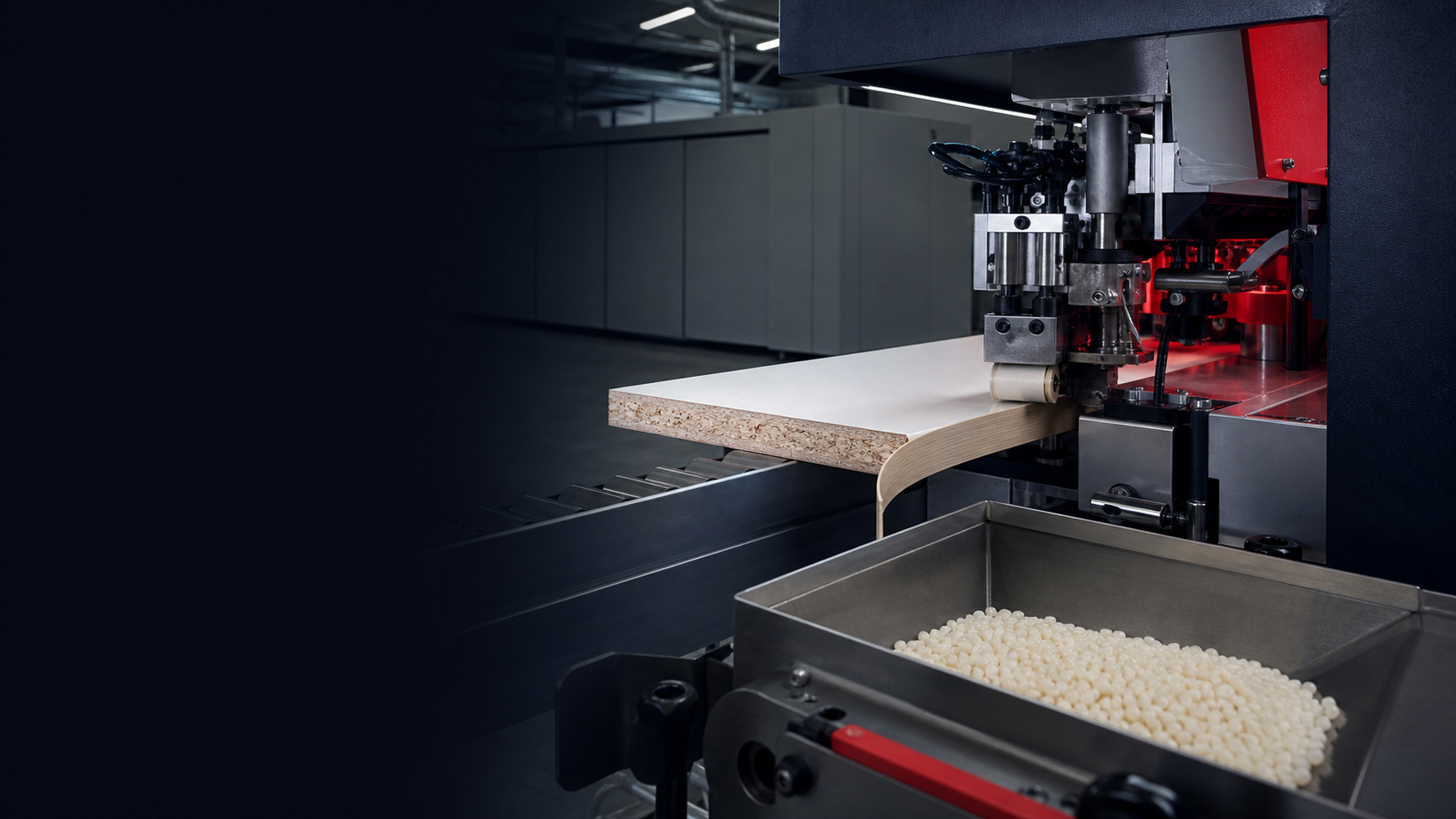
PUR hot melt is first heated and fluidized and applied to the surface in a controlled manner. Cooling ensures rapid initial adhesion. Then, the reactive groups of the product react with ambient moisture and form a cross-linked structure that can provide higher ultimate strength. For this reason, the initial part retention and final service performance of PUR products should not be evaluated in the same time period.
This technology does not mean “the best glue for all conditions”. Keeping the equipment free of exposed product, moisture management, correct temperature, proper cleaning and product replacement are critical. technical information center and TDS/SDS documents should be used according to the current product code and machine conditions.
How does PUR cure?
- The product is fluidized in the tank, hose or nozzle system at a temperature suitable for TDS.
- It is transferred to the surfaces as a controlled film and the part is pressed.
- The first mechanical adhesion occurs with cooling.
- Reaction with ambient humidity progresses and the ultimate strength develops.
- The required curing time and test method for the actual service condition of the product are verified from the manufacturer's document.
Curing behavior may slow down in closed and very dry environments; Excessive moisture may cause problems in terms of surface, foaming or process safety. The storage and unpacking procedure for PUR systems differs from the standard EVA hot melt approach.
Where is PUR glue used?
- Furniture applications where edge banding and especially low visible joints are expected.
- Coating of PVC, ABS, melamine, acrylic and wooden profiles.
- Panel, film and decorative surface lamination.
- Premium furniture and industrial applications where moisture, temperature or chemical exposure are important products.
- Productions requiring fast and thin adhesion line in suitable machine and surface combinations.
Difference between PUR and EVA
| Criteria | PUR | EVA |
|---|---|---|
| Bond formation | Cooling followed by reaction with moisture | Basic cooling and physical solidification |
| Ultimate strength | Potential for high heat/humidity performance under suitable conditions | General purpose performance dependent on product and application |
| Process accuracy | Moisture, exposure and equipment cleanliness more critical | Generally easier commissioning and cleaning |
| Selection approach | Evaluated if there is a difficult service and thin joint target | Evaluated in economical, fast and standard applications |
equipment and process control
Cured product remaining in thePUR-powered tank, hose, nozzle and application head may lead to equipment failure and contamination in subsequent production. Cleaning before and after product replacement should be planned according to manufacturer procedure. Moisture absorption from exposed packaging may also change product behavior.
- Open packaging according to manufacturer's instructions and protect unused product from moisture.
- Monitor temperatures not only for flow but also for color and heat stability.
- Verify cleaning procedure and cleaning agent used at machine change.
- Measure initial adhesion, post-cure peeling, heat and moisture resistance on the real sample.
Koçak Endüstri can evaluate reactive hot melt solutions, Jowat products and technical offer support together with your application conditions.
What is PUR Glue? Where is it used? Reactive Polyurethane Guide hakkında merak edilenler
Is PUR glue water resistant?
High water and moisture resistance can be achieved under appropriate formulation and correct curing conditions. However, not all PUR products are in the same class; should be based on product TDS, application surface and actual service testing.
Why does PUR glue harden in the machine?
The product may have come into contact with moisture, the waiting time in the equipment may have been extended, or the cleaning procedure may not have been performed. Moisture management, closed system and manufacturer cleaning procedure should be checked.
Can PUR glue be used instead of EVA?
In some applications yes, but machine compatibility, substrate, belt, cure time and cleaning system must be verified. Switching to PUR is not just a product change, but a process and maintenance procedure change.
Technical resources and verification
The content has been prepared in Turkish with the technical experience of Koçak Endüstri, based on the following manufacturer resources.
Let's choose the right adhesive for your application together
You can get technical guidance and offers for Jowat products by sharing your machine, material and consumption information.
Get a technical quote

