



Anti-Slip Palletizing Hot Melt in Logistics: Preventing Load Collapse and Cutting Stretch Film by 60%
In automated logistics and freight transportation, anti-slip palletizing hot melt adhesives eliminate load shifting, box slippage, and pallet collapse by balancing high shear strength with low peel force. Applied in micro-dots or beads onto corrugated cartons, multi-wall paper sacks, or shrink-wrapped goods, the adhesive locks stacked layers horizontally against dynamic transit forces (vibrations, sharp turns, emergency braking) while permitting vertical depalletizing with zero paper tear or package defacement. Integrating anti-slip hot melt reduces stretch film consumption by 50% to 70%, eliminates the need for expensive edge protectors, and drastically cuts plastic packaging taxes under EU PPWR regulations. Operating at 140°C–160°C, Jowat® palletizing adhesives offer superior thermal stability, clean cut-off, and 100% repulpability in recycling mills.
In industrial warehousing and intermodal freight transport, load shifting and pallet collapse remain among the costliest sources of product write-offs, warehouse accidents, and customer disputes. To prevent cartons from sliding during forklift transit or container shipping, manufacturers traditionally resort to heavy layers of plastic stretch wrap, PET strapping, and corner boards—exponentially driving up packaging costs and corporate plastic footprint. Anti-Slip (Palletizing) Hot Melt Adhesive Technology applies microscopic adhesive beads directly between stacked units, creating a rigid interlocking load horizontally while allowing seamless vertical release without tearing packaging graphics. This technical engineering paper examines rheological adhesive design, line integration parameters, and verified methodologies to cut stretch wrap usage by up to 60%.
1. Working Mechanism of Anti-Slip Hot Melts: Shear Resistance vs. Peel Strength
Unlike standard case-sealing adhesives formulated to penetrate cellulose fibers and create permanent destructive bonds (fiber-tear), palletizing adhesives require a unique dual-function rheological profile:
- High Dynamic Shear Resistance: When subjected to lateral acceleration during truck braking, rail shunting, or vessel roll, the adhesive matrix prevents adjacent cartons from slipping laterally. The pallet behaves as a solid monolithic block.
- Low Vertical Peel Resistance: When depalletizing manually or via automated vacuum grippers at the customer destination, upward lifting encounters negligible resistance, separating cleanly without surface delamination.
- Zero Surface Stickiness After Separation: The adhesive film remains non-tacky upon release, preventing cartons from sticking to conveyors or accumulating airborne warehouse dust.
2. Slashing Stretch Wrap by 60%: Cost, Carbon Footprint, and ESG Impact
Securing a standard 800–1,000 kg pallet load conventionally consumes 400 to 600 grams of LLDPE stretch film (18–25 wraps). When anti-slip hot melt handles structural stabilization, stretch film is reduced to a light dust/rain cover of only 3–5 wraps (120–180 grams), saving over 60% of plastic raw material per pallet.
| Operational Metric | Traditional Heavy Stretch Wrapping | Anti-Slip Hot Melt + Lightweight Wrap |
|---|---|---|
| Plastic Film per Pallet | 450 – 600 g | 120 – 180 g (60–70% reduction) |
| Hot Melt Consumption | 0 g | 2.0 – 4.0 g (Micro-dot deposition) |
| Cardboard Corner Protectors | Mandatory for heavy loads | Completely eliminated in most lines |
| In-Transit Damage Claims | 2.0% – 4.0% average | < 0.05% (Near-zero load displacement) |
| EU PPWR & EPR Tax Exposure | High plastic packaging tax penalties | Complies with 2030 packaging waste mandates |
3. Application Technologies: Automated Electric Guns, Bead and Micro-Dot Dispensing
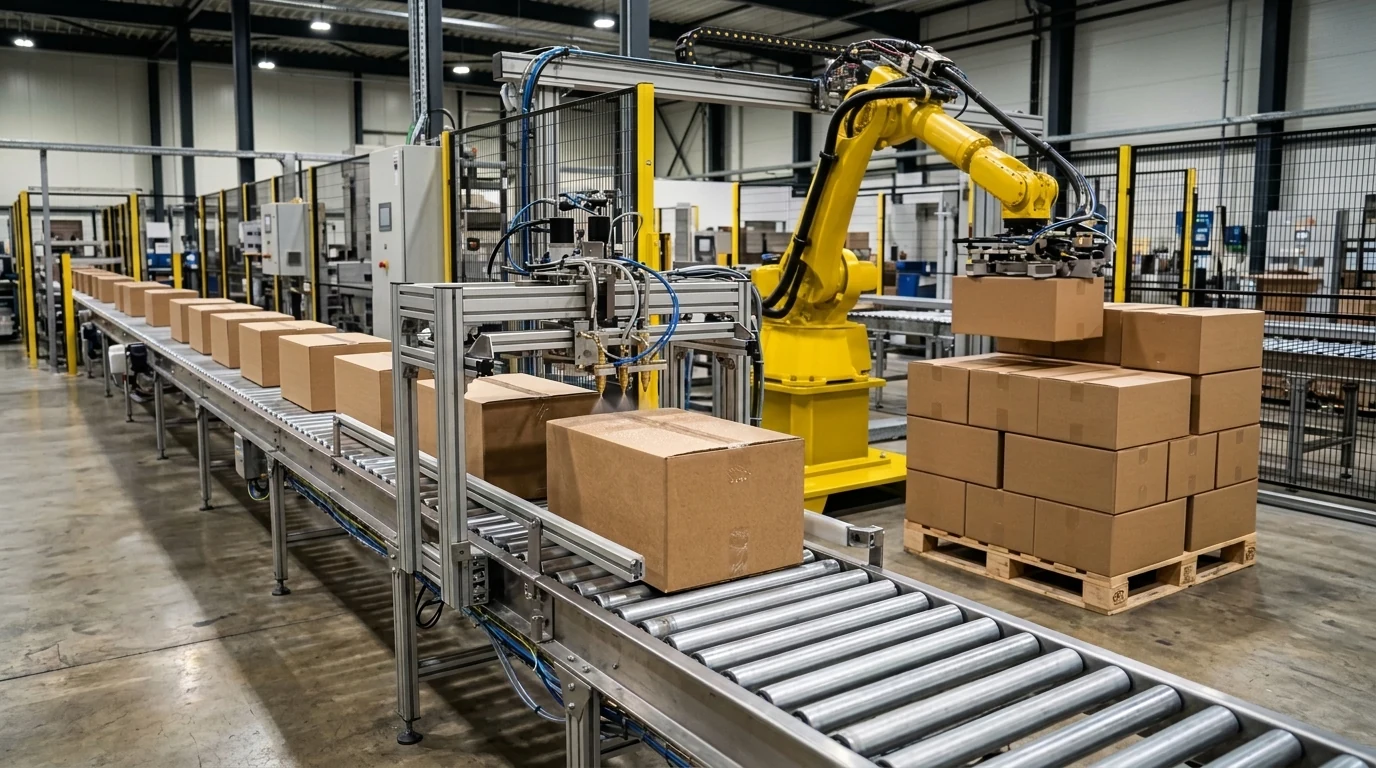
Integrated seamlessly on the outfeed conveyor prior to robotic palletizers, high-speed dispensing nozzles apply precise adhesive shots without slowing line speed:
- Micro-Dot Deposition: Applying 2 to 4 dots (0.05–0.10 g each) on the upper carton flaps. Best practice for corrugated cardboard RSC cases.
- Continuous Bead Line: Applied parallel to the seams of multi-wall kraft paper valve bags (flour, cement, minerals) to eliminate slippery bag-on-bag sliding.
- Swirl / Spray Pattern: Used on shrink-wrapped multipacks (PET beverage bottles) to distribute holding force across delicate PE films without burn-through.
4. Zero Packaging Defacement: Preventing Carton Fiber-Tear and Barcode Damage
A frequent mistake in logistics optimization is attempting to use diluted standard packaging hot melt. Because standard EVA adhesives penetrate deeply, depalletizing rips high-gloss graphics and obscures scannable EAN/UPC barcodes, triggering retail chargebacks. Formulated Jowat® palletizing polymers remain on the outer paper crests, forming a frictional brake rather than a structural weld.
5. Critical Process Parameters: 140°C–160°C Temperature and Adhesive Mileage
Precision control of hot melt dispensing parameters guarantees trouble-free 24/7 operation:
- Operating Temperature (140°C – 160°C): Formulated with antioxidant stabilizers to eliminate nozzle charring, nozzle clogging, and stringing.
- Extended Open Time: The adhesive remains receptive during the 5–30 second transfer window from conveyor application to robotic pallet placement.
- High Mileage Yield: At 0.25 g per case, a single 25 kg bag of Jowat® palletizing hot melt securely stabilizes up to 100,000 cartons.
6. Circular Economy & EU PPWR Packaging Regulation Compliance
The European Packaging and Packaging Waste Regulation (PPWR) enforces dramatic reductions in commercial secondary plastic packaging. Anti-slip hot melt addresses plastic reduction at the source. Furthermore, our formulations are water-dispersible and certified repulpable during recycling cycles without creating sticky polymer contaminants.
7. Koçak Endüstri Technical Support, Dispensing Systems, and Tilt Testing
Koçak Endüstri supplies cutting-edge Jowat® palletizing adhesives and retrofittable automated hot melt dispensing equipment throughout the industrial market. Our field service engineers conduct on-site dynamic Tilt Tests (inclining palletized loads to 25°–35° angles without stretch film) to scientifically validate load stability before full commercial roll-out.
Anti-Slip Palletizing Hot Melt in Logistics: Preventing Load Collapse and Cutting Stretch Film by 60% hakkında merak edilenler
Will anti-slip hot melt damage carton print or barcodes upon depalletizing?
No. Jowat® anti-slip hot melts are specifically engineered with low peel adhesion. When a box is lifted vertically, it releases cleanly without pulling paper fibers or defacing printed barcodes.
Can anti-slip hot melt completely replace stretch wrap?
For internal intra-facility transfers, stretch film can be 100% eliminated. For open-road freight, stretch film is reduced to a minimal dust/moisture cover of 2–3 wraps, achieving 60%+ plastic savings.
How many boxes can be palletized with 1 kg of adhesive?
With calibrated micro-dot application (0.2 to 0.3 grams per box), 1 kg of adhesive securely stabilizes between 3,500 and 5,000 cartons.
Does it work on slippery multi-wall paper and plastic sacks?
Yes. Specialized grades provide superior anti-skid friction on glossy PE sacks, multi-wall valve paper bags (cement, flour, chemical resins), and shrink-wrapped bundles.
Technical resources and verification
The content has been prepared in Turkish with the technical experience of Koçak Endüstri, based on the following manufacturer resources.
Let's choose the right adhesive for your application together
You can get technical guidance and offers for Jowat products by sharing your machine, material and consumption information.
Get a technical quote

