


Protein Gelatin Jelly Glue in Luxury Rigid Box and Case Making: Viscosity and Brix Control Guide
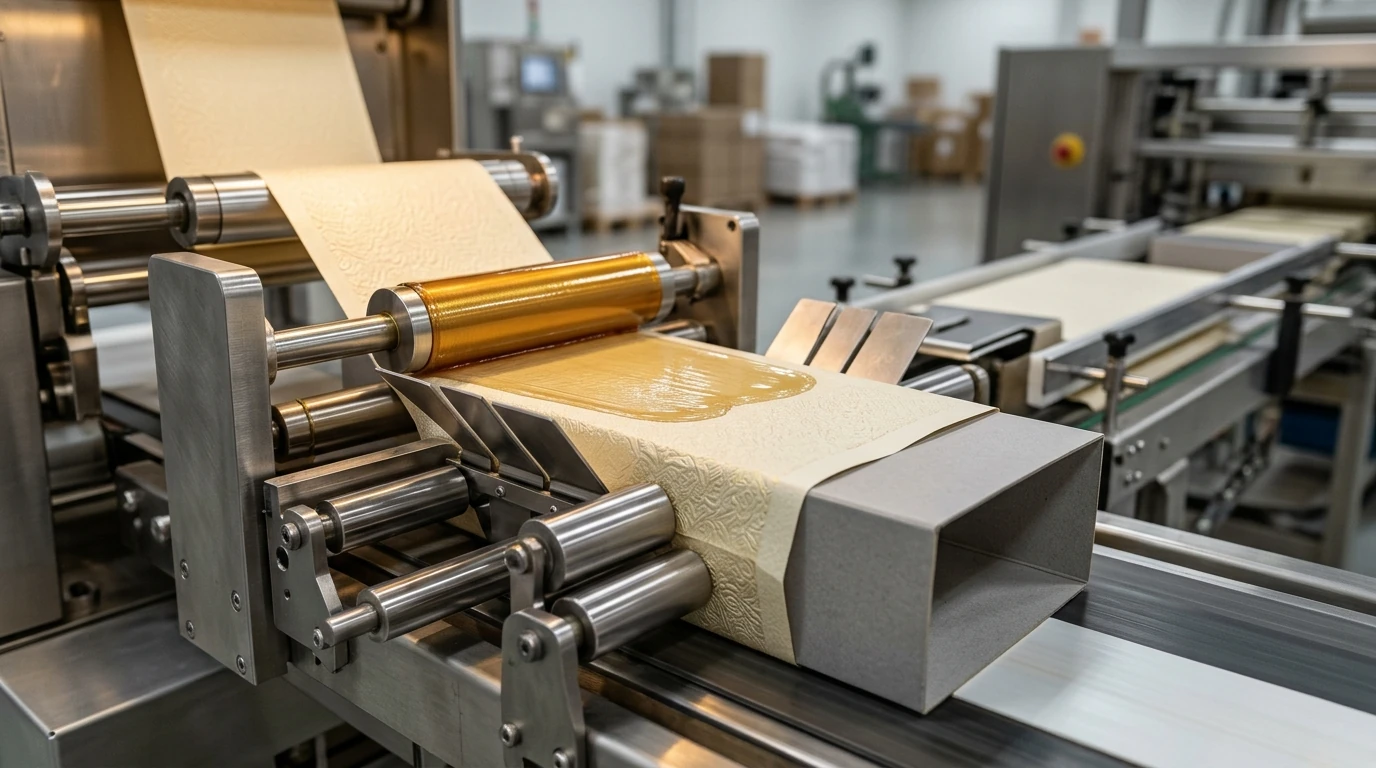
In automated luxury rigid box manufacturing, hard cover bookbinding, and case making operations, animal protein gelatin glues (jelly glues) are unmatched due to their thermo-reversible gelling, instant green tack, and exceptional anti-warping (lay-flat) behavior. In automated machines (e.g., Emmeci, Kolbus), optimal operating temperature must be maintained strictly between 60°C and 65°C, with viscosity controlled via an optical refractometer at 55% to 65% Brix solid concentration. Diluting below 50% Brix introduces excess water, causing prolonged drying, board distortion (warping), and mold vulnerability; exceeding 68% Brix leads to premature gelling on rollers, stringing, and open-time starvation resulting in bond failure. Protein adhesives are 100% biodegradable, virtually odorless, non-toxic, and fully compliant with circular economy regulations.
In high-end luxury packaging for perfumes, cosmetics, jewelry, and consumer electronics, maintaining perfect board flatness (lay-flat) and zero corner spring-back is the ultimate benchmark of structural quality. While synthetic water-based PVA adhesives introduce excess moisture that causes paper fibers to swell and warp the underlying greyboard, animal protein gelatin adhesives (jelly glues) provide rapid, moisture-controlled bonding through thermo-reversible phase change. This technical engineering guide details the rheological behavior of protein jelly glues, refractometric Brix viscosity management, 60°C–65°C thermal control, and production optimization on high-speed automated box wrapping machines.
1. Protein Gelatin Chemistry and Thermo-Reversible Gelling Mechanism
Protein jelly glues are formulated from the controlled thermal hydrolysis of natural collagen. Unlike solvent- or dispersion-based glues that require water evaporation to set, gelatin glue sets via a physical phase transition: fluid when hot, rapidly forming an elastic gel matrix as temperature drops below 55°C–50°C upon roller transfer onto room-temperature paper and greyboard.
- Instant Green Tack: Forms a high-tenacity gel bond within 2–5 seconds, preventing wrapped edges and corners from opening up during folding cycles.
- Bound Moisture Matrix: Water molecules are tightly bound within the gelatin triple-helix protein network, preventing free water from migrating into the porous paperboard and causing dimensional distortion.
- Flexible Glue Line: Retains elasticity over time, eliminating joint cracking along box hinge grooves and folded corners.
2. Jelly Glue vs. Water-Based PVA: Warping Tendency and Open Time Analysis
The comparative engineering differences between hot gelatin glues and room-temperature synthetic PVA dispersions are presented below:
| Operational Parameter | Hot Protein Gelatin Glue | Water-Based PVA Dispersion |
|---|---|---|
| Setting Mechanism | Physical thermo-reversible gelling upon cooling (1–4 sec) | Water evaporation and substrate absorption (15–60 sec) |
| Board Warping Risk | Virtually zero (Anti-warp lay-flat characteristic) | Severe curling and bending due to moisture penetration |
| Open Time Flexibility | Adjustable via temperature and machine speed (3–15 sec) | Highly sensitive to ambient room humidity |
| De-inking & Recyclability | 100% Water-soluble, repulpable without clogging filters | Polymer micro-stickies contaminate recycled paper pulp |
| Ecological Profile | Natural, renewable, biodegradable protein source | Petrochemical synthetic polymer |
3. Critical Process Parameters: 60°C–65°C Operating Temperature and Brix Range
Consistent performance on automated box wrapping lines (e.g., Emmeci, Kolbus, Europrogetti) requires precise control of two core variables:
1. Temperature Window (60°C – 65°C): The glue reservoir and applicator roller must be maintained within 60°C–65°C. Temperatures below 58°C cause premature skinning and uneven transfer. Temperatures above 70°C irreversibly degrade (denature) protein chains, leading to loss of cohesive strength, darkening of color, and foul odors.
2. Refractive Solid Concentration (55% – 65% Brix): Water continuously evaporates from the open roller bath during continuous operation. Uncontrolled evaporation increases solid content, requiring disciplined periodic water replenishment.
4. Refractometer Brix Measurement and Warm Water Dilution Rules
Operators must never rely on subjective visual inspections. Use a calibrated handheld or digital optical refractometer (0–80% Brix range):
- Sampling: Take a small drop of hot adhesive directly from the applicator roller using a clean spatula.
- Thermal Stabilization: Close the prism cover and wait 5–10 seconds for temperature compensation before reading.
- Dilution Protocol: If reading exceeds 64% Brix, slowly introduce clean preheated warm water (55°C–60°C) while running the mixer. Never add cold water directly, as it causes localized gel clotting and viscosity shock.
5. Automated Rigid Box Troubleshooting Guide and Corrective Actions
| Observed Defect | Probable Root Cause | Engineering Corrective Action |
|---|---|---|
| Corner flaps opening after pressing (Spring-back / Flagging) | Glue gelled prior to folding (Open time exceeded) or temp < 58°C | Increase roller temperature to 63°C, raise line speed, or dilute with warm water to 60% Brix. |
| Board warping or bubbling under thin cover paper | Excessive water dilution (< 52% Brix) or heavy coat weight | Restore concentration to 58%–62% Brix; tighten doctor blade gap to reduce glue film thickness. |
| Excessive foaming in roller reservoir | Vigorous mechanical agitation or contaminated dilution water | Adjust circulation pump speed; switch to low-foaming formulated Jowat protein grade. |
| Glue bleeding or staining through embossed art paper | Porous decorative paper coupled with overly low viscosity | Operate at higher solid concentration (62%–64% Brix) to limit capillary absorption. |
6. Sustainability: Biodegradability and Circular Packaging Compliance
Under tightening global packaging waste directives (such as the EU PPWR), luxury brands must prove the circularity of their rigid packaging. Protein jelly glues are water-soluble and effortlessly separate from paper fibers during industrial hydropulping recycling cycles without producing harmful synthetic stickies.
7. Koçak Endüstri & Jowat Protein Glue Solutions and Field Support
Koçak Endüstri supplies premium, de-odorized, high-speed Jowat protein gelatin glues engineered specifically for luxury packaging converters across the region. Our technical field engineers offer on-site machine calibration, refractometric setup, and glue line optimization to eliminate production downtime and maximize box aesthetics.
Protein Gelatin Jelly Glue in Luxury Rigid Box and Case Making: Viscosity and Brix Control Guide hakkında merak edilenler
Why must cold water never be added to a hot gelatin glue pot?
Adding cold tap water causes thermal shock, creating localized gel clumps and severe viscosity spikes that clog circulation pumps and create uneven roller coating.
What is the recommended wet coat weight for luxury box wrapping?
Typical optimal wet glue coat weight ranges between 20 and 35 g/m², depending on paper porosity and greyboard roughness. Excess glue impairs drying and promotes board warping.
Does animal protein glue emit unpleasant odors in cosmetic packaging?
High-grade industrial gelatin glues supplied by Koçak Endüstri undergo refined filtration and deodorization processes; once dried, they are completely odorless and food/cosmetic safe.
How do you recognize thermal denaturation (burned glue)?
A dark burnt color, irreversible viscosity loss despite high solid content, and poor final adhesion indicate broken protein chains. The pot must be drained, thoroughly rinsed, and refilled.
Technical resources and verification
The content has been prepared in Turkish with the technical experience of Koçak Endüstri, based on the following manufacturer resources.
Let's choose the right adhesive for your application together
You can get technical guidance and offers for Jowat products by sharing your machine, material and consumption information.
Get a technical quote

