



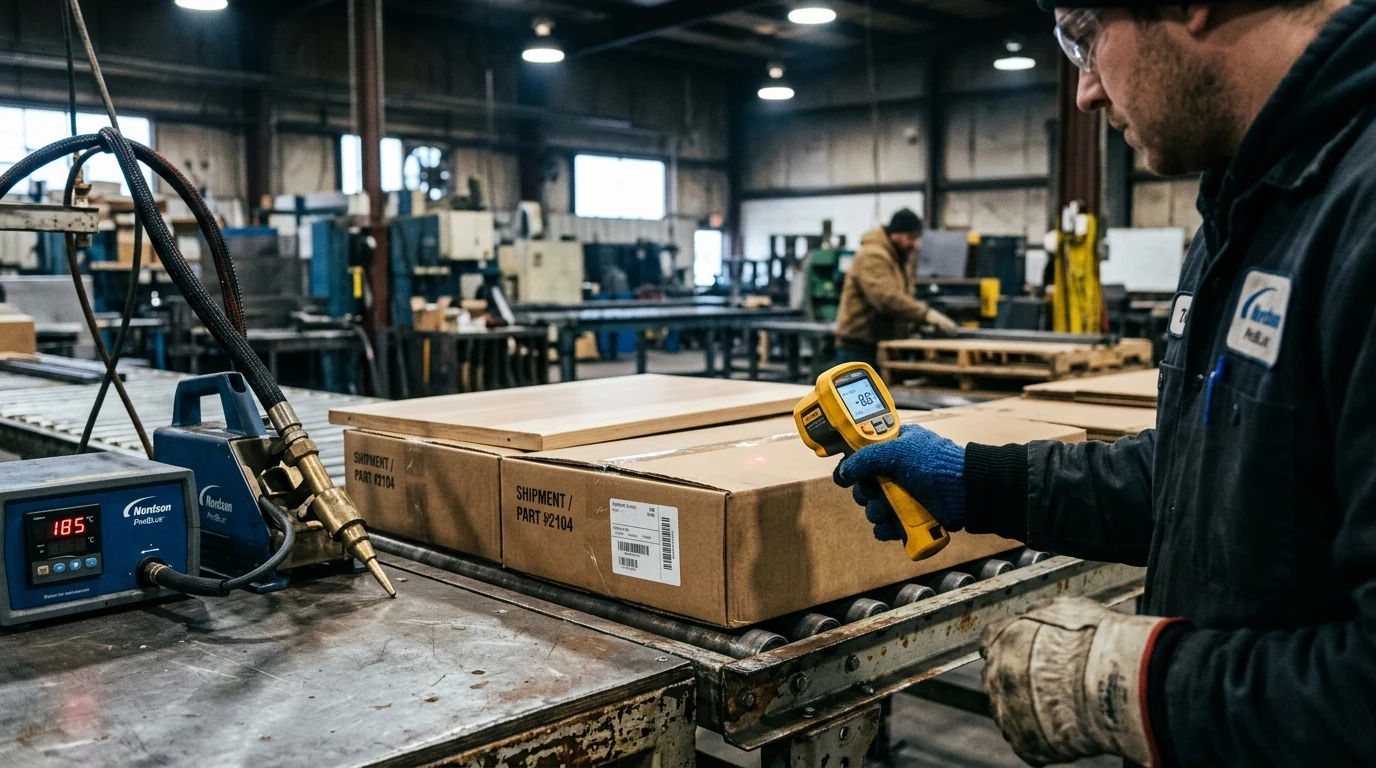
Hotmelt Application Problems and Solutions at Low Ambient Temperature in Winter
During the winter months, when the factory ambient temperature drops below 15°C and the new boxes or MDF panels coming from the warehouse are cold (+5°C to +10°C), the hot glue (160–200°C) freezes within seconds with thermal shock when it touches the surface. Open time is dramatically shortened; The glue crystallizes before wetting the opposing surface and separates with dry contact after pressing, causing 'cold bond' error. The solution is not just to overheat the glue pot; to condition material surfaces, to protect applicator nozzles from air flow and, if necessary, to switch to formulations with longer open time.
Hot glue that works perfectly in the summer in production lines suddenly opens when the winter months come, box covers spontaneously fall off or edge bands break easily. This is one of the most common seasonal malfunctions encountered in industrial facilities. The problem is usually not glue quality; is low factory ambient temperature and cold material surfaces .
The critical distinction here is that it should not be confused with low-temperature “Cool Melt” glue technology; The issue is not the melting degree of the glue, but environmental thermodynamics and thermal conduction . As Koçak Endüstri, we offer seasonal line adjustment and formula optimization with Mayer Glue and Jowat adhesives in order to prevent winter-related quality losses in your facilities.
Thermal shock problem in winter conditions and hotmelt
Hot melt adhesives (EVA and polyolefin) harden with a decrease in temperature during the transition from the liquid phase to the solid phase. When a drop of glue at 180°C is applied to a parcel at 25°C in summer, the temperature difference is ΔT = 155°C. When applied to a parcel at 8°C entering the line from an unheated warehouse in winter, the temperature difference jumps to ΔT = 172°C and the cold cardboard instantly absorbs the heat of the glue like a heat sink.
Shortening of open time and 'cold bond'
A glue with an open time of 5 seconds under normal conditions bonds the surface shell in 1.5–2 seconds under winter conditions. When the box lid is closed or the edge band enters the printing roller, the glue cannot wet the opposite surface (insufficient wetting). The result is a glassy and brittle layer that visually looks like it is stuck, but when pulled with a finger, it separates without tearing the fibers.
The biggest mistake made in the field: Overheating the boiler
| Overflowing the flow rate by excessively increasing the pressure | Glue overflowing outside the packaging and pollution | Increasing the pressure roller pressure and bringing the nozzle closer to the line |
| Immediately taking the pallet from the cold storage to the line | Ice-cold panels shocking the glue | Keeping the materials in the production hall for at least 24 hours in advance |
5-item line precaution list for winter months
- Material Acclimatization: Boxes, cardboard and wooden panels should be kept in an environment of at least 18°C in the production hall for 24 hours to balance their internal temperatures.
- Block Airflow: Cold airflow from an open door, shipping dock or window instantly freezes the glue line between the nozzle and the panel; A windbreak/protective curtain should be placed around the nozzle.
- Printing Roller and Press Distance: In edge banding, the distance and transition time between the glue application unit and the first printing roller should be minimized.
- Hose and Head Insulation: Insulation sheaths should be checked to ensure that heated hoses are not affected by the ambient cold in winter.
- IR Preheater Usage: In edge banding machines, an infrared (IR) lamp should be placed at the panel entrance to slightly warm the chipboard/MDF edge.
Seasonal product selection: Long open time adhesives
___ X15Stock and technical support
You can contact Koçak Endüstri technical unit to completely solve the complaints about increased openings in your factory during the winter months, to perform line temperature calibration and to perform seasonal sample testing.
Hotmelt Application Problems and Solutions at Low Ambient Temperature in Winter hakkında merak edilenler
Why does the glue separate without tearing the fibers in winter?
The cold material surface instantly absorbs the heat of the glue; Since the glue freezes before wetting the opposing surface, 'cold adhesion' occurs, which separates without tearing fibers.
Wouldn't increasing the temperature of the boiler by 20 degrees solve the problem?
No. Excessive heat burns and chars the glue and clogs the nozzles; The correct solution is to condition the material at room temperature and cut off the air flow.
What should be the panel surface temperature in winter?
It is recommended that the wood, MDF or box surface be at least +18°C for ideal adhesion quality.
Is there a product called winter glue?
Yes, manufacturers offer special modified hotmelt formulations with longer open time and lower viscosity for cold lines.
Technical resources and verification
The content has been prepared in Turkish with the technical experience of Koçak Endüstri, based on the following manufacturer resources.
Let's choose the right adhesive for your application together
You can get technical guidance and offers for Jowat products by sharing your machine, material and consumption information.
Get a technical quote

