



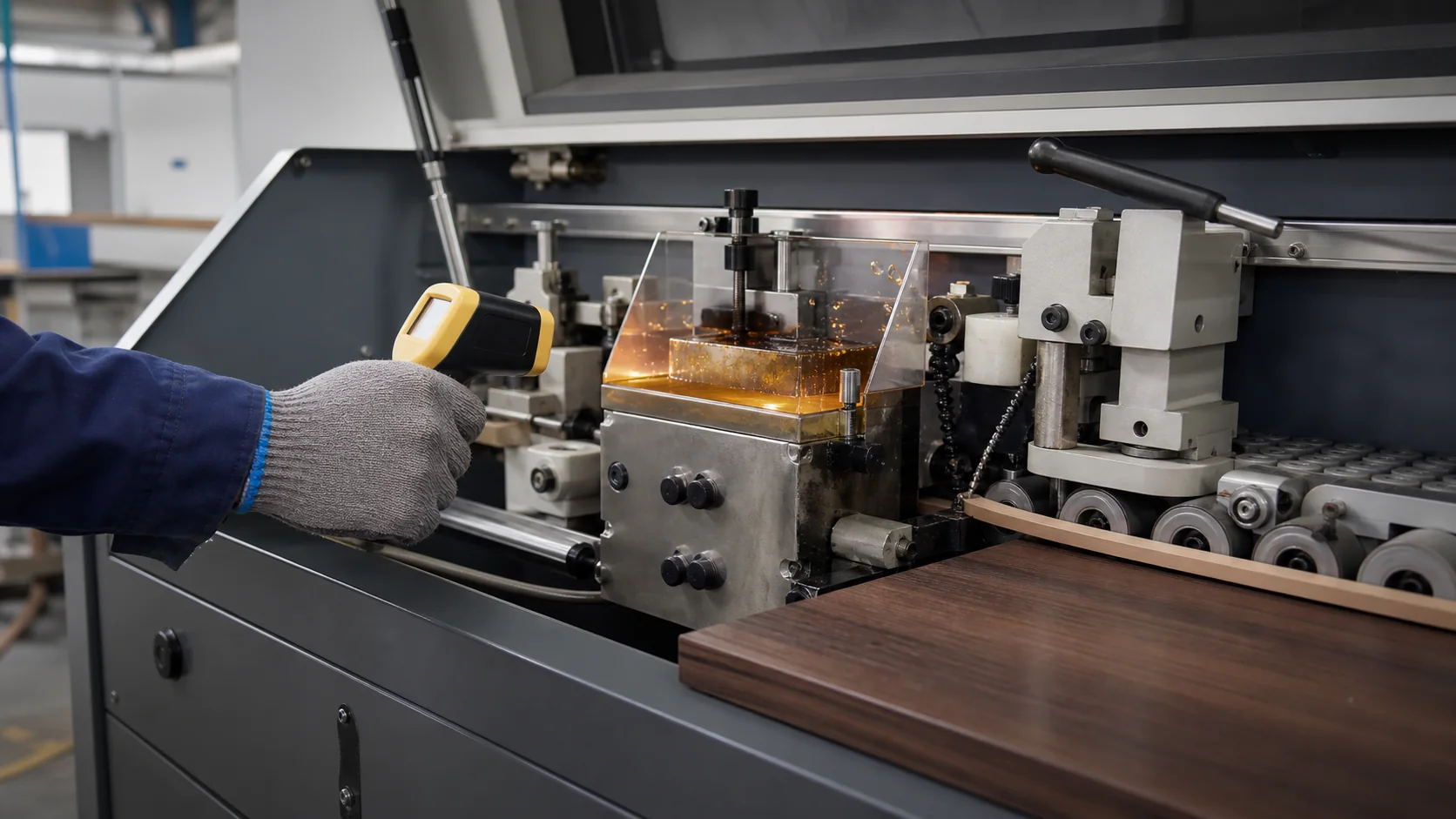
Edge Banding Adhesive Temperature and Viscosity Adjustment
Good edge banding depends on real adhesive temperature, viscosity, line speed, open time, panel and tape temperature, pressure rollers and surface cleanliness—not only the display value. Use the current product TDS, change one variable at a time and confirm every adjustment with a real sample.
Edge banding quality is affected by adhesive temperature, viscosity and transfer as a system. Raising temperature can lower viscosity, but it does not automatically improve bonding. Excess heat may increase colour change, thermal ageing, stringing or residue risk. Too little heat can reduce wetting and initial adhesion.
This guide gives a safe diagnostic order rather than a product-specific recipe. Exact temperature and viscosity values must always be taken from the current Jowat or Mayer TDS.
Temperature and viscosity
| Signal | Possible effect | First check |
|---|---|---|
| Poor wetting | Adhesive may not spread sufficiently | Real temperature, viscosity, cleanliness and coat weight |
| Excess squeeze-out | Film or pressure may be too high | Coat weight, roller pressure and tape alignment |
| Stringing | Open time, viscosity, nozzle and line speed may interact | TDS range, nozzle cleanliness and speed |
| Colour or odour change | Excess heat or residence time may be present | Tank temperature, residence time and residue |
The application-point temperature can differ from the sensor value because of sensor location, hose loss, tank level and speed. If the reading is doubtful, compare the sensor and a suitable measuring instrument through an authorised safety procedure.
Correct adjustment order
- Confirm product family, product code, tape and panel.
- Check tank, hose, nozzle, filter and pressure rollers for cleanliness and mechanical condition.
- Choose a safe starting point inside the TDS processing range.
- Confirm that panel and tape are dry, clean and conditioned to the production environment.
- Keep line speed stable and change one variable in small steps.
- Record bonding, glue line, squeeze-out, stringing and alignment after each sample.
Changing temperature, speed and pressure at the same time makes the cause difficult to identify. Check product and mechanics first, then temperature and viscosity, followed by coat weight, speed and pressure.
Reading fault signals
Check wetting, tape backing, surface cleanliness, real temperature and pressure contact together.
Check coat weight, geometry, roller pressure and viscosity; do not simply reduce temperature.
Inspect open time, speed, nozzle geometry, residue and product changeover.
Consider excess heat, long tank residence, dirty surfaces or finishing residue.
The adhesive may not be the only cause. Panel moisture, tape backing primer, cut quality, pressure rollers, room temperature and dust also affect the result. See the edge banding faults guide.
EVA and PUR process difference
EVA forms a thermoplastic bond through heat and cooling. Reactive PUR develops final performance through a moisture reaction after cooling. Moisture management, closed-system discipline, residence time and special cleaning can therefore be more critical for PUR.
Do not manage both families with the same settings or maintenance assumption. Use the PUR hot melt guide and EVA hot melt guide.
Safe control checklist
- Use suitable heat and chemical PPE; never touch molten adhesive.
- Follow the machine, TDS and SDS cleaning procedure.
- Never exceed the upper temperature limit in the TDS.
- Prevent incompatible chemical mixing during product changeover.
- Approve a real panel-and-tape sample before series production.
Check the Jowat catalogue, Mayer products or contact Koçak technical support for product-specific confirmation.
Edge Banding Adhesive Temperature and Viscosity Adjustment hakkında merak edilenler
What temperature should edge banding adhesive use?
There is no single value for every product. Follow the current TDS and verify the machine, tape and panel combination with a real sample.
Does lower viscosity always improve bonding?
No. It may change flow while excess heat can cause squeeze-out, ageing or surface problems.
Why does stringing occur?
Open time, line speed, nozzle geometry, viscosity, residue and product changeover can all contribute.
Can EVA and PUR use the same machine settings?
They should not be assumed to. Chemistry, moisture management, cleaning and final cure behaviour differ.
How should temperature be checked?
The application-point temperature should be verified safely by trained personnel using suitable measuring equipment and the machine procedure.
Technical resources and verification
The content has been prepared in Turkish with the technical experience of Koçak Endüstri, based on the following manufacturer resources.
Let's choose the right adhesive for your application together
You can get technical guidance and offers for Jowat products by sharing your machine, material and consumption information.
Get a technical quote

