

What Types of Hot Melt Adhesive Are There?
Hot melt adhesives are 100% solid products that are heated for application and form a bond by cooling or reactive curing. The main families are EVA, PO, PUR, PSA, PA and APAO. The right choice depends on the surface, line speed, open time, temperature, required resistance, equipment and total process cost.
Hot melt adhesive is a solid adhesive that is heated until it flows, applied to a surface and then forms an initial bond as it cools. It is also called hot melt or hot-melt adhesive. Because it is supplied as a 100% solids product, it is widely used in packaging, furniture, edge banding, bookbinding, textiles, hygiene products, automotive and electronics.
Hot melt is not a single product. EVA, PO, PUR, PSA, PA and APAO have different polymers, open times, viscosities, tack, flexibility and service resistance. Selection must consider the surface, line speed, application method, cleaning, temperature, moisture and the current TDS.
What is hot melt adhesive and how does it work?
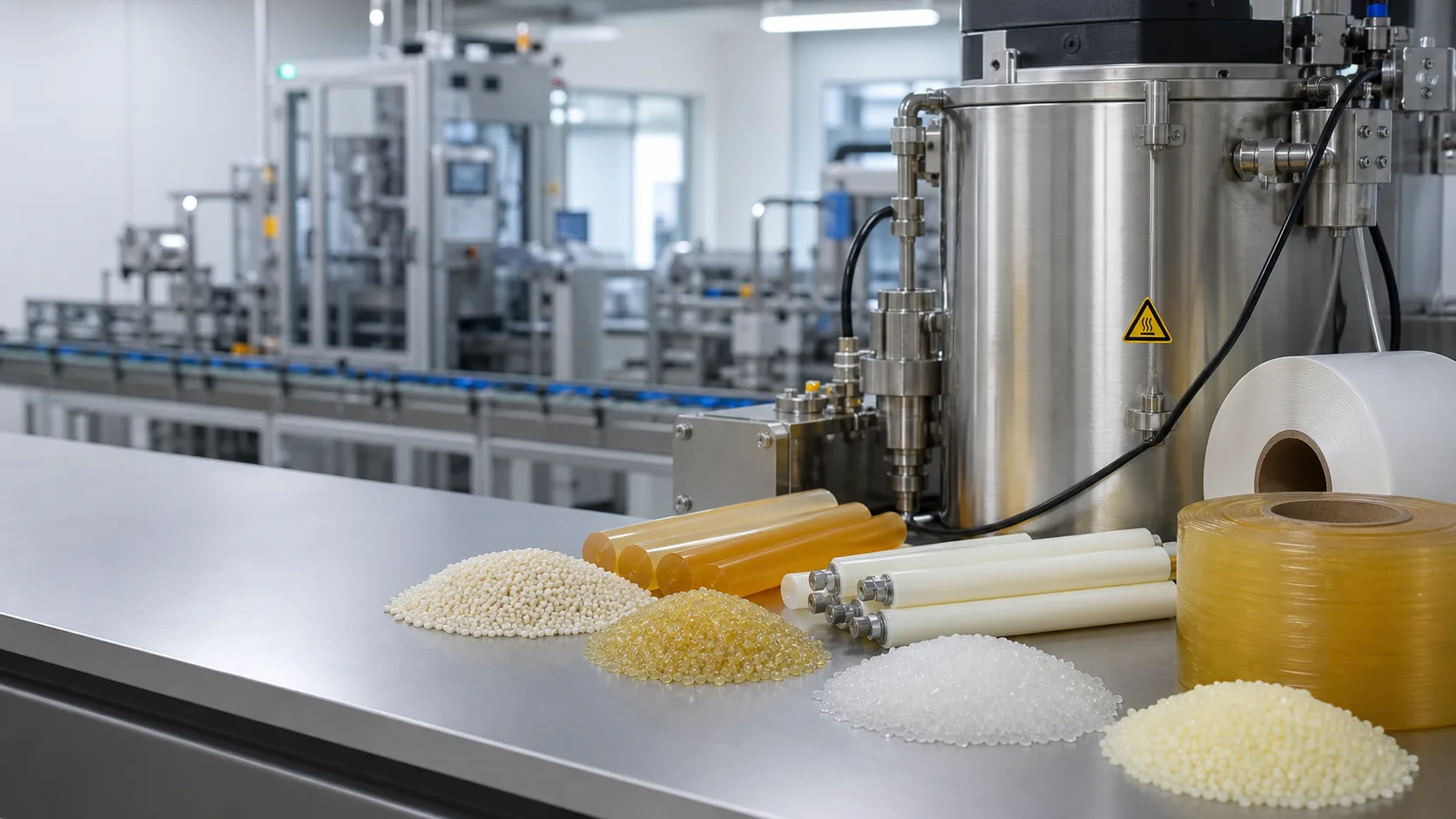
Pellets, beads, cartridges, blocks, films and rolls are heated in a tank or applicator. The adhesive is transferred as a film, bead, dot, spray or pattern and the parts are joined within the open time. Cooling creates the first handling strength. Reactive PUR continues curing with moisture. Read the basic hot melt guide for the process fundamentals.
EVA hot melt adhesives
EVA is the most common and usually the most economical thermoplastic hot melt family. It offers fast initial hold, practical machine management and many viscosity and open-time options for packaging, paper, bookbinding and standard edge banding. Heat softening, moisture exposure, joint appearance and the actual product TDS must still be checked. See the detailed EVA hot melt guide.
PO polyolefin hot melts
PO and metallocene hot melts are thermoplastic alternatives to EVA. Depending on the formulation, they can offer stable processing, specific surface wetting, low density and improved colour or odour stability. They are considered for glossy or laminated packaging and difficult plastic surfaces. Lower density does not automatically mean lower consumption; measure real gram weight and bond performance. Read the PO hot melt guide.
Reactive PUR hot melts
PUR first bonds through hot application and cooling, then reacts with moisture and cross-links. After curing it is not remelted like EVA. It can be selected for high moisture, water, heat and chemical resistance in furniture, profiles, textiles and automotive trim. Moisture-protected packaging, suitable equipment, cure time and timely cleaning are essential. See the reactive PUR guide.
PSA pressure-sensitive hot melts
PSA products remain tacky after cooling and bond when pressure brings the adhesive into close surface contact. SBC elastomers and tackifier resins are common formulation components. Labels, carton tape, shipping bags, double-sided tape, diapers and hygiene products are typical uses. Tack, peel, shear, surface energy, coating weight and ageing must be tested. Read the PSA guide.
PA polyamide hot melts
PA hot melts are designed for demanding engineering applications where heat and chemical resistance matter. Automotive oil and air filters, electronic encapsulation, insulation and component protection are possible fields. Melting range, viscosity, electrical performance and chemical resistance vary by product, so real service testing is required. See the PA polyamide guide.
APAO hot melts
APAO is an amorphous poly-alpha-olefin hot melt family considered for long open time, flexibility at lower temperatures and wide-area bonding. Mattress, foam, textile, appliance insulation and automotive assembly are common fields. Pattern, coat weight, air permeability, foam compression and positioning time are as important as bond strength. Read the APAO guide.
Hot melt adhesive comparison
| Family | Bond mechanism | Typical focus | Critical control |
|---|---|---|---|
| EVA | Thermoplastic cooling | Packaging, paper, standard furniture | Open time, temperature and moisture |
| PO | Polyolefin thermoplastic cooling | Laminated and difficult surfaces | Wetting, stability and real consumption |
| PUR | Cooling plus moisture cure | High durability furniture and trim | Moisture, cure and cleaning |
| PSA | Persistent tack and pressure bond | Labels, tapes and hygiene | Tack, peel, shear and ageing |
| PA | High-performance thermoplastic | Filters and electronics | Heat and chemical resistance |
| APAO | Flexible thermoplastic cooling | Foam, mattress and wide areas | Open time, pattern and flexibility |
Selection by industry
Packaging often prioritises speed and initial hold; furniture also requires tape, panel, joint and moisture compatibility; textiles and foam need flexibility and open time; automotive and electronics add heat, chemicals, vibration and insulation. Do not select by polymer name alone. Compare the real surface, line and service condition.
Process control checklist
- Record the surface, machine, speed, application method and service condition.
- Set tank, hose, roller, nozzle or slot-die temperatures from the current TDS.
- Measure coat weight, open time, pressure, initial hold and final bond.
- Test heat, moisture, chemical, peel or shear resistance as required.
- Document cleaning, changeover and first-piece approval.
For technical selection, share your machine, materials, speed and performance target with Koçak Endüstri.
What Types of Hot Melt Adhesive Are There? hakkında merak edilenler
What is hot melt adhesive?
It is a 100% solids adhesive heated for application and bonded by cooling or reactive curing.
Which hot melt family is most common?
EVA is widely used in standard packaging, paper and furniture production, but PO, PUR, PSA, PA or APAO may be better for specific conditions.
What is the difference between EVA and PO?
Both are thermoplastic, but their polymer structures affect wetting, flow, density, odour and thermal stability. The product TDS and a real sample decide the result.
Why is PUR different from EVA?
PUR continues curing through moisture and cross-links after cooling, while EVA remains a thermoplastic cooling bond.
Where is PSA used?
Labels, tapes, shipping bags, diapers and hygiene products where persistent tack and pressure bonding are required.
How should a hot melt be selected?
Define the surface, machine, speed, temperature, open time, coat weight, service resistance and cleaning method, then verify them with TDS and production samples.
Technical resources and verification
The content has been prepared in Turkish with the technical experience of Koçak Endüstri, based on the following manufacturer resources.
Let's choose the right adhesive for your application together
You can get technical guidance and offers for Jowat products by sharing your machine, material and consumption information.
Get a technical quote

