

Hotmelt Heat Hose Selection Guide: Machine Compatibility and Information Required for Quoting
Heat hose selection in hot melt and PUR lines; The distance between the melter vessel and the applicator head (hose length), the inner diameter suitable for the viscosity of the fluid and the line flow rate (usually DN6, DN8, DN13 or DN16), the working pressure (max. 100-250 bar), the maximum temperature threshold (standard 200°C or high temperature 250°C) and most critically the temperature sensor type of the main machine (PT100, Ni120, Fe-CuNi etc.). If the wrong sensor or incompatible electrical socket is selected, the melter unit will malfunction and the hose cannot heat homogeneously.
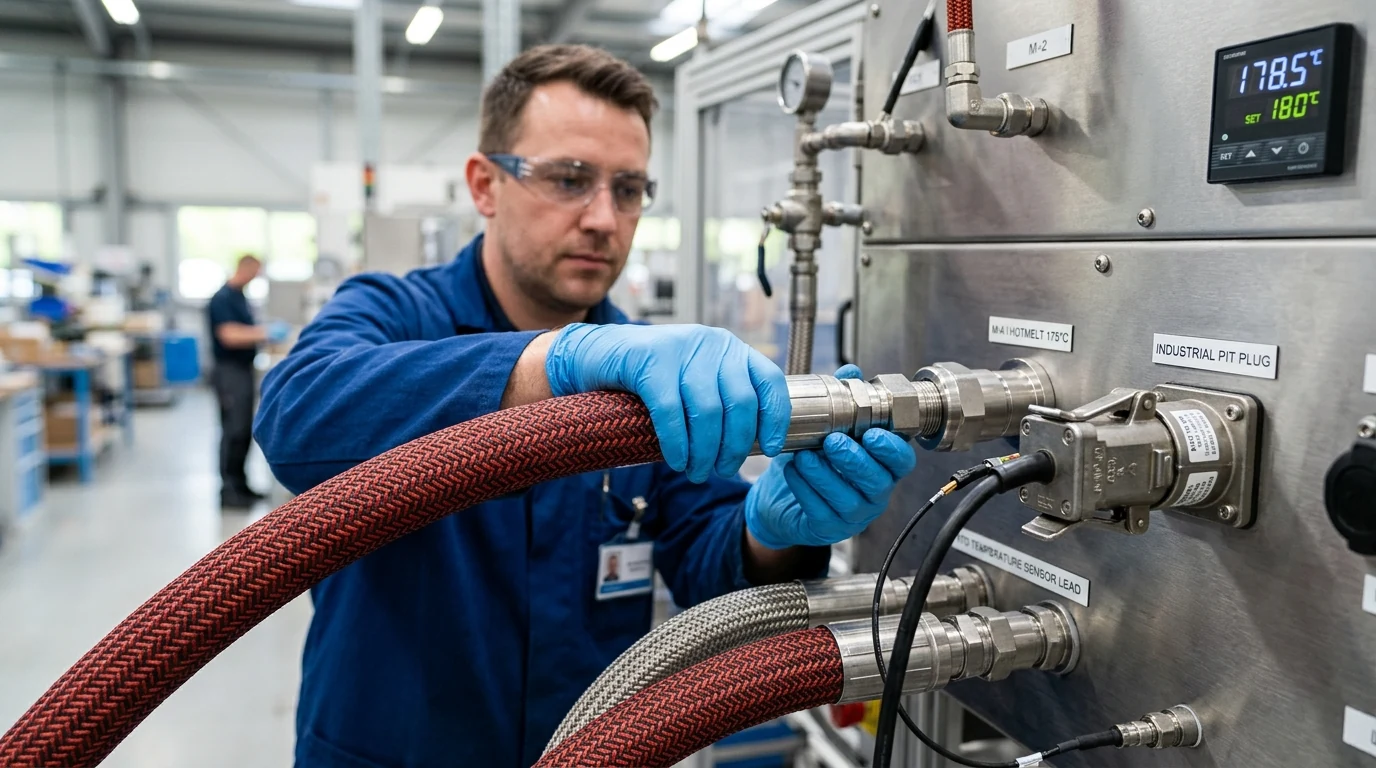
In hot glue systems used in industrial packaging, furniture edge banding, automotive assembly and lamination lines, after the adhesive is liquefied in the melting tank, it is carried to the applicator gun by electrically heated hoses (heat hoses) . The teflon (PTFE) core inside a heat hose, the resistance wire that provides homogeneous heating, the temperature sensor and the multi-layer outer protection braid ensure that the glue flows along the line without losing temperature.
Hose failure, resistance breakage or wrong hose selection; It causes the glue to freeze in the line, viscosity fluctuations and production stoppage. As Koçak Endüstri, we offer verified technical solutions with industrial heat hoses and Mayer ProHose series, compatible with all main brand equipment in your facilities.
The structure of the heat hose and its critical function in the glue line
Unlike a standard hydraulic hose, hotmelt heat hose is an advanced engineered product with multiple layers from inside to outside:
- PTFE Inner Hose: Chemical-resistant, non-adhesive pure teflon inner channel.
- Stainless Steel Braid: Resistant layer against high hydraulic pressure (100–250 bar) and mechanical explosion.
- Resistance and Heat Sensor: Spiral-wrapped homogeneous resistance that does not create a local hot spot and a sensitive sensor that reports the temperature to the brain of the melter.
- Thermal Insulation and Outer Sheath: Silicone foam insulation that prevents heat loss and polyamide/metal outer braid that is resistant to mechanical friction.
Machine and OEM brand compatibility: Electrical sockets and pinout
Hotmelt melter manufacturers around the world use different electrical sockets, voltage ratings and pin arrangements. Even if the mechanical fitting thread of a hose fits, if its electrical socket does not fit the machine, the system will not work. As mentioned in the heat hoses section on our site, the main OEM families on the market are:
| Special industrial automation cells |
Temperature sensor selection: PT100, Ni120 and Thermocouple difference
The sensor located inside the heat hose reports the instantaneous temperature of the hose to the main control panel with the change in resistance. Most commonly used sensors:
- PT100 (Platinum Sensor): provides 100 Ohm resistance at 0°C. It is high precision, the most common type by modern European standards.
- Ni120 (Nickel Sensor): resists 120 Ohms at 0°C. It is especially frequently used in certain American and German OEM standards.
- Fe-CuNi (Iron-Constantan Thermocouple / J-Type): These are traditional systems that work on the principle of voltage difference.
Note: If you attach a Ni120 sensor hose to the line while your board is programmed to read PT100, the device will read the temperature completely wrong; It either overheats and burns the glue, or it stops working with a "sensor open circuit" error.
How to calculate inside diameter (DN), length and working pressure?
- Hose Internal Diameter (DN): While DN6 (6 mm) or DN8 (8 mm) is sufficient for low viscosity packaging glues and short distances; DN13 or DN16 diameter should be chosen to prevent pressure drop in high viscosity adhesives and high flow lamination lines.
- Hose Length: If the hose is chosen longer than necessary, unnecessary energy will be wasted and pressure loss will occur; If it is chosen shorter than necessary, it will stretch and experience mechanical breakage. Standard lengths such as 1.2 m, 1.8 m, 2.4 m, 3.0 m, 4.0 m should be preferred.
- Robotic Applications (Dynamic Hose): The hoses to be attached to the 6-axis robot arm must be equipped with a special robotic outer armor with spiral springs that is resistant to constant bending.
6 technical information that must be conveyed when receiving a hose quote
Checklist you need to submit to our technical team to order the correct heat hose with zero errors:
- Make and model of existing melter unit (e.g. Nordson ProBlue, Robatech Concept, etc.).
- Type of fluid/glue used (EVA hotmelt, reactive PUR, PSA or mastic).
- Required hose length (in meters) and inner diameter (DN size).
- Operating temperature (e.g. 160–200°C) and operating pressure.
- Clear photos of the existing hose socket and applicator fitting fitting.
- Information on whether the hose will run on a fixed line or on a moving robot arm.
Mayer ProHose industrial hose solutions
Mayer ProHose series offered by Koçak Endüstri; It is used safely in your facilities with verified TDS documents in Turkish and English, compatible with Bühnen, Dynatec, Meler, Melton, Nordson, Preo, Robatech and UES. For detailed documents, you can review our Heat Hoses page.
Stock and technical support
You can immediately contact our Koçak Endüstri technical sales representatives to determine a compatible replacement hose for your faulty hose or to configure a hose set suitable for your new project.
Hotmelt Heat Hose Selection Guide: Machine Compatibility and Information Required for Quoting hakkında merak edilenler
Does every hot glue hose fit every machine?
No. The melter's electrical socket, pin configuration, temperature sensor type (PT100, Ni120, etc.) and mechanical fitting thread must match exactly.
What is the difference between PT100 sensor and Ni120 sensor?
PT100 is a platinum-based 100 Ohm reference sensor, while Ni120 is a nickel-based 120 Ohm reference sensor; They are not interchangeable, the machine board will give an error.
How to determine the hose inner diameter (DN)?
While DN6/DN8 is used in low viscosity and low flow rates, DN13/DN16 is preferred to prevent pressure drop in high viscosity PUR or high-meter lines.
Do I need a special heat hose for PUR glue?
Yes, since PUR is extremely sensitive to moisture, special PUR hoses with increased moisture tightness and high temperature stability should be used.
Technical resources and verification
The content has been prepared in Turkish with the technical experience of Koçak Endüstri, based on the following manufacturer resources.
Let's choose the right adhesive for your application together
You can get technical guidance and offers for Jowat products by sharing your machine, material and consumption information.
Get a technical quote

