


What is Hot Foam? Difference between Hot and Cold Foam and its Effect on Lamination
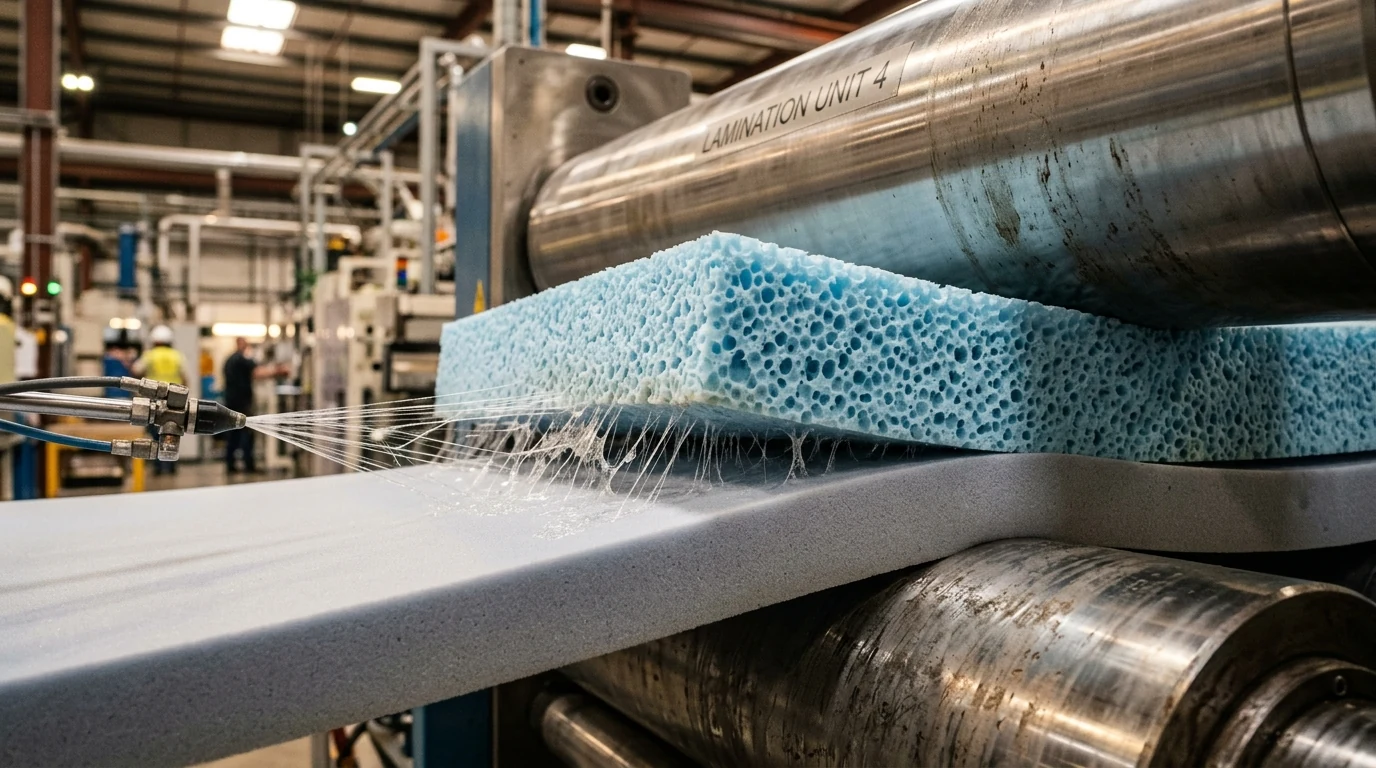
Hot Foam; They are traditional block polyurethane sponges, in the production of which exothermic reaction heat is supported by high baking temperatures. It has a dense, more homogeneous and partially closed cell structure. Cold Foam (cold casting / HR foam) is a high elasticity (High Resilience) sponge with irregular and completely open cells that cures at lower mold temperatures. In terms of lamination, the difference is critical: While open-cell cold foam absorbs liquid adhesive like a sponge and can lead to excessive glue consumption, closed-pore hot foam retains a film on the surface but requires APAO or PSA-based flexible hotmelt adhesive for elastic bonding.
Comfort, springiness and ergonomics in the production of beds, sofas, armchairs, office furniture and automotive seats are achieved by laminating polyurethane sponge layers of different density and hardness on top of each other. The two most basic categories in foam production technology are Hot Foam and Cold Foam (cold casting / HR foam) materials.
The biggest cost and quality problem experienced in production lines is that these two different foam types are approached with the same adhesive and the same weight. The pore structure of the sponge directly determines the behavior of the adhesive remaining on the surface or sinking into the sponge. As Koçak Endüstri, we provide process-compatible adhesive support with Mayer Tutkal PSA series and Jowat industrial hot melt solutions for manufacturers engaged in foam and sponge lamination.
Verified definitions: What are hot foam and cold foam?
- Hot Foam (Hot Foam / Conventional PU): These are standard block sponges that are hardened by the oven effect of the high internal temperature (140–180°C) created by the chemical reaction during production. Cell walls are more uniform and have relatively more closed pores.
- Cold Foam (HR Foam): It is a high elasticity (High Resilience) polyurethane foam that is reacted at much lower mold temperatures (usually 50–60°C). After leaving the mold, the cell membranes are exploded by mechanical crushing; In this way, it gains a structure with completely open pores, breathability and a high spring coefficient.
Mechanical differences of open and closed cell structure
Hot foam gives a more linear hardness feeling when sitting; Thanks to its irregular open cells, cold foam shows point stretching according to body weight and does not collapse in beds. However, while the open cells allow air to pass through, they also pave the way for the applied adhesive to escape deep into the sponge pores (strike-through).
Effect of foam type on adhesive selection and lamination process
| Cell Structure | Regular, partially closed and tight walls | Irregular, completely open porous structure |
| Risk of Hardening | Medium | If the glue fills the pores, the sponge hardens (wedge effect) |
The role of APAO and flexible hotmelt adhesives in foam lamination
Due to the odor and flammability risks posed by solvent-based adhesives in sponge lamination, modern facilities are switching to hot melt hotmelt (especially APAO and PSA) systems. APAO hotmelt adhesives do not form a hard shell between the sponge layers, thanks to their long open time and rubbery flexibility. It does not break when spring, does not make a rustling sound and provides permanent flexibility.
Mayer and Jowat sponge lamination solutions
Mayer MT-PSA 350 MultiTack and Jowat mattress sponge lamination hotmelts in Koçak Endüstri portfolio; When applied with slot-die or swirl spray guns, it creates a micro-web on the surface without escaping into the open pores of the sponge. In this way, it saves weight in both cold foam and hot foam plates and definitely prevents the edges of the bed from opening.
Stock and technical support
You can request an on-site line trial from our Koçak Endüstri technical experts to increase the adhesion strength of the foam layers in your mattress, base and seating group production lines, prevent rustling noise and optimize weight costs.
What is Hot Foam? Difference between Hot and Cold Foam and its Effect on Lamination hakkında merak edilenler
What is the main difference between hot foam and cold foam?
Hot foam is a closed-cell standard sponge produced with high exothermic baking temperature; Cold foam is a sponge with open pores and high elasticity (HR) that cures at low temperatures.
Why does cold foam sponge consume more glue?
Because the cells are completely open, the liquid glue sinks into the pores; In order to leave a film on the surface, hotmelts with high viscosity or fast initial tack should be used.
Why is APAO hotmelt preferred in sponge lamination?
APAO adhesives have long open time and high elasticity; When you sit on the bed, it stretches, does not break, forms a hard plate and does not make noise.
How is Mayer MT-PSA 350 MultiTack applied in sponge bonding?
It creates a perfect bond without sinking into the open cell by applying it to large surfaces in the form of a homogeneous micro network with a swirl spray or multiple bead applicators.
Technical resources and verification
The content has been prepared in Turkish with the technical experience of Koçak Endüstri, based on the following manufacturer resources.
Let's choose the right adhesive for your application together
You can get technical guidance and offers for Jowat products by sharing your machine, material and consumption information.
Get a technical quote

