

IP67/IP69K Sealing and Flame-Retardant Sealants in EV Lithium Battery Enclosures
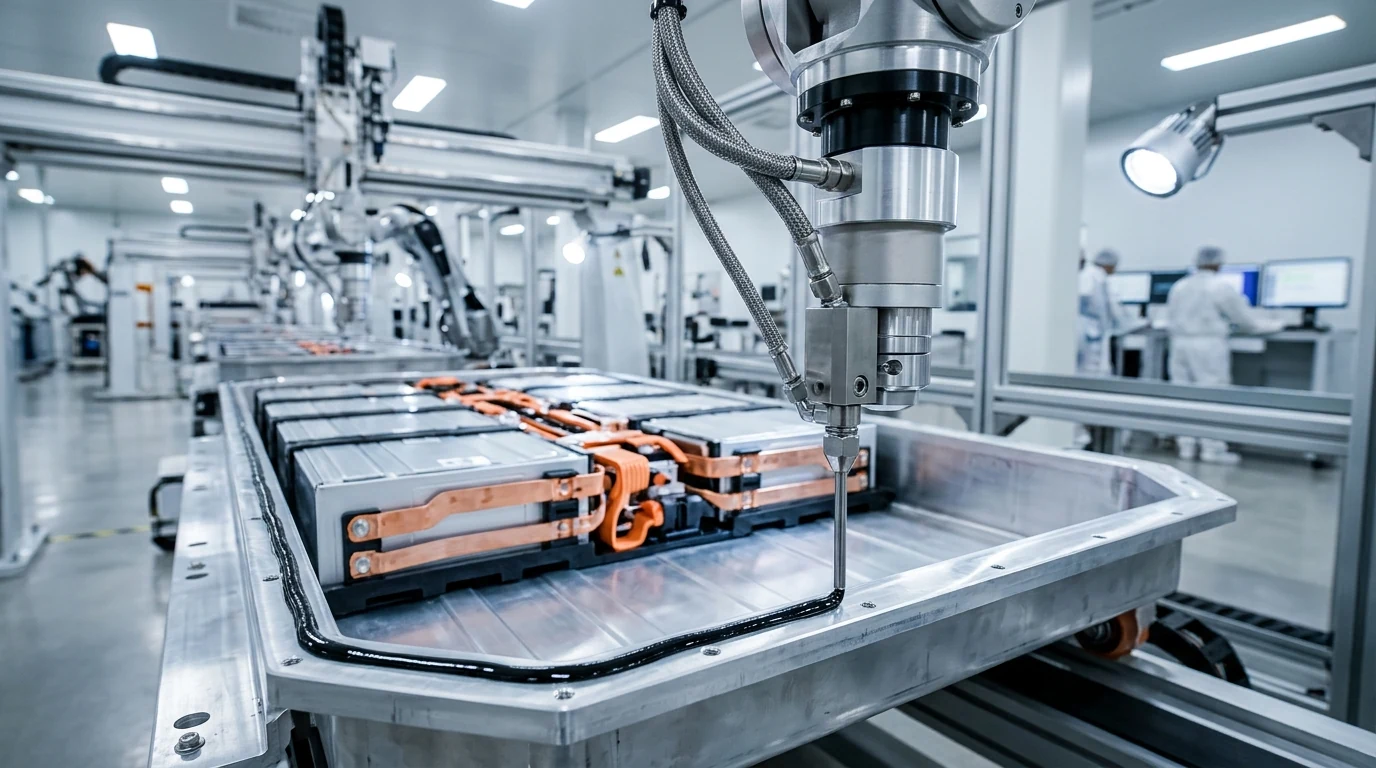
In electric vehicle (EV) and energy storage system (ESS) lithium-ion battery packs, the perimeter seal between the lower battery tray and upper cover must withstand severe road wash, submerged water crossings, mud, salt spray, and extreme thermal cycling. To eliminate compression-set fatigue and bolt-spacing leakages associated with solid EPDM gaskets, automotive OEMs have transitioned to automated Cure-In-Place Gasket (CIPG) and Formed-In-Place Gasket (FIPG) reactive polyurethane and silicone liquid sealants. Operating continuously between -40°C and +120°C, these specialized sealants deliver IP67 (submersion up to 1 meter) and IP69K (high-pressure washdown at 100 bar, 80°C) protection while maintaining UL 94 V-0 flame retardancy to contain thermal runaway events. Furthermore, they provide a cohesive, service-removable release property that permits cell module maintenance and warranty repair without damaging the lightweight aluminum flange.
High-voltage battery packs (400V–800V DC) mounted beneath the chassis of electric vehicles face aggressive environmental exposure. Water ingress inevitably triggers ground faults, short circuits, and catastrophic thermal runaway. Achieving IP67, IP69K, and UL 94 V-0 compliance demands automated liquid gasketing technologies that accommodate dynamic chassis torsional flexing while allowing clean service disassembly.
1. Critical Safety Role of EV Battery Enclosure Sealing
Battery enclosures span up to 2 meters in length, experiencing substantial thermal expansion differentials between aluminum trays and steel fasteners. The sealing mastic must maintain elastic recovery across road vibration, internal pressure swings during fast charging, and negative vacuum cycles during cool-down.
2. IP67 & IP69K Ingress Protection and Automotive Stress Testing
Under ISO 20653 and IEC 60529, battery packs undergo 8-hour dust vacuum circulation (IP6X), 1-meter submersion for 30 minutes (IPX7), and multi-angle 100-bar steam washing at 80°C (IPX9K) without a single drop of internal moisture penetration.
3. Solid EPDM Gaskets vs. CIPG and FIPG Liquid Gasket Systems
Solid rubber gaskets suffer compression set and leak between bolt centers. Cure-In-Place Gaskets (CIPG) are robotically dispensed and pre-cured into elastomeric seals before lid assembly, delivering precision sealing with clean opening during maintenance.
4. Chemistry Selection: Polyurethane vs. Silicone (UL 94 V-0 & Glycol Resistance)
Reactive polyurethane and silicone mastics offer UL 94 V-0 self-extinguishing flame barriers and chemical resistance against ethylene-glycol cooling fluid leaks.
5. Repairability and Clean Removal for Battery Module Servicing
Automotive circularity regulations mandate that individual modules or BMS controllers can be repaired. Controlled-adhesion sealants peel cleanly without deforming lightweight aluminum trays.
6. Koçak Endüstri & Mayer EV Battery Sealing Solutions
Koçak Endüstri partners with EV commercial vehicle and battery pack assemblers to supply robotic-dispensed, high-yield sealing solutions across the region.
IP67/IP69K Sealing and Flame-Retardant Sealants in EV Lithium Battery Enclosures hakkında merak edilenler
Why replace mechanical EPDM gaskets with liquid sealants?
Liquid sealants eliminate tooling costs, adapt to complex geometric flanges robotically, and prevent compression-set leakage between bolts.
Why is service-removability critical for battery enclosure sealants?
To allow warranty repair, cell module swapping, or recycling without bending the costly aluminum tray flange during disassembly.
What does UL 94 V-0 certification signify in battery sealants?
It guarantees that in the event of an internal thermal runaway fire, the sealant extinguishes vertically within 10 seconds without dropping burning particles.
Are battery sealants resistant to cooling fluids?
Specially formulated reactive polyurethane and MS polymer sealants demonstrate zero swelling and complete resistance to water-glycol mixtures.
Technical resources and verification
The content has been prepared in Turkish with the technical experience of Koçak Endüstri, based on the following manufacturer resources.
Let's choose the right adhesive for your application together
You can get technical guidance and offers for Jowat products by sharing your machine, material and consumption information.
Get a technical quote

