



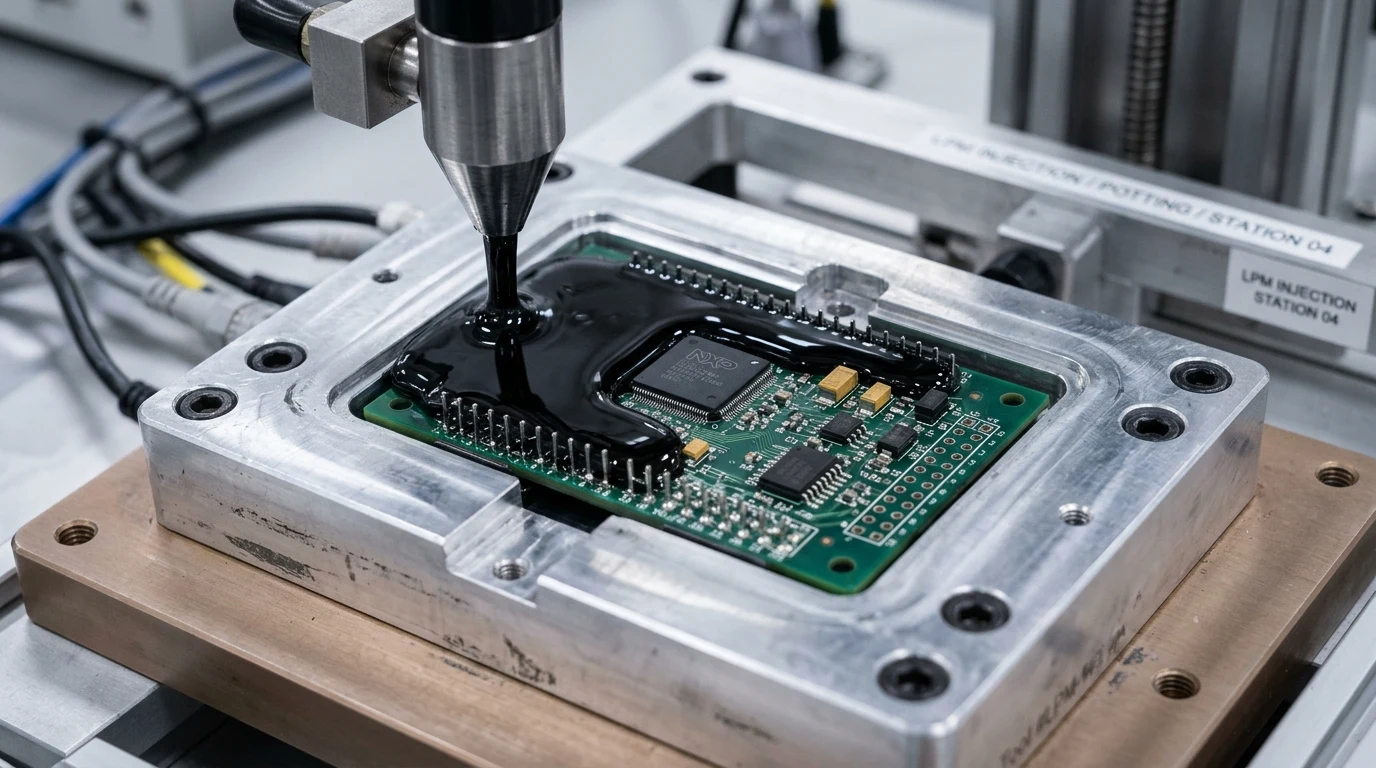
Low Pressure Molding (LPM) and Hot Melt Potting in Electronics: Sensor and PCB Encapsulation
In protecting electronic printed circuit boards (PCBs), micro-sensors, and wire harnesses against moisture, dust, vibration, and thermal shock, Low Pressure Molding (LPM) technology is rapidly replacing traditional 2-component epoxy or polyurethane potting. Utilizing dimer fatty acid-based thermoplastic polyamide (PA) hot melts, the LPM process operates at low injection pressures of 2 to 20 bar and melting temperatures of 190°C–230°C. It encapsulates sensitive SMD components without causing solder joint fractures or mechanical stress. With cycle times of just 15 to 45 seconds, polyamide hot melts eliminate 24-hour oven curing, boosting production throughput by up to 90%. Meeting IP67/IP68 ingress ratings, UL 94 V-0 flame retardancy, and a -40°C to +150°C operating window, LPM sets the benchmark for automotive electronics, medical sensors, and industrial IoT devices.
In modern electronics manufacturing, protecting sensitive printed circuit boards (PCBs), microprocessors, and sensor arrays from hostile ambient conditions is a vital engineering challenge. Under-the-hood automotive environments, heavy industrial automation floors, and outdoor IoT nodes expose circuitry to moisture, salt spray, lubricating oils, and continuous vibration. Traditional 2-part epoxy or polyurethane potting requires separate pre-molded plastic enclosures, hazardous chemical curing agents, and hours in curing ovens. In contrast, Low Pressure Molding (LPM) uses single-component bio-based thermoplastic polyamide hot melts to form a finished protective housing directly over bare electronics in 15 to 45 seconds. This technical article explores LPM rheology, process parameters, electrical insulation standards, and OEM compliance.
1. Traditional Potting (Epoxy/PU) vs. Low Pressure Molding (LPM)
Conventional potting requires assembling the electronic board into a pre-manufactured plastic shell before dispensing a liquid 2K epoxy, polyurethane, or silicone. Curing takes 12 to 24 hours at room temperature, while exothermic reactions can overheat sensitive silicon dies, and entrained air bubbles compromise dielectric integrity.
Low Pressure Molding integrates housing creation and encapsulation into a single clean step:
- No Separate Housing Required: Polyamide hot melt serves as both encapsulant and outer shell, eliminating casing procurement and gasket inventories.
- 15–45 Second Cycle Times: As a thermoplastic material, polyamide hardens upon contact with chilled aluminum tooling, allowing immediate testing and pack-out.
- Clean, Sustainable Chemistry: Free of isocyanates, solvents, and toxic amines; dimer acid-based resins comply fully with RoHS and REACH.
- Reworkability: Defective assemblies can be carefully warmed and stripped, salvaging expensive PCB substrates and microchips.
| Engineering Criteria | 2K Epoxy / PU Potting | Standard Plastic Injection | Low Pressure Molding (LPM) |
|---|---|---|---|
| Injection Pressure | Gravity dispense (0 bar) | 300 – 1,000 bar (Extremely High) | 2 – 20 bar (Ultra-Low) |
| Cycle Time | 2 – 24 Hours (Cure waiting) | 20 – 40 Seconds | 15 – 45 Seconds |
| Component Stress | Low (Exotherm heat risk) | Severe (Fractured SMD components) | Zero (Safe on wire bonds & solder) |
| Tooling Cost | Low (Poured in boxes) | Very High (Hardened steel >$25k) | Affordable (Machined aluminum >$3k) |
| Ingress Protection | IP65 – IP67 | IP40 (Requires secondary seals) | IP67 – IP68 (Direct hermetic bond) |
| Environmental Health | Fumes, VOC & isocyanate risk | Neutral | Clean, odorless, zero VOC |
2. Polyamide (PA) Chemistry: Dielectric Breakdown and UL 94 V-0 Flammability
LPM hot melts differ fundamentally from standard packaging adhesives. Synthesized via polycondensation of dimer fatty acids and polyamines, these macromolecular polyamides exhibit unique properties:
- High Dielectric Strength: Delivers >25 kV/mm breakdown resistance and volume resistivity exceeding 10¹² Ω·cm, preventing flashovers in high-voltage designs.
- UL 94 V-0 Flame Retardancy: Halogen-free flame-retardant grades self-extinguish within 10 seconds of ignition without flaming drips.
- Low Melt Viscosity: Possesses melt viscosity between 2,000 and 6,000 mPa.s at 200°C, penetrating sub-millimeter gaps under BGA chips without voids.
- Low Glass Transition (Tg): Tg below -40°C maintains elastomeric flexibility in sub-zero climates, preventing brittle fracture.
3. LPM Process Parameters: Pressure (2-20 Bar), Melt Temp, and Aluminum Tooling
Conventional injection molding crushes solder fillets under 1,000 bar pressure. LPM utilizes specialized gear or piston pumps operating between 2 and 20 bar, gentler than standard pneumatic shop air.
Key operational control parameters include:
- Melt Tank Temperature: Maintained at 190°C–220°C with nitrogen blanket or dry air blanket to prevent atmospheric moisture absorption and oxidative degradation.
- Heated Hose and Nozzle: Uniform thermal control from reservoir to gate avoids premature viscosity spikes.
- Tooling Temperature Control: Aircraft-grade aluminum molds are kept between 25°C and 45°C via closed-loop liquid chilling, dissipating polymer heat rapidly.
- Packing Pressure: A brief holding pressure of 10–15 bar compensates for polymer cooling shrinkage (<1%, far lower than crystalline plastics).
4. Environmental Endurance: IP67/IP68 Sealing, -40°C to +150°C Thermal Shock
Polyamide hot melts bond chemically to FR4 solder masks, copper traces, and cable jacketing (PVC, PUR), forming hermetic seals superior to mechanical O-rings.
- IP67 / IP68 Ingress Protection: Zero water intrusion under 1m submersion for 30 minutes and 2m submersion for 24 hours.
- Thermal Cycling (-40°C to +125°C / +150°C): 1,000 continuous shock cycles without interfacial micro-cracking or delamination.
- Salt Spray Endurance (ASTM B117): 500 hours of 5% neutral salt fog with zero pin corrosion.
- Vibration Damping (ISO 16750-3): Polymeric viscoelasticity dampens resonance, preventing fatigue failure of solder joints.
5. Industrial Applications: Automotive Sensors, ECU, Medical, and IoT
LPM has been adopted by Tier-1 suppliers across leading industrial sectors:
- Automotive Sensors: Wheel speed (ABS) pickups, transmission sensors, tire pressure sensors, and door latch microswitches.
- Harness Grommets & Connectors: Direct overmolding over connector backshells and firewall transitions replaces loose rubber boots.
- Outdoor LED Drivers: Architectural and municipal luminaires requiring reliable moisture resistance.
- Medical Wearables: Skin-safe, biocompatible encapsulation for diagnostic monitors and portable pumps.
- Smart Utility Meters: Hermetic 10+ year battery and electronics sealing for water and gas meters.
6. Koçak Endüstri & Jowat Polyamide Molding and Potting Solutions
Koçak Endüstri supplies technical adhesive systems and Jowat's premier Jowat-Toptherm® and Jowatherm® Polyamide portfolios across the region, backing manufacturers with full engineering services:
- Grade Optimization: Formulation selection for extreme heat (+150°C), flame resistance (UL 94 V-0), or high flexibility.
- Tooling Design Guidance: Runner geometry, gate positioning, and venting channel modeling to guarantee void-free encapsulation.
- Pilot Line Testing: On-site dispensing trials, adhesive peel verification, and IP68 laboratory validation.
7. Frequently Asked Questions (FAQ)
Will the 200°C injection temperature reflow solder on the PCB?
No. Standard lead-free solder (SAC305) melts around 217°C–220°C. Furthermore, chilled aluminum mold tooling absorbs over 80% of the polymer's thermal energy in 1 to 2 seconds. The maximum instantaneous temperature experienced by PCB components rarely exceeds 70°C–90°C.
How does LPM reduce total unit manufacturing cost?
LPM eliminates separate injection-molded housings and sealing O-rings, removes oven curing energy expenses, shortens cycle times from hours to 30 seconds, and slashes operator labor by up to 70%.
Low Pressure Molding (LPM) and Hot Melt Potting in Electronics: Sensor and PCB Encapsulation hakkında merak edilenler
Will the 200°C injection temperature reflow solder on the PCB?
No. Standard lead-free solder (SAC305) melts around 217°C–220°C. Furthermore, chilled aluminum mold tooling absorbs over 80% of the polymer's thermal energy in 1 to 2 seconds, keeping peak component temperatures below 70°C–90°C.
How does LPM reduce total unit manufacturing cost?
LPM eliminates separate injection-molded housings and sealing O-rings, removes oven curing energy expenses, shortens cycle times from hours to 30 seconds, and slashes operator labor by up to 70%.
Is polyamide encapsulation UV and outdoor weather resistant?
Yes. Carbon-black pigmented and UV-stabilized polyamide grades withstand direct sunlight, rain, and thermal cycling for over 15 years in automotive exterior applications.
Technical resources and verification
The content has been prepared in Turkish with the technical experience of Koçak Endüstri, based on the following manufacturer resources.
Let's choose the right adhesive for your application together
You can get technical guidance and offers for Jowat products by sharing your machine, material and consumption information.
Get a technical quote

