



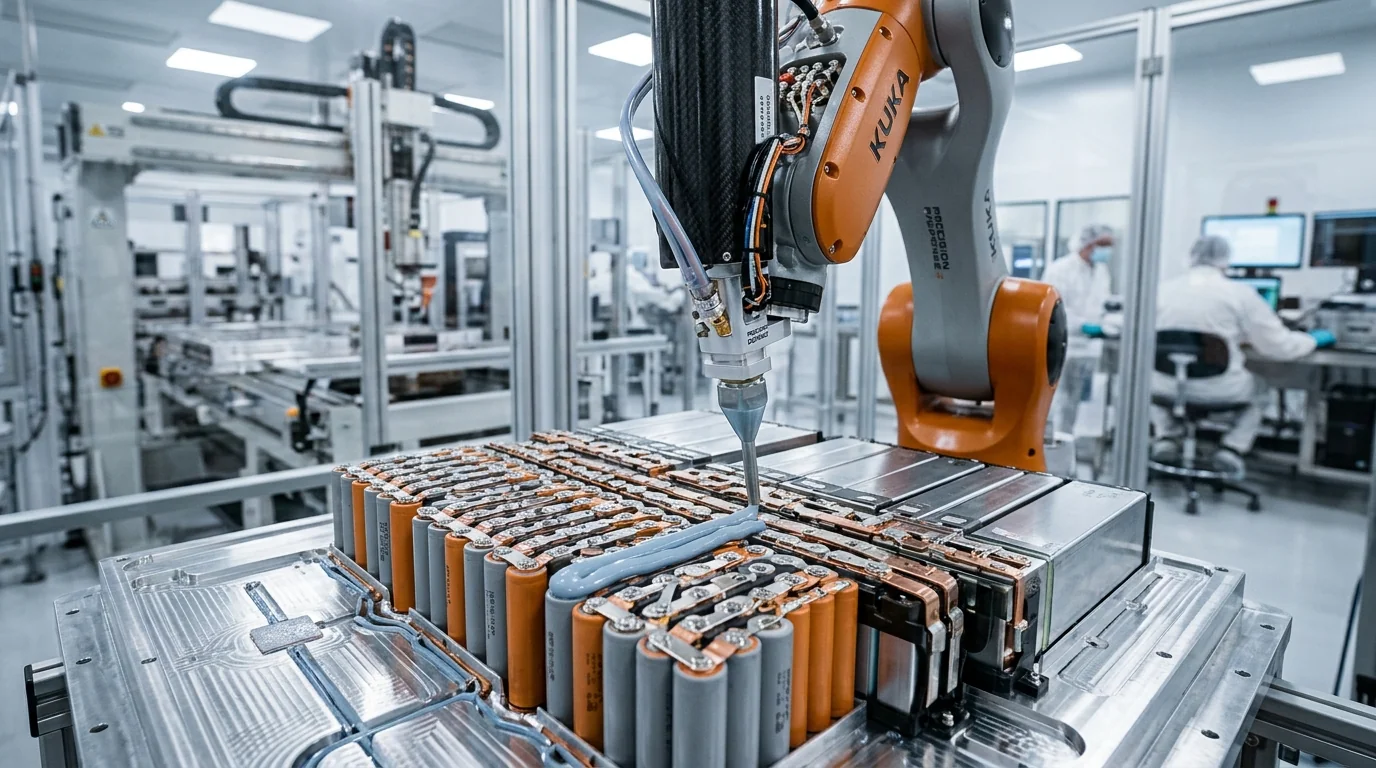
Thermal Conductive Adhesives and Potting in EV Battery Packs: Cell Structural Bonding and UL 94 V-0 Fire Safety
In electric vehicle (EV) lithium-ion battery manufacturing, bonding battery cells to aluminum cooling plates and potting module interiors is achieved using dual-component (2K) polyurethane and silicone thermal conductive adhesives (gap fillers). Featuring high thermal conductivity (1.5 to 3.5 W/m·K) and dielectric insulation (> 15 kV/mm), these compounds maintain cell temperatures within the optimal +25°C to +35°C window during fast charging, prevent thermal runaway propagation, provide UL 94 V-0 flame retardancy, and deliver dynamic structural dampening against road vibrations.
The safety and charging performance of electric vehicle (EV) battery systems rely entirely on thermal regulation. High-voltage lithium-ion cells generate intense heat during acceleration and rapid DC charging. Thermal conductive gap fillers and potting resins transfer thermal energy to liquid cooling plates while providing structural rigidity and fire barriers.
1. Thermal Management and the Role of Adhesives in EV Batteries
Air gaps between cell walls and aluminum heat exchangers act as thermal insulators. Liquid dispensing of automated gap fillers displaces all micro-voids, ensuring efficient thermal transfer to keep battery packs within +20°C to +35°C operating parameters.
2. Thermal Conductive Adhesives (TCA) vs. Thermal Gap Fillers
Structural adhesives provide high mechanical shear strength (> 10 MPa) for cell-to-pack monocoque builds, while reworkable gap fillers focus on maximizing thermal conductivity (up to 3.5 W/m·K) with low compression modulus for serviceability.
3. Thermal Conductivity (W/m·K) and Dielectric Breakdown Resistance
Formulated with ceramic mineral fillers such as aluminum oxide and boron nitride, these polymers achieve superior heat conduction while maintaining dielectric breakdown thresholds exceeding 20 kV/mm to prevent electrical arcing in 800V architectures.
4. Mitigating Thermal Runaway and UL 94 V-0 Flame Retardancy
In thermal runaway scenarios, intumescent UL 94 V-0 certified polyurethane and silicone resins form ceramic insulating char barriers that isolate defective cells and prevent cascading fire spread.
5. Cell Potting for Impact Absorption and IP67/IP69K Sealing
Low-density potting encapsulates cylindrical cell arrays, dampening automotive vibration, protecting wire bonds, and preventing moisture ingress under IP67/IP69K standards.
6. Koçak Endüstri & Jowat EV Adhesive Solutions
Koçak Endüstri supplies certified polyurethane gap fillers, structural pack bonding adhesives, and automated dispense compounds engineered for modern EV battery gigafactories.
7. Frequently Asked Questions (FAQ)
Thermal Conductive Adhesives and Potting in EV Battery Packs: Cell Structural Bonding and UL 94 V-0 Fire Safety hakkında merak edilenler
How do thermal conductive gap fillers differ from conventional potting silicones?
Standard silicones offer low thermal conductivity (~0.2 W/m·K). EV gap fillers are loaded with specialized ceramic minerals to achieve 1.5 to 3.5 W/m·K heat transfer.
Why is adhesive selection critical in Cell-to-Pack (CTP) architectures?
CTP designs eliminate modular framing; adhesives must simultaneously provide structural chassis stiffness and direct thermal conductivity to cooling channels.
Can EV thermal gap fillers be disassembled for battery recycling or repair?
Yes. Gap fillers are engineered with low shear modulus and peelable cohesion, allowing battery modules to be serviced without cell damage.
Technical resources and verification
The content has been prepared in Turkish with the technical experience of Koçak Endüstri, based on the following manufacturer resources.
Let's choose the right adhesive for your application together
You can get technical guidance and offers for Jowat products by sharing your machine, material and consumption information.
Get a technical quote

