


EN 1279 Compliant Butyl and Polysulfide Sealant Engineering in Insulated Glass Units
Maintaining the thermal insulation value of insulated glass units (IGU) throughout a design service life exceeding 25 years requires an EN 1279-compliant dual-seal barrier system. The primary sealant, polyisobutylene (PIB/butyl), prevents argon gas leakage and blocks atmospheric water vapor penetration. The secondary sealant, two-component polysulfide or polyurethane, mechanically anchors the glass panes to the spacer bar, absorbing wind loads and thermal expansion stresses. Koçak Endüstri's glass sealant portfolio meets EN 1279-2 moisture ingress and EN 1279-3 gas leakage standards, ensuring annual gas loss below 1% and maintaining interior dew points below -40°C.
Insulated glass units (IGU) form the core of energy-efficient building envelopes. Ensuring that a double or triple glazed unit prevents condensation, retains argon gas, and resists wind shear over a 25 to 30 year lifespan depends directly on the chemistry of the edge seal system. Because no single polymer can fulfill both impermeable gas barrier requirements and heavy structural load transmission, the global glass industry relies on a dual-seal architecture. The primary sealant establishes an airtight vapor barrier, while the secondary sealant provides elastic structural anchorage.
1. Dual-Seal System Architecture in Insulated Glass Units
An insulated glass unit consists of multiple glass lites separated by an aluminum or warm-edge hybrid spacer frame containing desiccating molecular sieve beads. The edge seal divides structural and physical duties into two dedicated zones:
- Primary Sealant: Polyisobutylene (PIB) hot-extruded onto both sides of the spacer bar. Its sole function is gas retention and moisture barrier defense.
- Secondary Sealant: Two-component polysulfide (PS) or polyurethane (PU) filled into the perimeter cavity behind the spacer. Its function is permanent elastic bonding and mechanical shear absorption.
2. Primary Sealant: Polyisobutylene (PIB) Gas and Vapor Barrier
Polyisobutylene exhibits exceptionally low water vapor and gas permeability. Extruded at temperatures between 115°C and 130°C onto the spacer shoulders at precise application rates (typically 2.5 to 3.5 g/m), PIB remains non-curing and permanently elastomeric. When glass lites are compressed in the roller press, PIB forms an unbroken hermetic bead of at least 4 mm contact width, preventing condensation between the lites.
3. Secondary Sealant Selection: Two-Component Polysulfide vs. Polyurethane
The secondary sealant bears the brunt of atmospheric pressures, thermal cycling, and wind suction. It protects the delicate primary PIB seal from tensile displacement:
| Criterion / Property | Two-Component Polysulfide (PS) | Two-Component Polyurethane (PU) | Structural Silicone (SSG) |
|---|---|---|---|
| Chemical Base | Liquid thiokol polymer + manganese dioxide | Polyol resin + MDI isocyanate prepolymer | Neutral-curing silicone polymer |
| Shore A Hardness | 40 - 45 Shore A | 45 - 50 Shore A | 35 - 45 Shore A |
| Gas & Vapor Barrier | Outstanding (Ideal for Argon retention) | Good (Reliable barrier) | High permeability (Requires PIB) |
| UV & Ozone Resistance | Very High (Direct window exposure) | Good (Frame-recessed units) | Excellent (Mandatory for open facade joints) |
| Handling Strength | 2 - 4 hours | 1.5 - 3 hours | 12 - 24 hours |
4. EN 1279-2 and EN 1279-3 Standards: Gas Leakage and Moisture Index
Insulated glass units must satisfy strict European EN 1279 specifications:
- EN 1279-2 (Moisture Penetration Index - I): After extensive cyclic exposure to 95% relative humidity and 55°C, the moisture index must remain below 0.20. Premium sealants achieve values under 0.05.
- EN 1279-3 (Gas Leakage Rate): The annual loss of argon gas must remain below 1.0% per year, ensuring over 80% argon concentration after 25 years.
- EN 1279-4 (Sealant Physical Properties): Tensile adhesion, shear modulus, and aging stability must conform to specified mechanical limits.
5. Spacer Bars, 3A Molecular Sieve Desiccant, and Sealant Interaction
Inside the spacer frame, 3-Angstrom zeolite desiccant beads instantly absorb ambient moisture trapped during assembly, depressing interior dew points below -40°C. Secondary sealants must be 100% solvent-free to avoid poisoning the desiccant micropores with volatile chemical vapors.
6. Automated Line Extrusion Temperature, Metering, and Curing Kinetics
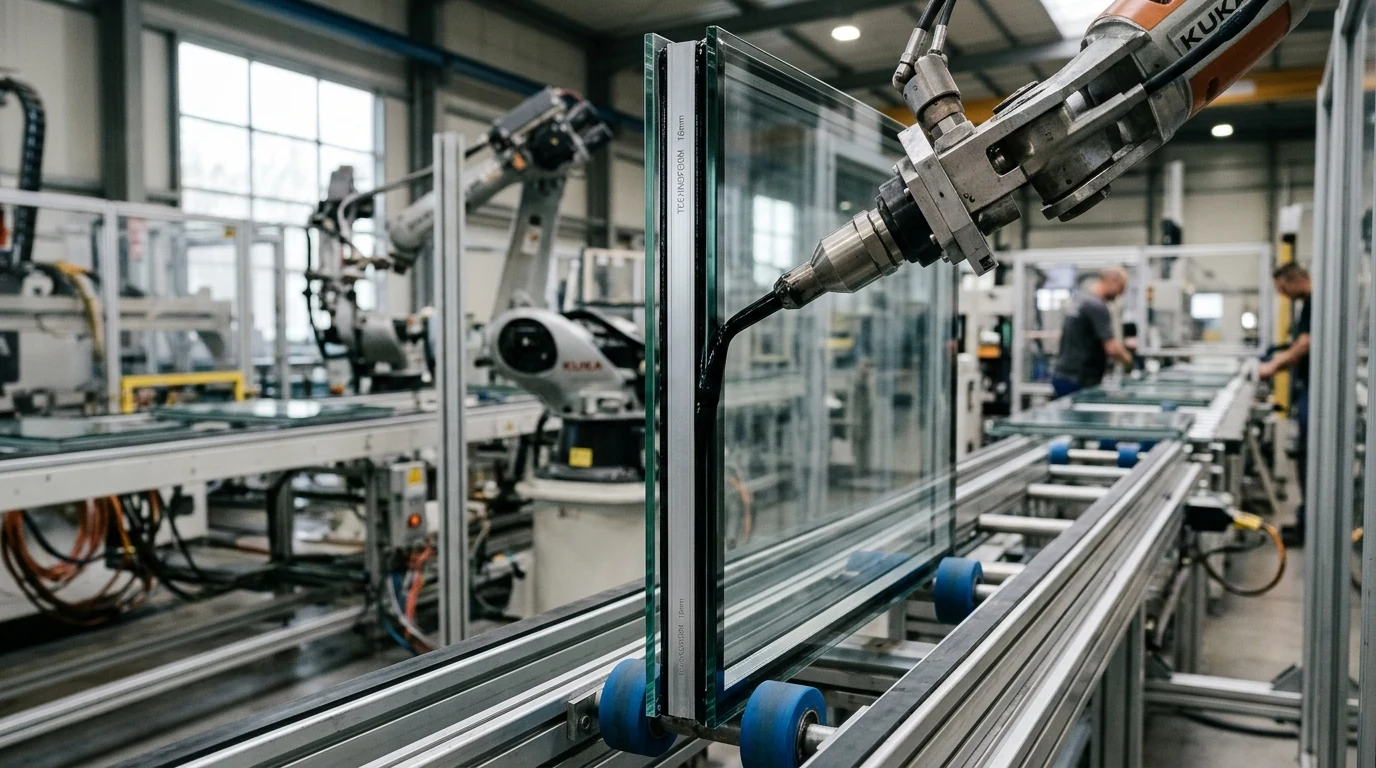
In automated Lisec, Forel, or Bystronic lines, polysulfide base and hardener components are metered at a precise 10:1 volumetric ratio. Robotic dispensing heads ensure void-free corner filling with minimum seal depths of 3 mm on the spacer and 8 mm overall cavity thickness.
7. Koçak Endüstri Glass and Facade Sealant Portfolio
Koçak Endüstri supplies architectural glass processors with industrial-grade PIB butylene, reactive two-component polysulfide sealants, and high-performance neutral silicones. Our engineering staff provides comprehensive support for adhesion testing, mixing ratio checks, and gas retention audits.
8. Frequently Asked Questions (FAQ)
Why is primary butyl sealant indispensable in double glazing?
Secondary sealants alone permit slow gas and water vapor diffusion. The primary PIB butyl seal provides molecular-level impermeability, blocking moisture ingress and preserving the argon gas blanket.
What is the difference between polysulfide and polyurethane secondary sealants?
Polysulfides offer superior natural resistance to gas permeation, solvents, and UV radiation. Polyurethanes offer faster green strength build-up and cost advantages for standard framed window units.
What does the EN 1279 gas loss threshold mandate?
Under EN 1279-3, the annual gas loss must not exceed 1.0% per year, guaranteeing that high thermal insulation performance persists throughout decades of service.
EN 1279 Compliant Butyl and Polysulfide Sealant Engineering in Insulated Glass Units hakkında merak edilenler
Why is primary butyl sealant indispensable in double glazing?
Primary PIB butyl provides an impermeable molecular barrier against argon leakage and atmospheric moisture. Secondary sealants cannot maintain gas retention without it.
What is the difference between polysulfide and polyurethane secondary sealants?
Polysulfide provides higher gas retention and UV stability, whereas polyurethane cures faster and offers high mechanical modulus in framed windows.
What does the EN 1279 gas loss threshold mandate?
EN 1279-3 mandates an annual argon leakage rate below 1.0%, guaranteeing over 80% gas volume retention after 25 years of service.
Technical resources and verification
The content has been prepared in Turkish with the technical experience of Koçak Endüstri, based on the following manufacturer resources.
Let's choose the right adhesive for your application together
You can get technical guidance and offers for Jowat products by sharing your machine, material and consumption information.
Get a technical quote

