



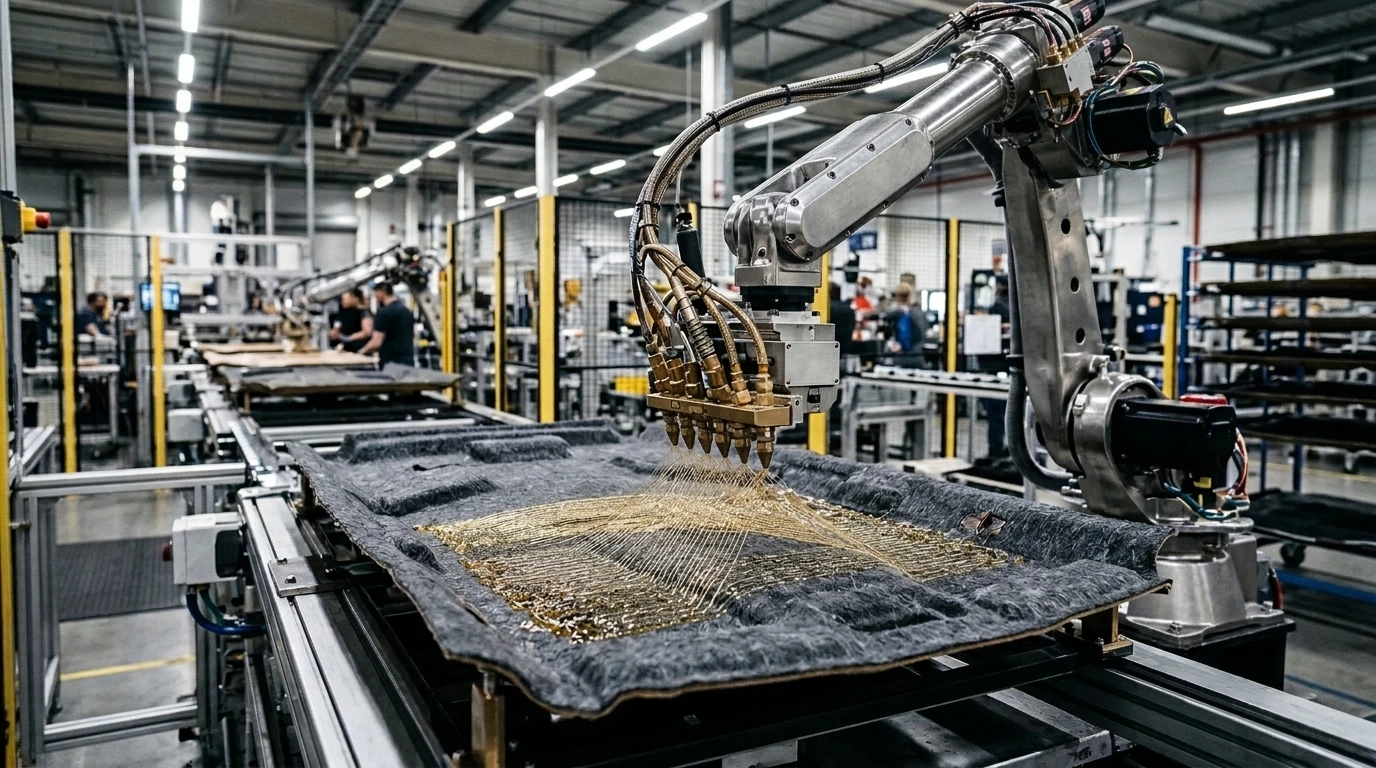
Reactive PUR Hotmelt Lamination for Automotive Acoustic Felt and Headliner Modules
In automotive interior manufacturing, moisture-curing reactive polyurethane (PUR) hotmelt adhesives are the global benchmark for laminating noise, vibration, and harshness (NVH) acoustic felt composites and headliner modules. Automotive headliners are complex multi-layer sandwich structures consisting of decorative fabric, polyurethane foam, fiberglass reinforcement, and porous nonwoven acoustic felt. Applied at 110°C–135°C via slot-die or robotic multi-nozzle spray systems, reactive PUR hotmelts deliver exceptional green strength within seconds, allowing immediate thermoforming and edge-folding without line slowdown. Over the subsequent 24–72 hours, exposure to ambient humidity triggers chemical cross-linking, producing a resilient thermoset bond capable of withstanding extreme cabin temperatures from -40°C to +120°C. For OEM compliance, specialized low-monomer PUR formulations are mandatory to meet strict DIN 75201 windshield fogging and VDA 277 / VDA 278 low-VOC cabin air quality standards.
In modern automotive design, acoustic quietness and cabin comfort have become key differentiators, accelerated by the transition toward electric vehicles (EVs). Without internal combustion engine noise masking road vibrations, tire hum and wind turbulence become sharply pronounced, placing immense engineering demands on headliners, cabin carpets, and wheel arch acoustic insulation. To bond these lightweight, multi-layered sandwich composites, moisture-curing reactive polyurethane (PUR) hotmelt adhesives are the undisputed choice of global Tier-1 suppliers and OEMs. This technical paper examines reactive PUR cross-linking kinetics, robotic spray versus slot-die dispensing, and compliance with stringent DIN 75201 and VDA 278 vehicle interior air quality standards.
1. NVH Acoustic Insulation and Composite Headliners in Modern Vehicles
The vehicle headliner is an integrated structural and acoustic shield. Exposed to roof metal temperatures exceeding +90°C under desert sun and sub-zero winter chills of -30°C, the lamination adhesive must satisfy four non-negotiable criteria:
- High Thermal Creep Resistance: Prevents fabric detachment and gravitational sagging during prolonged summer sun exposure.
- Wide-Range Elasticity: Buffers differential thermal expansion between dissimilar substrates (fabric, foam, glass mat, PP felt) across -40°C to +120°C.
- Rapid Cycle Times: Yields robust green tack within 5–15 seconds, enabling instantaneous press unmolding and peripheral edge folding.
- Acoustic Permeability Preservation: Deposited in open-mesh or micro-porous patterns to preserve the noise reduction coefficient (NRC) of acoustic felt.
2. Reactive PUR Hotmelt Chemistry: Green Strength to Thermoset Cross-Linking
Unlike conventional thermoplastic hotmelts (EVA/APAO) that can re-melt under summer roof heat, reactive PUR undergoes a two-phase curing process:
- Phase 1 (Physical Solidification): Dispensed at 110°C–130°C, molten PUR rapidly cools on contact with ambient substrates, crystallizing within seconds to provide initial green strength for robotic handling.
- Phase 2 (Moisture Cross-Linking): Over the subsequent 24 to 72 hours, terminal isocyanate (-NCO) groups react with ambient humidity and substrate moisture to form polyurea cross-links, transforming the polymer into a non-fusible, high-heat-resistant thermoset.
3. Multi-Layer Sandwich Architecture and Substrate Challenges
A typical modular automotive headliner consists of heterogeneous functional layers:
| Layer Position | Substrate Material | Engineering Role & Bonding Challenge |
|---|---|---|
| A-Side (Cabin Facing) | Knitted textile / Alcantara + PU Foam | Aesthetic haptics; high sensitivity to adhesive bleed-through |
| Structural Core | Thermoformable PU foam or Recycled Felt | Rigidity, minimal weight, and dimensional shape stability |
| Reinforcement | Chopped fiberglass roving mat | Impact resistance and flexural modulus |
| B-Side (Roof Metal Facing) | Nonwoven needle-punched acoustic fleece | Vibration damping, structural bonding, and acoustic absorption |
4. Application Engineering: Slot-Die Roller Coating vs. Robotic Airless Spray
Tier-1 manufacturing lines rely on two primary adhesive dispensing architectures:
1. Wide Slot-Die Extrusion: Best suited for continuous coil-to-coil roll lamination of textiles and foam. Ensures exact coat-weight control (15–35 g/m²) across broad web widths.
2. Multi-Axis Robotic Spray (Swirl / Spiral): Essential for complex 3D molded geometries, recessed sunroof recesses, and molded edge flaps. Controlled spiral deposition ensures bonding without forming an airtight barrier, preserving the acoustic absorption of the underlying felt.
5. Automotive OEM Standards: Low-VOC, DIN 75201 Fogging, and Thermal Cycling
Global carmakers enforce uncompromising interior emissions thresholds (e.g., VW 50180, BMW GS 97014, Stellantis):
- DIN 75201 Windshield Fogging: Restricts condensable outgassing that leaves an oily visual veil on the windscreen (Gravimetric G < 1.0 mg, Reflectometric F > 90%).
- VDA 278 Thermal Desorption Analysis: Quantifies volatile organic compounds (VOC) and semi-volatile substances (FOG), requiring specially purified low-monomer PUR adhesives.
- Environmental Cataplasma Testing: 7-day cyclical exposure to +90°C and 95% relative humidity followed by freeze cycles without bond degradation.
6. Production Troubleshooting: Eliminating Bleed-Through and Delamination
| Defect / Issue | Root Cause | Corrective Engineering Action |
|---|---|---|
| Adhesive strike-through on face fabric | Excessive coat weight or overly high spray pressure | Reduce coat weight to 20–25 g/m²; increase stand-off distance and optimize air atomization. |
| Corner spring-back post-molding | Slow crystallization rate or open time exceeded | Switch to a faster-setting Jowat-Reaktant grade; reduce press cycle transfer delays. |
| Post-bake delamination in environmental chamber | Incomplete PUR moisture cross-linking | Maintain post-mold curing warehouse humidity at ≥ 45% RH; install ultrasonic atomizers if winter humidity is low. |
| Nozzle clogging and premelt charring | Moisture ingress into unloader or thermal overexposure | Ensure dry nitrogen/dry air blanket over drum unloader; drop temperature to 90°C during standby. |
7. Koçak Endüstri & Jowat Automotive PUR Portfolio and Engineering
Koçak Endüstri supplies OEM-approved Jowat-Reaktant® polyurethane hotmelts to Tier-1 automotive manufacturers throughout the region. Backed by dedicated technical specialists, we provide robot trajectory programming, coat weight calibration, and comprehensive VOC/fogging verification to ensure seamless serial production.
Reactive PUR Hotmelt Lamination for Automotive Acoustic Felt and Headliner Modules hakkında merak edilenler
How long does it take for reactive PUR hotmelt to fully cure?
Initial handling green strength is achieved in seconds upon cooling; complete thermoset moisture cross-linking takes 24 to 72 hours depending on ambient temperature and relative humidity.
How do automotive plants manage dry winter curing conditions?
When indoor plant humidity drops below 35% in winter, intermediate staging areas must be equipped with ultrasonic humidifiers or fine moisture-misting stations to ensure full cure kinetics.
Why is DIN 75201 fogging compliance mandatory for headliner adhesives?
High roof heat can vaporize volatile plasticizers from sub-par adhesives, forming a hazy deposit on the interior windshield that impairs driver visibility.
What is the primary advantage of robotic spray over slot-die for 3D acoustic felt?
Robotic spiral spray deposits adhesive across deep 3D contours without crushing porous nonwoven felt, preserving both acoustic damping properties and lightweight targets.
Technical resources and verification
The content has been prepared in Turkish with the technical experience of Koçak Endüstri, based on the following manufacturer resources.
Let's choose the right adhesive for your application together
You can get technical guidance and offers for Jowat products by sharing your machine, material and consumption information.
Get a technical quote

