


Choosing Jowat Hot Melt in Packaging and Fast Case Sealing Lines: Comparison of Polyolefin (PO) vs EVA
In fast case closing and packaging lines, Jowat PO (polyolefin) hot melt glues offer high thermal stability compared to EVA glues, completely eliminating carbonization (burning) in the tank and nozzle. It provides up to 30% weight saving, clean glue break (fadenabriss) and resistance to -40°C deep freezer and +80°C hot shipment; Reduces line downtime due to nozzle clogging by 80%.
In food, beverage, personal care, pharmaceutical and e-commerce logistics, high-speed automatic parcel closing lines operate uninterruptedly at a speed of 50 to 120 parcels per minute. At these speeds, the slightest glue nozzle clogging or threading (fadenbildung) stops the packaging line for minutes, causing serious production loss. Jowat PO (Polyolefin) hot melt adhesives (Jowat-Toptherm® and Jowatherm® PO series) have been developed to solve these chronic malfunctions encountered in packaging lines.
1. Basic Problems Encountered in Automatic Box Sealing Lines
Classic EVA-based packaging hot melt glues undergo thermal oxidation when heated in the tank for a long time. This process creates the following chain of business problems:
- Carbonization (Cracking): Black carbon particles accumulate on the tank walls and filters, blocking the nozzle outlets over time, causing incomplete glue application.
- Stringing (Angel Hair): When the nozzle closing needle hits as a result of viscosity imbalance, the glue cannot be broken completely and thin adhesive threads are scattered on the conveyor belts and box surfaces.
- Pop-Up: Recycled kraft cardboards have high fiber resistance and surface tension. EVA glues with insufficient adhesion cause box lids to burst immediately after leaving the printing station or during shipment.
2. Technical Advantages of Jowat Polyolefin (PO) Technology
Jowat's patented synthetic polyolefin polymer formulations bring radical advantages to packaging operations:
- High Thermal Stability: does not change color, does not gel, and does not form carbonization residue even if kept for days at operating temperatures of 160°C–180°C. In-tank filter and nozzle life is extended many times.
- Low Density and Weight Saving: The specific gravity of PO hot melts (~0.90 g/cm³) is lower than standard EVA glues (~0.98–1.02 g/cm³). 20% to 35% less grammage is consumed at the same volume of glue point.
- Wide Adhesion Spectrum: Highly recycled corrugated cardboards provide strong polymeric penetration on lacquered or foil-coated cardboard surfaces and increase the fiber tear rate to 100%.
3. EVA vs Jowat PO: Comparative Performance and Cost Analysis
Although PO glues seem higher than EVA in terms of unit kg price, they provide significant savings in total cost of ownership (TCO):
| Criterion | Classic EVA Hot Melt | Jowat PO Polyolefin (Jowat-Toptherm®) |
|---|---|---|
| Thermal Stability | Low (Causes carbonization and yellowing) | Excellent (Zero carbonization, clear melt) |
| Unit Density | ~ 0.98 - 1.05 g/cm³ | ~ 0.88 - 0.92 g/cm³ (15% lighter) |
| Consumption per Box | 0.8 – 1.2 g/carton | 0.5 – 0.8 g / case (30% savings) |
| Temperature Resistance | -10°C to +60°C | -40°C to +85°C (Freezer and container safety) |
| Nozzle Maintenance Frequency | Weekly cleaning and nozzle replacement | Monthly / 3-monthly routine periodic check |
| Line Downtime Cost | High (Unplanned stoppage due to clogging) | Minimum (Uninterrupted high speed flow) |
4. Clean Fadenabriss and Stringing Prevention
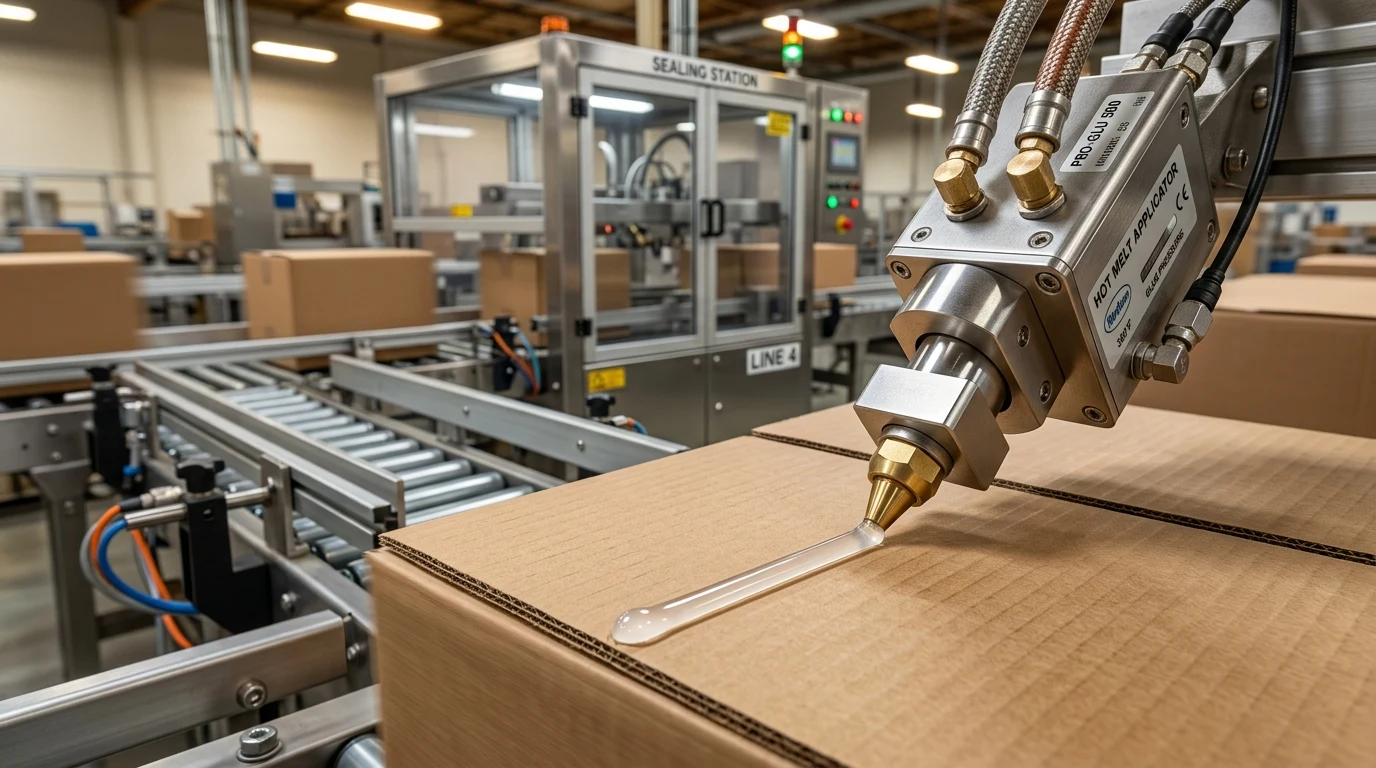
In high-speed lines, with each stroke of the nozzle needle (600–1000 beats per minute), the glue drop must reach the cardboard and be cut off without leaving a tail behind. The clean break character, called 'fadenabriss' in German, is achieved by the optimized rheological structure of Jowat PO adhesives:
- Thanks to the correct viscosity and surface tension, droplet build-up is prevented at the nozzle tip.
- Sensors, reflectors and pneumatic pistons are not contaminated with glue strands.
- Contamination of the barcode and QR code areas on the packaging is prevented, and logistics reading errors are reset.
5. Hot Climate and Deep Freezer (-40°C) Shipping Conditions
In food packaging, frozen pizza, meat, seafood or ice cream boxes pass through -18°C to -40°C freezing tunnels. Classic EVA glues become glassy and brittle at these temperatures, and the box lids open at the slightest transportation impact.
Jowat polyolefin hot melt adhesives maintain their impact damping elasticity even at -40°C, thanks to their flexible polymer backbone. Likewise, in summer months, when the internal temperature reaches +70°C in overseas container shipments, the PO glue line does not flow.
6. Jowat Packaging Hot Melt Selection Chart
| Field of Application | Recommended Jowat Technology | Application Temperature | Key Benefit |
|---|---|---|---|
| Standard Carton and Box Closing | Jowat-Toptherm® PO Series | 150°C – 170°C | High thermal stability, low consumption |
| Deep Freezer Packaging | Jowatherm® PO Freezer Series | 140°C – 160°C | -40°C cold fracture resistance |
| Beverage Straw and Tray Gluing | Jowat High Speed PO Series | 160°C – 180°C | Microsecond setting time |
| Economic Fast Lines | Jowatherm® EVA Packaging Series | 160°C – 180°C | High initial adhesion, low raw material cost |
Reduce Glue Consumption in Your Packaging Line by 30%
___ X18Request a Sample and Line Trial or Check Out Our Packaging Solutions .
Choosing Jowat Hot Melt in Packaging and Fast Case Sealing Lines: Comparison of Polyolefin (PO) vs EVA hakkında merak edilenler
Why does Jowat PO hot melt glue not carbonize?
Polyolefin adhesives consist of saturated hydrocarbon polymer chains. It is extremely resistant to oxidation and sustained high temperature; It does not break down and form carbonized residue like EVA.
Is tank cleaning required when switching to PO glue in the packaging line?
Yes. Mixing EVA glue and PO glue in the tank may cause viscosity fluctuation. Before switching, the tank should be emptied and old carbonized residues in the tank should be cleaned with hot melt cleaner.
Do PO glues cause opening in deep freezer environment?
No. Special Jowat PO series maintain their elasticity down to -40°C and continue to hold cardboard fibers tightly without vitrification/breakage.
How does Jowat PO hot melt reduce unit case cost?
Thanks to its low specific density, it reduces the weight by 25-35% in the same box size. It also reduces labor and maintenance costs by eliminating nozzle blockages and line stoppages.
What is fadenabriss and why is it important?
Fadenabriss is when the hot glue breaks cleanly after being sprayed from the nozzle, leaving no sticky threads behind. It prevents contamination of packaging machines, photocells and boxes.
Technical resources and verification
The content has been prepared in Turkish with the technical experience of Koçak Endüstri, based on the following manufacturer resources.
Let's choose the right adhesive for your application together
You can get technical guidance and offers for Jowat products by sharing your machine, material and consumption information.
Get a technical quote

