



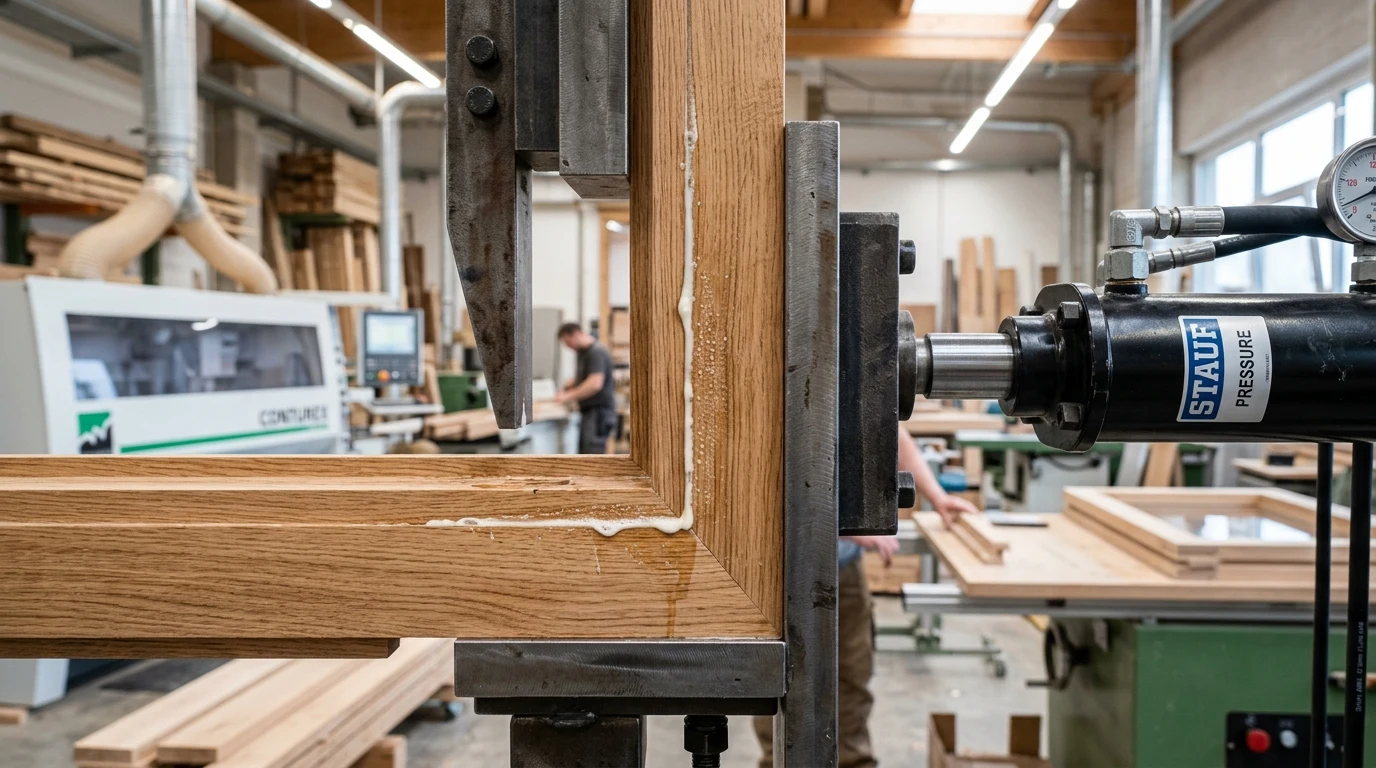
D3 and D4 Standards in Wood and Door-Window Production: Jowacoll® 103.30 Application and Press Guide
Jowacoll® 103.30 provides D3 water resistance when used as a single component according to DIN EN 204 standard; It is a high-performance PVAc dispersion wood glue that increases to D4 class when 5% Jowat® 195.40 hardener is added. Solid wood lamination is used in the manufacture of outdoor door and window joinery, frame presses and stairs; Pressing time is approximately 15-20 minutes for solid wood in a 20°C environment.
Building elements such as wooden window frames, external doors, kitchen countertops and bathroom furniture are directly exposed to rainwater, moisture, dew and condensation. The quality of the glue to be used in such critical connections directly determines the service life of the structure. Jowat Jowacoll® 103.30 is one of the sector's reference dispersion glues with its water resistance and mechanical adhesion power in the furniture and solid wood industry.
1. What Do DIN EN 204 D3 and D4 Standards Mean in the Wood Industry?
European DIN EN 204 norm divides thermoplastic wood adhesives into four classes (D1, D2, D3, D4) according to their water and moisture resistance levels:
- D3 Class: It is suitable for use in interior areas that are frequently exposed to short-term flowing water or high humidity (kitchen, bathroom furniture) and in sheltered outdoor spaces (under-eaves joinery). According to EN 205 standard, it meets the minimum 2 N/mm² breaking strength requirement after being kept in cold water for 4 days.
- D4 Class: It is a mandatory class for outdoor wooden elements (exterior doors, windows, garden furniture, bridge/staircase elements) that are directly exposed to weather conditions and intense water contact. The sample must provide a shear strength of at least 4 N/mm² even after being kept in boiling water for 6 hours.
2. Chemical Structure and Highlights of Jowacoll® 103.30
Jowacoll® 103.30 is a modified polyvinyl acetate (PVAc) polymer dispersion. It offers flexible use as both single-component and two-component:
- Dual Function Use: It is used directly for D3 class applications as a single component, straight out of its packaging. In outdoor joinery that requires D4, it is increased to the D4 norm by adding a hardener.
- pH Value and Wood Color Protection: Thanks to its low-acidity controlled pH formula, it does not cause glue staining or darkening on acidic hardwoods such as oak and chestnut containing tannins or on light-colored beech and birch surfaces.
- Elastic and Cutter-Friendly Glue Line: The hardened glue film does not become excessively brittle; Prevents premature dulling of profile milling cutters and diamond blades.
3. Transition from D3 to D4: Jowat® 195.40 Hardener Mix Ratio and Pot Life
Jowat® 195.40 Hardener (Hardener) is used to upgrade Jowacoll® 103.30 to DIN EN 204 D4 class. The mixing procedure must be carried out meticulously:
- Mixing Ratio: 5% of Jowat® 195.40 is added into 100 weight units of Jowacoll® 103.30 (Ex: 500 g hardener to 10 kg glue).
- Homogeneous Mixing: The mixture should be whipped with a mechanical mixer for at least 3-5 minutes until it becomes homogeneous. Insufficient mixing causes local D3/D4 strength fluctuations in the glue mass.
- Pot Life: The usage time of the 2K mixture prepared at 20°C ambient temperature is approximately 24 hours . After 24 hours, even if the mixture remains fluid in terms of viscosity, it loses its capacity to form chemical cross-links and returns to the D3 level.
4. Surface Preparation, Wood Moisture Balance (8-12%) and Application Amount
The adhesion quality of PVAc dispersion glues is directly related to the moisture content and pore structure of the wood:
| Parameter | Ideal Value | Description and Operational Note |
|---|---|---|
| Wood Moisture Rate | 8% – 12% (Indoor) / 12% – 15% (Outdoor) | When humidity exceeds 15%, pressing time increases exponentially; Below 7%, the pores absorb the glue water too quickly ('starvation combination'). |
| Application Quantity | 150 – 200 g/m² | One-sided application is sufficient. Double-sided (80-100 g/m² on both sides) is recommended for hardwoods or rough surfaces. |
| Open Time | 6 – 10 minutes (at 20°C) | The time taken after the glue is applied until the press is pressed. The glue film should not be skinny when touched with fingers. |
| Ambient and Material Temperature | Min. 15°C (Optimum 18°C–22°C) | At temperatures below +10°C, the white point (MFT) limit of PVAc emulsion is exceeded and the glue chalks and does not hold. |
5. Pressing Parameters: Cold Press, Hot Press and HF (High Frequency)
Since the curing of water-based dispersions occurs by the absorption of water into the wood, pressing time varies depending on temperature and press type:
- Cold Press (20°C Hydraulic Frame Press): Pressing time for solid panel insertion and frame joints is between 15 and 25 minutes. For stressed hardwoods (oak, ash), this period should be increased to 30 minutes.
- Hot Press (50°C – 70°C): In veneer laminations, the pressing time is reduced to 2 to 5 minutes. To prevent the glue from boiling, the temperature should not be exceeded 80°C.
- High Frequency (HF) Press: In solid wood beam and block joining, the glue line is directly heated with radio waves; pressing time decreases to 1-2 minutes.
- Press Pressure: 0.2–0.5 N/mm² for softwoods; For hardwoods and window joinery, a hydraulic pressure of 0.6–1.0 N/mm² should be applied. A homogeneous thin glue overflow bead (squeeze-out) should be visible on the surface.
6. Jowacoll® 103.30 D3/D4 Technical Parameter Table
| Specification | Single Component (1K) Use | Two Component (2K + 5% Hardener) |
|---|---|---|
| DIN EN 204 Strength Class | D3 | D4 |
| Suitable Area of Use | Interior furniture, kitchen/bathroom panels | Exterior door, wooden window, garden furniture |
| Hardener | Not required | Jowat® 195.40 (5% by weight) |
| Pot Life | Unlimited (In original sealed packaging) | Approximately 24 hours (at 20°C) |
| Viscosity (Brookfield, 20°C) | ~ 12,000 – 16,000 mPa.s | ~ 9.000 – 13.000 mPa.s |
| Glue Film Color | Translucent, slightly elastic | Transparent, hard-elastic water-resistant film |
Jowacoll® Supply for Your Wood and Joinery Production
Koçak Endüstri offers Jowat Jowacoll® 103.30 and 195.40 hardener stocks in industrial packages (30 kg drum, 1000 kg IBC) without interruption; It optimizes press time and humidity measurement in your factory environment.
D3 and D4 Standards in Wood and Door-Window Production: Jowacoll® 103.30 Application and Press Guide hakkında merak edilenler
Does Jowacoll 103.30 alone meet the D4 standard?
No. When used as a single component, Jowacoll 103.30 is in DIN EN 204 D3 class. To reach the D4 level, 5% Jowat 195.40 hardener by weight should be mixed homogeneously.
Can glue with hardener be used the next day?
The pot life of the mixture is approximately 24 hours at 20°C. After 24 hours, even if the glue maintains its fluidity, it cannot chemically meet the D4 norm and regresses to the D3 level.
Does Jowacoll 103.30 stain tannic woods such as oak?
Jowacoll has an optimized acidity of 103.30; It does not cause darkening or black stains on high-tannin woods such as oak, chestnut and cherry unless there is iron/metal contact.
How does moisture in wood affect glue adhesion?
Ideal wood moisture should be between 8-12%. Humidity above 15% excessively prolongs pressing time and reduces strength; Dry wood below 7% absorbs glue water prematurely, creating a weak bond.
How long is the pressing time of Jowacoll 103.30?
Standard pressing time for solid wood jointing at an ambient temperature of 20°C is between 15 and 25 minutes. In hot press applications (60°C), this time is shortened to 2-4 minutes.
Technical resources and verification
The content has been prepared in Turkish with the technical experience of Koçak Endüstri, based on the following manufacturer resources.
Let's choose the right adhesive for your application together
You can get technical guidance and offers for Jowat products by sharing your machine, material and consumption information.
Get a technical quote

