



Causes of Orange and Delamination in 3D Membrane Press Gluing: PUD Dispersion Application Guide
The two most common quality defects in 3D vacuum membrane press applications are orange peel and delamination (edge opening). Orange on the surface; It is caused by excessively large gun nozzle diameter (> 1.8 mm), insufficient atomization air pressure or pressing the glue before the water has fully evaporated. Foil delamination (delamination) in corners and deep cavities is caused by failure to reach the glue activation temperature on the press table (minimum 60–75°C joint temperature), insufficient vacuum time, or not double-layer gluing on the MDF edges.
Coating of 3D MDF panels processed with CNC router with PVC, PET or thermoplastic foils in the production of kitchen cabinets, bathroom furniture and interior room doors is carried out with 3D vacuum and membrane pressing technology. In this process, the main factors that determine the aesthetic success and the retention of the product without swelling or peeling for years are water-based polyurethane dispersion (PUD) membrane adhesive and application discipline.
The most common consumer complaints faced by furniture manufacturers regarding their membrane cover lines are; A rough orange peel appearance occurs on the surface and the foil peels off from the edges of the lid in hot summer months or near the stove (delamination). As Koçak Endüstri, we offer end-to-end technical parameter support to your facilities with Mayer Glue water-based membrane series and Jowat dispersion solutions , which prevent these defects.
Working dynamics of PUD dispersion membrane glue
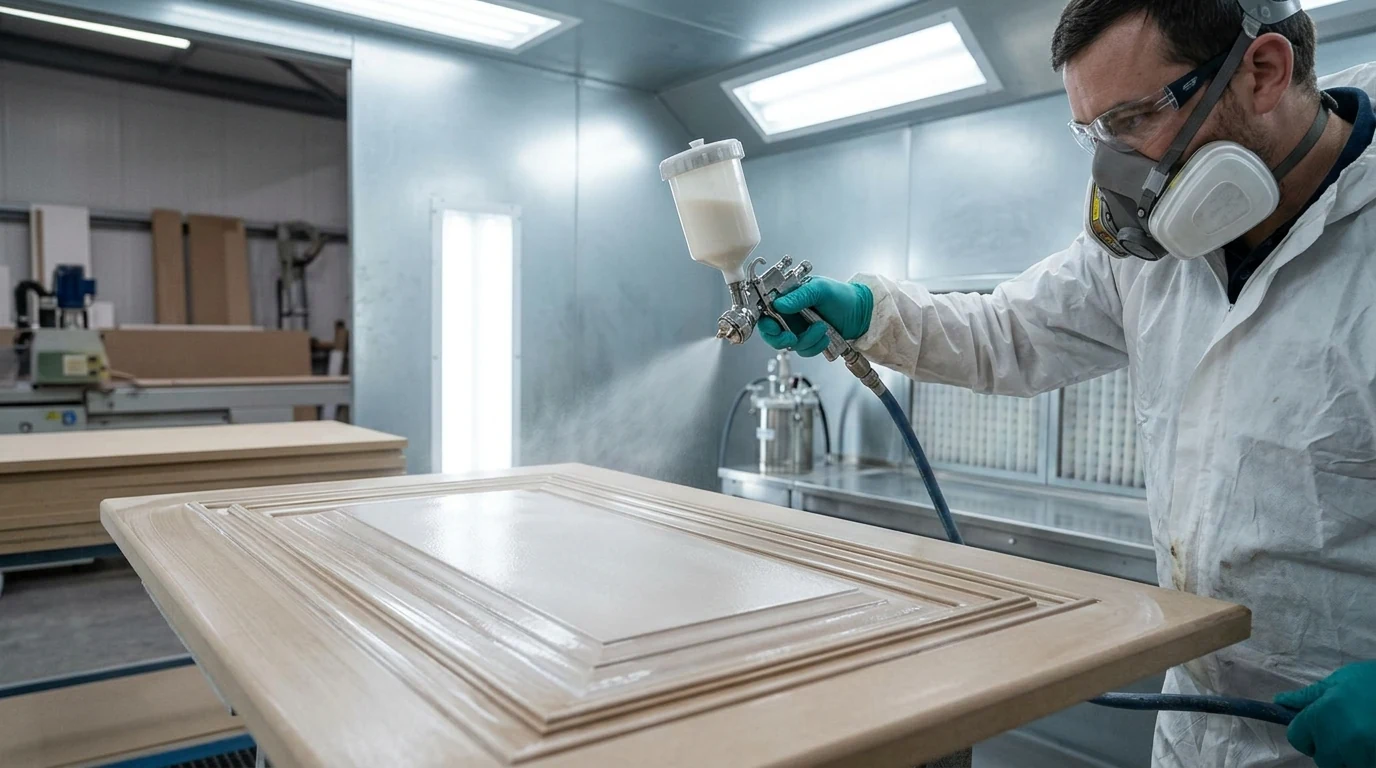
Water-based PUD adhesives are produced by homogeneously dispersing micronized polyurethane polymer particles in the water phase. After applying to the MDF surface with a spray gun:
- Water Evaporation: The sprayed white liquid glue becomes transparent as it dries. When the water in it evaporates completely, a dry, thermoplastic polyurethane film layer remains on the surface, which is not sticky to the touch.
- Thermal Activation and Pressing: When the foil is heated from above in the membrane pressing machine (100–140°C radiant heat), the glue film melts reactively as soon as it reaches the joint temperature of 60–75°C , and the MDF with the foil under the effect of vacuum and positive pressure. interlocks the fibers together.
- Hardening and Heat Resistance: Single-component (1K) or two-component (2K) systems with isocyanate hardener form a bond with high heat resistance when cooled.
What causes orange defect on MDF surface?
The main reasons for the rough, wavy orange peel texture appearing on the glossy or matte surface of the pressed PVC foil are as follows:
- Nozzle Diameter and Atomization Error: If the gun nozzle diameter is larger than 1.8 mm, the glue will eject in droplets. The ideal nozzle diameter should be 1.4–1.6 mm , air atomization pressure should be 3–4 bar .
- Wet Pressing (Inadequate Drying): If the piece is given to the press before the glue becomes fully transparent and there is water vapor remaining in it, the water vapor trapped under the heat will create bubbles and roughness under the foil.
- MDF Surface Dust and Sanding Error: After CNC processing, the fine sawdust remaining in the grooves is clumped with glue. All dust should be removed with an air gun before spraying.
Delamination and thermal activation temperature
While there is adhesion on the flat surfaces of the covers, spontaneous delamination of the foil at corner turns and deep cavities is the biggest risk of the process. Physical reasons behind this:
| Problem Source | Mechanism | Technical Solution Criteria |
|---|---|---|
| Insufficient Edge Glue | The porous edge section of MDF absorbs the glue; There is no film left on the surface. | A second layer of glue must be applied 5 minutes after the first layer is applied to the edges. |
| Low Joint Temperature | If the glue film layer cannot reach 60°C, it cannot fully melt and wet. | The glue line temperature should be measured at 65–75°C with thermo-strip on the press table. |
| Vacuum Delay | If vacuum is not removed before the foil cools, the tension will break the glue. | Upper pressure and lower vacuum timing must be synchronized. |
| Lack of Hardener (2K) | 1K may be insufficient for kitchen doors that require high heat resistance. | With the addition of Mayer D4 hardener (5%), the heat resistance of WATT 91 is increased to 95°C. |
Vacuum press parameters control matrix
- Glue Weight: 60–80 g/m² wet glue should be applied to flat surfaces and 100–120 g/m² wet glue should be applied to absorbent edges and profiles.
- Drying Window: Full transparency should be achieved by waiting at least 30–45 minutes in a 20°C environment (or 10 minutes in the drying tunnel).
- Pressing Temperature: Machine upper ceiling temperature should be adjusted between 110–135°C depending on the foil thickness.
- Pressing Time: 120–180 seconds of pressing and minimum 40 seconds of vacuum evacuation should be applied.
Line efficiency with Mayer MT-WB 420 Membrane
Koçak Endüstri production Mayer MT-WB 420 Membrane , with its 1.400 ± 300 mPa·s viscosity and 60–75°C low activation threshold, provides perfect fluidity and zero orangeing in both single-component and hardener use. It eliminates the risk of edging by establishing a flexible and high-strength bond between thermoplastic foils and MDF.
Stock and technical consultancy
For gun nozzle calibration, drying time optimization or sample requests on your membrane press line, you can contact our Koçak Endüstri technical team, and fill out the Offer Form for specific solutions for your process.
Causes of Orange and Delamination in 3D Membrane Press Gluing: PUD Dispersion Application Guide hakkında merak edilenler
What should be the activation temperature of membrane glue?
In order for the PUD membrane glue to fully melt and bond to the MDF fibers, a temperature of at least 60–75°C must be achieved at the glue line (joint surface).
Why are two layers of glue applied to the edges of the membrane cover?
MDF's CNC-machined edge sections are much more absorbent than the flat surface; A single layer of glue is absorbed by the fibers and does not leave a film on the surface.
At what pressure should PUD membrane glue be discharged from the gun?
In spray guns with a nozzle diameter of 1.4-1.6 mm, 3 to 4 bar atomization air pressure provides the ideal droplet size and prevents orange formation.
Should Mayer MT-WB 420 1K or 2K be used?
Mayer MT-WB 420 can be used as a single component (1K) on standard covers; Heat resistance can be increased to 95°C as 2K with 5% Mayer hardener near oven/steam or in export furniture.
Technical resources and verification
The content has been prepared in Turkish with the technical experience of Koçak Endüstri, based on the following manufacturer resources.
Let's choose the right adhesive for your application together
You can get technical guidance and offers for Jowat products by sharing your machine, material and consumption information.
Get a technical quote

